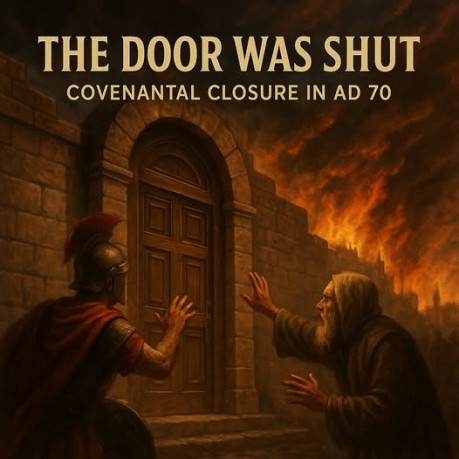
THE DOOR WAS SHUT – COVENANTAL CLOSURE IN AD 70
Once judgment fell in AD 70, the Old Covenant age was brought to a
close and the unique covenant position of Israel was removed
(Hebrews 8:13). That moment was not just the destruction of a city,
it was the full and final removal of the old system, the old
priesthood, and the old way of access to God. Everything that had
been established under Moses found its appointed end in Christ, and
when that generation rejected Him, the covenant itself reached its
termination point. The "door" language in
scripture is covenantal, meaning it refers to the God-given access
within a specific covenant arrangement, and in this case it points
to the closing of the Old Covenant door for first-century Israel at
the AD 70 judgment, not to an ongoing closure for people today. In
Matthew 25:10, the foolish virgins arrive after the bridegroom has
come and "the door was shut." This same imagery appears in
Luke 13:25-28, where people knock after the master shuts the door
and He says, "I do not know where you are from." In both
cases, the door represents the opportunity within a covenant
arrangement that was available for a time and then closed forever
for that generation. In Matthew 25:10 and Luke 13:25-28,
the shutting of the door is tied to Israel's covenantal window of
grace in the first century. Once the Messiah came in judgment in AD
70, that door shut for that generation, it does not describe an
ongoing door-shutting for people today. So when you say "the door was shut," you are talking
about: A covenant door, access through
the Old Covenant arrangement with God. A time-bound event, the closing of that access in AD 70 for
those who rejected Christ during their generation's visitation. For us today under the New Covenant,
the door is still open (Revelation 22:17). That is why the "door
shut" passage is not about our era at all, it is about the
first-century closure of the Old Covenant. Jesus tied this event to His own time
statements. In Matthew 24:34, He promised, "Truly I say to you,
this generation will not pass away until all these things take
place." In Matthew 16:27-28, He declared that some standing
there would not taste death until they saw the Son of Man coming in
His kingdom. These words leave no room for a delay of thousands of
years, the shutting of the door happened exactly when He said it
would. The Old Testament prophets confirm
this pattern of open invitation followed by a closed door. Isaiah
22:22 speaks of the key of the house of David, where God opens and
no one can shut, and shuts and no one can open. Micah 3:4 warns that
when judgment comes, "He will not answer them," showing
that there comes a point where access is removed. This covenantal
closure in AD 70 fits perfectly with God's consistent dealings with
His people throughout history. It is also critical to see that the
"door shut" was a corporate judgment. It fell on Israel as
a covenant people, not on scattered individuals throughout the
centuries. That generation had a unique role in redemptive history,
they were the stewards of the promises, the keepers of the temple,
the recipients of the Messiah. When they rejected Him during their
time of visitation, the whole covenant structure they stood in was
removed. Luke 13:25-28 makes this even clearer.
Jesus was speaking directly to His first-century audience, the ones
standing in front of Him as He warned them about the door being
shut. He was not giving a distant prophecy for another age but
delivering a personal and urgent warning to His own generation. THE COVENANTAL VERDICT ON THAT
GENERATION Jesus came to His own, and His own did not receive Him (John
1:11). For forty years, from His ministry to the destruction of
Jerusalem, there was a window of grace for Israel to repent and
believe. This was their time of visitation (Luke 19:41-44). But when
they hardened their hearts, the verdict became irreversible. Hebrews 12:17 gives the example
of Esau, who "found no place for repentance, though he sought
it with tears." The point is not that God delights in shutting
people out, but that there is a divinely appointed time for
decision. When it is passed, the opportunity is gone. In the same way, the first-century covenant people who
refused the invitation until the day of judgment were shut out when
the King came. The parable of the wedding feast in Matthew 22:1-14
shows those who spurned the invitation being destroyed, and the
feast being filled with others. NO MORE OLD COVENANT TO ENTER After AD 70, there was no longer an
Israel under the Old Covenant to be part of. The temple was gone,
the priesthood was gone, and the genealogical records that
determined tribal identity were gone. The door to that covenant was
permanently shut. This does not mean that God turns away
a truly repentant heart in any age. The New Covenant gospel
continues to save all who believe. Revelation 22:17 declares, "The
Spirit and the bride say, 'Come.' And the one who hears say, 'Come.'
And the one who is thirsty come, the one who desires, let him take
the water of life without cost." The invitation remains open to
the nations throughout the New Covenant age and will remain open
forever, as the gospel continues to call people from every tribe,
tongue, and nation into the everlasting kingdom of God. THE FINALITY OF AD 70 AND THE OPENNESS OF THE NEW
COVENANT For that specific generation,
once the King came in judgment and the wedding feast began, those
who had rejected the Messiah during their time of visitation were
left outside. It was a covenantal closure,
meaning the end of a specific Old Covenant arrangement, not a
blanket denial of salvation to individuals in the centuries after. The principle from Hebrews 12:17 is that a point of no
return can arrive in God's plan. For Israel as a covenant nation,
that point was the destruction of Jerusalem in AD 70. In short, the picture of Esau fits
perfectly with the first-century reality. There was a set time for
the covenant people to embrace their Messiah. Once that time passed,
the verdict on that generation was final. But in the New Covenant
era that followed, the invitation stands to all nations and all
generations who respond to Christ in faith. Today, we live in that era. The old
door is shut, but a new and living way has been opened through the
blood of Jesus (Hebrews 10:19-20). That way will remain open
forever, as the gospel continues to gather people from every tribe,
tongue, and nation into the everlasting kingdom of God.
By Dan Maines
Links