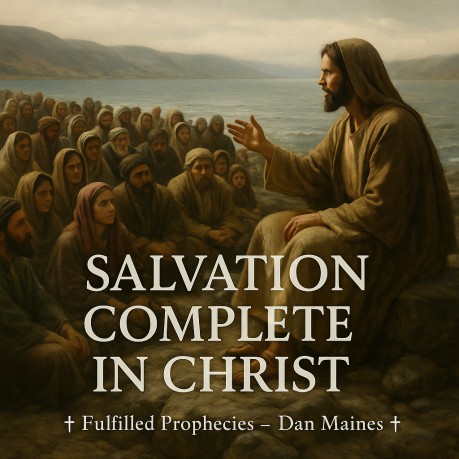
Salvation Complete in Christ There are some who teach that salvation comes in three stages:
past (justification), present (sanctification), and future
(glorification). But the Bible reveals that salvation is a single,
completed work of Christ that believers receive the moment they
believe. Scripture does not divide salvation into stages, it shows
that we are fully justified, sanctified, and glorified in Him. † Many futurists teach that salvation unfolds
in time through three separate stages. But that idea forces the
believer to live as if salvation is unfinished and yet to be
completed, denying the very words of Jesus who said, It is finished
(John 19:30). The apostles never spoke of salvation as progressive or
delayed but as a present possession in Christ. Philippians 1:6 † Paul was not teaching three stages of
salvation, but the assurance that the work God began in them would be
brought to completion when Christ returned in His generation (Matthew
16:27-28; Hebrews 9:26). † Salvation is not a process stretched through
time but a completed work in Christ. When one believes, they are
justified, sanctified, and glorified together in Him (Ephesians 2:6;
Colossians 2:10). † Justification is the forgiveness of sins
through faith (Romans 5:1). Sanctification is being set apart in that
same faith (1 Corinthians 1:2). Glorification is being made alive
with Christ, sharing in His glory (Romans 8:30; Colossians 3:4). † The error comes from misunderstanding
Philippians 1:6 as referring to a lifelong or future process. The
"good work" began when they believed and was perfected when
Christ fulfilled His promise to return to judge and reward in that
same generation (Matthew 24:34; Revelation 22:12). † At the moment of belief, one receives eternal
life. Jesus said those who believe have passed from death to life
(John 5:24; John 3:36). † Hebrews 10:14 says, For by one offering He
has perfected for all time those who are sanctified. That single
verse destroys the idea of a three-stage salvation. Christ's work was
one offering that perfected, sanctified, and justified all who
believe (Romans 8:1; Colossians 1:22). † The so-called "salvation future"
applied to the first-century saints awaiting Christ's return to
complete redemption of the covenant people. After AD 70, the work was
finished, and believers entered the fullness of salvation (Luke
21:28; Romans 13:11; Hebrews 9:28). † To divide salvation into three stages is to
make it incomplete and dependent on human progression. But salvation
is the gift of God, not of works, lest anyone should boast (Ephesians
2:8-9; Titus 3:5). Saved By Jesus Only † The futurist view still expects what the
first-century saints already received. They are waiting for what
Scripture says was completed in Christ's generation. The end came
when the Old Covenant passed away and the New Covenant stood forever.
We now live in that fulfilled kingdom age of redemption (Hebrews
8:13; Luke 21:31-32). Historical References How It Applies To Us Today † This is the fulfilled perspective we proclaim at
Fulfilled Prophecies † Source Index
By Dan Maines
For I am confident of this
very thing, that He who began a good work in you will perfect it
until the day of Christ Jesus.
Colossians 1:13-14 He rescued
us from the domain of darkness and transferred us to the kingdom of
His beloved Son, in whom we have redemption, the forgiveness of sins.
Titus 2:11-12 For the
grace of God has appeared, bringing salvation to all men, instructing
us to deny ungodliness and worldly desires and to live sensibly,
righteously, and godly in the present age.
2 Corinthians 5:17 Therefore
if anyone is in Christ, he is a new creation; the old things passed
away; behold, new things have come.
John 14:6
Jesus said to him, I am the way, and the truth, and the life; no one
comes to the Father except through Me.
Acts 4:12
And there is salvation in no one else; for there is no other name
under heaven that has been given among mankind by which we must be
saved.
John 10:9 I am the door; if anyone
enters through Me, he will be saved, and will go in and out and find
pasture.
Romans 10:9 That if you confess with
your mouth Jesus as Lord, and believe in your heart that God raised
Him from the dead, you will be saved.
John 11:25
Jesus said to her, I am the resurrection and the life; the one who
believes in Me will live, even if he dies.
1 John 2:23
Whoever denies the Son does not have the Father; the one who
confesses the Son has the Father also.
John 20:30-31
Many other signs Jesus also performed in the presence of the
disciples, which are not written in this book, but these have been
written so that you may believe that Jesus is the Christ, the Son of
God, and that by believing you may have life in His name.
†
Clement of Rome wrote that believers were "justified freely by
faith, not by works of righteousness."
†
Irenaeus confirmed that those who believed in Christ "were
already glorified in Him."
† Eusebius
described the destruction of Jerusalem as the visible completion of
God's redemptive plan foretold by the prophets.
†
We are not being saved in stages, we are living in the completed
salvation of Christ. We walk in that finished work, showing forth the
fruit of His Spirit, not to earn salvation but because we already
have it. Our justification, sanctification, and glorification are
secure in Him from the moment we believe (Romans 6:4; Galatians 2:20;
Colossians 2:6).
© Fulfilled Prophecies - Dan
Maines.
†
Philippians 1:6; Matthew 16:27-28; Hebrews 9:26; Ephesians 2:6;
Colossians 2:10; Colossians 1:13-14; Romans 5:1; 1 Corinthians 1:2;
Romans 8:30; Colossians 3:4; Matthew 24:34; Revelation 22:12; John
5:24; John 3:36; Titus 2:11-12; Hebrews 10:14; Romans 8:1; Colossians
1:22; Luke 21:28; Romans 13:11; Hebrews 9:28; Ephesians 2:8-9; Titus
3:5; 2 Corinthians 5:17; John 19:30; Hebrews 8:13; Luke 21:31-32;
John 14:6; Acts 4:12; John 10:9; Romans 10:9; John 11:25; 1 John
2:23; John 20:30-31; Romans 6:4; Galatians 2:20; Colossians 2:6
†
Clement of Rome, First Epistle to the Corinthians
†
Irenaeus, Against Heresies, Book 3
†
Eusebius, Ecclesiastical History, Book 3
Links