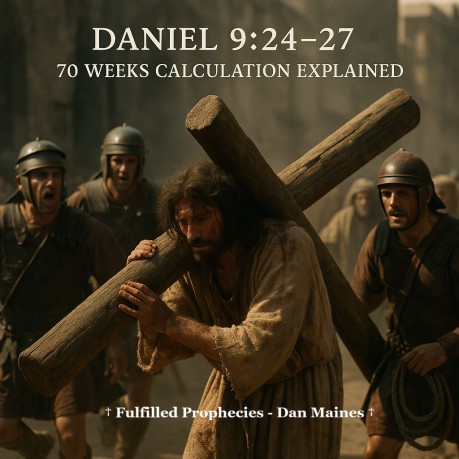
Daniel
9:24-27 – 70 Weeks Calculation Explained Daniel's
70 weeks began with the decree to restore and rebuild Jerusalem
(around 457 BC, Ezra 7). † From 457 BC,
count 69 weeks (7 + 62 = 483 years), that brings us to about AD
27-30, the time of Christ's baptism and crucifixion (Luke 3:13,
21-23; John 19:16-18). † The Starting Point – 457
BC † The 69 Weeks (483 Years) † The 70th Week † The Second Half of the
Week † From the Cross to AD 70 † Fulfillment in AD 70 Why the 70 Weeks End Before AD
70 Here's the clear explanation, backed
by Scripture and timing: The 70 weeks (490 years)
measure covenant fulfillment, not destruction † to finish
transgression, † to make an end of
sin, † to make atonement
for iniquity, † to bring in
everlasting righteousness, † to seal up vision
and prophecy, † and to anoint the
Most Holy. † All of those were
fulfilled by Christ's ministry and death, not by Jerusalem's
destruction. His atonement (AD 30) and the gospel's confirmation to
Israel (ending around AD 33–34) completed the prophetic purpose.
That's what the 70 weeks measured. † The 70 weeks
ended around AD 33–34, when the covenant was fully confirmed and
the gospel turned from Israel to the nations (Acts 7:51–60; Acts
13:46). AD 70 was the result, not part
of the 70 weeks † Verse 26: "After
the sixtytwo weeks the Messiah will be cut off…" that's the
Cross. † "…and the
people of the prince who is to come will destroy the city and the
sanctuary." that's Rome in AD 70. † Notice it says
"after," not "during." The destruction happens
after the 70 weeks have achieved their purpose. † AD 70 is the
final outworking and visible judgment Daniel predicted, but it's not
part of the 490year time count. The 70 weeks ended with covenant
completion; the destruction was the final confirmation that Israel's
old system had passed away (Hebrews 8:13). Why many extend it to AD 70 † Daniel 9:27 ends
the 70th week with the covenant confirmed and sacrifices stopped.
Then it says, "on the wing of abominations will come one who
makes desolate." That's the Roman invasion years later. † AD 70 fulfills
the final stage of Daniel's prophecy, but the 70 weeks themselves
end decades earlier, right after the gospel's confirmation to
Israel. † The 70 weeks (490 years):
457 BC to AD 33–34 Covenant completed in Christ. † After the
70 weeks: Roman destruction of Jerusalem in AD 70 Judgment
confirming the prophecy's end. † The difference is
between what the 70 weeks measure (redemption) and what follows
(judgment). Historical References How it applies to us today † This is the fulfilled
perspective we proclaim at Fulfilled Prophecies † Source Index
By Dan Maines
† Each
"week" represents 7 years, so 70 weeks = 490 years total
(Numbers 14:34; Ezekiel 4:6).
† The 70th week (the
final 7 years) was when Christ confirmed the covenant (Daniel 9:27).
In the middle of that week (after 3½ years), He was "cut off,"
ending the sacrifices (Hebrews 9:15-26; Matthew 27:50-51).
†
Isaiah 53:8-11 supports the Messiah being cut off for the sins of
His people, harmonizing with Daniel 9:26.
†
The remaining 3½ years extended to the gospel's confirmation to
Israel (Acts period), ending when judgment fell on Jerusalem in AD
70 (Acts 1:8; Acts 7:51-60; Matthew 23:37-38).
†
So the 70 weeks point directly from Jerusalem's restoration to
Christ's death and end in the city's destruction, complete
fulfillment by AD 70 (Luke 21:20-22).
† Ezra 7 records Artaxerxes'
decree to restore and rebuild Jerusalem, which included civil and
religious restoration. This fits Daniel 9:25 exactly (Ezra 7:7-26;
Nehemiah 2:18).
†
From 457 BC, counting 483 years brings you to AD 27-30, right when
Jesus began His ministry and was crucified after the 62 weeks.
That's why it says the Messiah would be cut off (Daniel 9:26; Luke
3:23; John 19:30).
†
During the final week, Jesus confirmed the covenant with many
(Daniel 9:27; Matthew 26:28). In the middle of the week, He was cut
off, ending the need for sacrifices. That's His death at the cross
around AD 30 (Hebrews 10:9-14).
† Hebrews
9:26 reinforces that Christ's sacrifice occurred at the end of the
ages, showing that Daniel's prophecy reached its conclusion in that
generation.
† The remaining 3½ years
completed the full 7year covenant confirmation period, as the gospel
continued going out primarily to Israel until the nation's final
rejection (Acts 2:36-39; Acts 3:25-26; Acts 13:46).
†
The 3½ years was the second half of the 70th week, not a span
stretching from the Cross to the destruction of Jerusalem.
†
The first 3½ years of that final week were from Christ's baptism to
His death. He was "cut off in the middle of the week"
(Daniel 9:27). The remaining 3½ years extended through the ministry
of the apostles as the covenant was confirmed to Israel before it
turned to the Gentiles (Acts 2–7).
† When
we say it's not referring to a "gap" between the Cross and
the destruction of Jerusalem, we simply mean the 3½ years of the
second half of the 70th week does not extend all the way from the
Cross (AD 30) to AD 70, that's 40 years, not 3½.
†
The 70 weeks themselves are continuous, no interruptions, no missing
years. The "middle of the week" is the Cross (about AD
30), and the second 3½ years finishes around AD 33–34. That
completes the 490year prophetic period.
†
Everything after that, up to AD 70, is still part of the same
historical outcome Daniel described ("desolations determined"),
but not part of the 70 weeks' count. The prophecy's purpose was to
measure the time until the covenant was confirmed and sin was atoned
for (Daniel 9:24), not to extend the week all the way to Jerusalem's
fall.
† So, to restate clearly: there is no
gap in the 70 weeks. The 70th week runs from Christ's baptism to
about AD 33–34. The destruction of Jerusalem in AD 70 is the final
outworking of that prophecy's fulfillment, not a separate or
"gapped" event.
† After that,
there was a period of continued rebellion and persecution leading up
to AD 70, which was the outpouring of judgment Daniel's prophecy
ends with. The 70th week was complete by around AD 33–34, and the
destruction of Jerusalem in AD 70 was the final act of judgment that
brought the prophecy to its visible fulfillment.
†
The prophecy ends with the desolation of the temple and city. That's
exactly what happened in AD 70, when Rome destroyed Jerusalem,
ending the Old Covenant system forever (Matthew 24:12; Luke 21:56;
Hebrews 8:13).
† Everything fits without
gaps or speculation, the 70 weeks lead straight from the restoration
decree to the cross, then to the temple's destruction in AD 70.
Fulfilled perfectly (Matthew 5:17; Luke 21:22).
That's a very good question, and it's one that has
caused confusion even among those who agree the prophecy is
fulfilled. The key lies in understanding what the 70 weeks were
meant to measure and what Daniel said would happen after those 490
years.
Daniel
9:24 says the 70 weeks were "determined for your people and
your holy city" to accomplish six specific things:
Daniel 9:26–27 makes a distinction
between the end of the 70th week and the destruction that follows:
†
Many extend it to AD 70 because they assume the prophecy must
include the city's destruction as part of the timeline. But the text
doesn't say the desolation happens within the 70 weeks, it happens
after them.
In short: the 70 weeks end around AD 33–34, but
the prophecy finds its final historical outcome in AD 70, the
destruction that proved it was all fulfilled.
†
Josephus, Wars of the Jews, Book 6, describes the destruction of the
temple in AD 70 as the final desolation foretold by Daniel.
†
Eusebius, Ecclesiastical History, Book 3, connects the fall of
Jerusalem with the fulfillment of Christ's prophecies.
†
This prophecy proves God's perfect timing and faithfulness. Christ's
covenant was confirmed and completed exactly as foretold (Hebrews
9:15; Galatians 3:16-17). We now live in the everlasting New
Covenant, where the temple is no longer made with hands but is the
body of believers in Christ (2 Corinthians 6:16; Ephesians 2:19-22).
©
Fulfilled Prophecies Dan Maines.
†
Daniel 9:24-27; Ezra 7:7-26; Nehemiah 2:18; Isaiah 53:8-11; Matthew
24:12; Luke 21:20-22; Hebrews 8:6-13; Hebrews 9:15-26; Hebrews 9:26;
Hebrews 10:9-14; Acts 2–7; Acts 7:51–60; Acts 13:46
†
Josephus, Wars of the Jews, Book 6
†
Eusebius, Ecclesiastical History, Book 3
Links