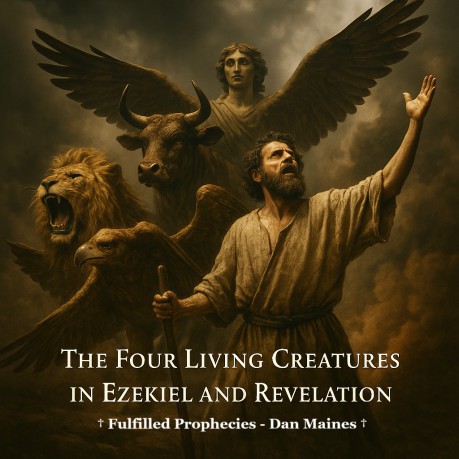
The Four Living Creatures in
Ezekiel and Revelation Ezekiel 1:5-6 Ezekiel 1:10 Ezekiel 10:14-15 Revelation 4:6-8 Revelation 5:8-9 Historical References How it applies to us today † This is the fulfilled perspective we proclaim at
Fulfilled Prophecies † Source Index
By Dan Maines
Within it there were figures
resembling four living beings. And this was their appearance: they
had human form. Each of them had four faces and four wings.
†
Ezekiel's vision revealed God's glory and presence moving among His
people, represented by four living creatures symbolizing the fullness
of His power and dominion (Ezekiel 1:26-28).
†
The four wings represented swiftness and readiness to carry out God's
will, just as the Spirit directed wherever He pleased (Ezekiel 1:12,
Psalm 103:20).
† These beings stood for
divine governance, showing God's omnipresence, omnipotence, wisdom,
and authority (Jeremiah 23:24, Proverbs 3:19, Psalm 115:3, Daniel
4:35, Psalm 103:19).
As for the form of their faces,
each had the face of a man, all four had the face of a lion on the
right and the face of a bull on the left, and all four had the face
of an eagle.
† The four faces symbolize the
completeness of creation under God's rule, reflected in the
arrangement of Israel's camp around the tabernacle and in Christ's
supremacy over creation (Revelation 4:7, Numbers 2, Colossians
1:16).
† The man represents wisdom and
understanding (Proverbs 2:6).
† The lion
represents strength and kingship (Proverbs 30:30, Revelation 5:5).
†
The ox (bull) represents service and endurance (1 Corinthians 9:9-10,
Deuteronomy 25:4).
† The eagle represents
divine vision and heavenly authority (Isaiah 40:31, Deuteronomy
32:11).
† Together they display every aspect
of God's nature revealed in His kingdom (Psalm 145:13).
And each one had four
faces: the first face was that of a cherub, the second a human face,
the third the face of a lion, and the fourth the face of an eagle.
Then the cherubim rose up. These were the living beings that I saw by
the river Chebar.
† Ezekiel identifies these
beings as cherubim, confirming their connection to God's throne
presence and His covenantal glory departing from Jerusalem before its
destruction (Ezekiel 10:18-19, Ezekiel 11:22-23).
†
The cherubim symbolized the Lord's authority extending beyond the
temple, showing His rule wasn't confined to one nation but would
reach all nations through His plan (Psalm 18:10, Malachi 1:11).
And before the throne there
was something like a sea of glass, like crystal, and in the center
and around the throne, four living creatures full of eyes in front
and behind. The first creature was like a lion, and the second
creature like a calf, and the third creature had a face like that of
a man, and the fourth creature was like a flying eagle. And the four
living creatures, each one of them having six wings, are full of eyes
around and within, and day and night they do not cease to say, Holy,
holy, holy is the Lord God, the Almighty, who was and who is and who
is to come.
† John's vision expands
Ezekiel's, showing the same four living creatures before the throne,
representing the fullness of creation and God's universal reign
through Christ (Revelation 5:13, Psalm 99:1).
†
The six wings parallel the seraphim in Isaiah 6, showing heavenly
beings joined in unending worship (Isaiah 6:2-3).
†
The added wings signify completeness in divine revelation, fulfilled
in Christ's kingdom, where heaven's worship and God's glory unite
with the New Jerusalem (Hebrews 12:22-24, Revelation 21:2-3).
†
The eyes symbolize perfect knowledge and vision, representing God's
omniscience and the Spirit's active awareness throughout His creation
(2 Chronicles 16:9, Zechariah 4:10, Proverbs 15:3).
When He had taken the
scroll, the four living creatures and the twenty-four elders fell
down before the Lamb, each one holding a harp and golden bowls full
of incense, which are the prayers of the saints. And they sang a new
song, saying, Worthy are You to take the scroll and to break its
seals; for You were slain, and purchased for God with Your blood
people from every tribe and tongue and people and nation.
†
The living creatures join the elders in worshiping the Lamb, showing
that creation and covenant authority now serve under Christ's
redemption (Philippians 2:9-11, Psalm 99:1).
†
The new song is the covenant fulfilled in Christ, where heaven and
earth together acknowledge His eternal reign (Revelation 11:15, Psalm
22:27-28).
† The four faces reflect the
fourfold witness of Christ revealed in the Gospels (Revelation 4:7,
Matthew 28:19-20).
† Matthew (Man, revealing
Christ's humanity and royal lineage)
† Mark
(Lion, showing His powerful kingship and authority)
†
Luke (Ox, emphasizing His priestly sacrifice and service)
†
John (Eagle, portraying His divinity and heavenly origin)
†
Irenaeus (Against Heresies, Book 3, Chapter 11, Section 8) associated
the four living creatures with the four Gospels, each revealing a
distinct aspect of Christ's nature.
† Jerome
and later Church Fathers echoed this, affirming the unity between
Ezekiel's and John's visions.
† Josephus
(Antiquities 3.6.4) described the veil's embroidery as consistent
with the biblical account of cherubim woven into the sanctuary
(Exodus 26:31, 2 Chronicles 3:14).
†
The four living creatures show that God's presence fills the earth
and His throne reigns among His people through Christ (Ephesians
1:22-23).
† This vision reminds us our
worship on earth joins with heaven, declaring Holy, holy, holy to the
Almighty (Revelation 4:8, Psalm 29:2).
† As
living temples of His Spirit, we reflect those same attributes:
strength like the lion, service like the ox, understanding like the
man, and heavenly focus like the eagle (1 Corinthians 3:16, Galatians
5:22-23, 2 Corinthians 3:18).
† The glory
that once departed from Jerusalem now abides permanently among us in
the New Covenant, through the indwelling of Christ (Revelation 21:3,
John 14:23).
© Fulfilled Prophecies - Dan
Maines.
† Ezekiel
1:5-10; 10:14-15; 11:22-23; Revelation 4:6-8; 5:8-9
†
Isaiah 6:1-3; Numbers 2; Psalm 18:10; Psalm 99:1; Psalm 22:27-28;
Psalm 29:2; Proverbs 15:3; Zechariah 4:10; Hebrews 12:22-24;
Colossians 1:16; John 14:23
† Irenaeus,
Against Heresies, Book 3, Chapter 11, Section 8
†
Jerome, Commentary on Matthew, Preface
†
Josephus, Antiquities 3.6.4; Exodus 26:31; 2 Chronicles 3:14
Links