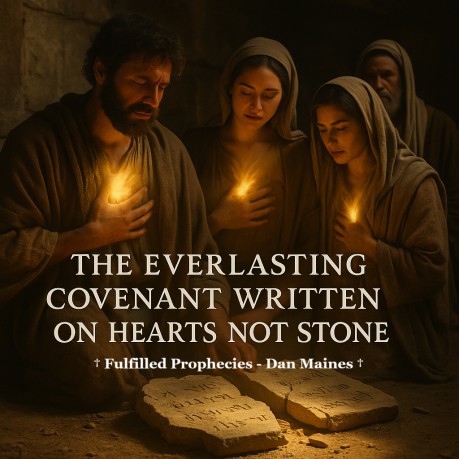
The Everlasting Covenant:
Written on Hearts, Not Stone Jeremiah 31:31-33 † God announced long before Christ that a new
covenant would replace the one made at Sinai. Jeremiah 31:34 † Under the new covenant, knowledge of God is
direct, not mediated by priests or rituals. Hebrews 8:6-7 † The covenant of Moses was temporary and
imperfect, pointing forward to something greater. Hebrews 8:10-13 † The writer of Hebrews confirms Jeremiah's
prophecy and declares that the old covenant was about to vanish. 2 Corinthians 3:6-9 † Paul contrasts the ministry of death written
on stone with the ministry of life written by the Spirit. Ezekiel 36:26-27 † Ezekiel's prophecy explains how the new
covenant works, God Himself gives the new heart and Spirit. Romans 10:4 † Christ brought an end to the law, not by
destruction, but by fulfillment. How it applies to us today † This is the fulfilled perspective we proclaim at
Fulfilled Prophecies † Source Index
By Dan Maines
"Behold, days are
coming," declares the Lord, "when I will make a new
covenant with the house of Israel and with the house of Judah, not
like the covenant which I made with their fathers in the day I took
them by the hand to bring them out of the land of Egypt, My covenant
which they broke, although I was a husband to them," declares
the Lord. "But this is the covenant which I will make with the
house of Israel after those days," declares the Lord, "I
will put My law within them and on their heart I will write it, and I
will be their God, and they shall be My people."
†
This covenant was not written on stone tablets but on the hearts of
His people.
† The internal law signifies
transformation, not regulation, a new heart instead of external
commandments.
† This covenant is everlasting
because it depends on Christ's finished work, not man's obedience.
"They will not teach
again, each man his neighbor and each man his brother, saying, 'Know
the Lord,' for they will all know Me, from the least of them to the
greatest of them," declares the Lord, "for I will forgive
their iniquity, and their sin I will remember no more."
†
Forgiveness is final, permanent, and remembered no more.
†
The personal relationship God desired from the beginning is now
restored in fullness through Christ.
† The
old covenant kept man distant, but the new covenant unites God and
His people eternally.
But now He has obtained a more
excellent ministry, by as much as He is also the mediator of a better
covenant, which has been enacted on better promises. For if that
first covenant had been faultless, there would have been no occasion
sought for a second.
†
Christ's covenant is better because it fulfills all that the first
one could only foreshadow.
† The old covenant
was conditional on human obedience, but the new is grounded entirely
in God's grace.
† The coming of the better
covenant marked the end of the old, it could not coexist once
fulfillment arrived.
"For this is the
covenant that I will make with the house of Israel after those days,"
says the Lord: "I will put My laws into their minds, and I will
write them on their hearts. And I will be their God, and they shall
be My people. And they shall not teach everyone his fellow citizen,
and everyone his brother, saying, 'Know the Lord,' for all will know
Me, from the least to the greatest of them. For I will be merciful to
their iniquities, and I will remember their sins no more." When
He said, "A new covenant," He has made the first obsolete.
But whatever is becoming obsolete and growing old is ready to
disappear.
†
"Ready to disappear" shows that this transition was already
underway in the first century.
† The
destruction of the temple in AD 70 marked the visible end of the
covenant written on stone.
† The everlasting
covenant, written on hearts, took its place, eternal, spiritual, and
unbreakable.
Who also made us
adequate as servants of a new covenant, not of the letter but of the
Spirit; for the letter kills, but the Spirit gives life. But if the
ministry of death, in letters engraved on stones, came with glory, so
that the sons of Israel could not look intently at the face of Moses
because of the glory of his face, fading as it was, how will the
ministry of the Spirit fail to be even more with glory?
†
The law engraved on tablets condemned, while the Spirit within
transforms.
† The fading glory of Moses' face
represents the old covenant's temporary nature.
†
The surpassing glory of the Spirit is permanent, marking the new
covenant as everlasting.
Moreover, I will give you a
new heart and put a new spirit within you; and I will remove the
heart of stone from your flesh and give you a heart of flesh. I will
put My Spirit within you and cause you to walk in My statutes, and
you will be careful to observe My ordinances.
†
The heart of stone represents the old covenant, lifeless and hardened
by the law.
† The heart of flesh is tender
and responsive, moved by the indwelling Spirit.
†
This inward change fulfills what the tablets could never accomplish,
true obedience born from within.
For Christ is the end of the law
for righteousness to everyone who believes.
† The law's
purpose was to lead to Him, and once fulfilled, its role ceased.
†
Believers now live under righteousness written on their hearts, not
carved in stone.
† This defines the
everlasting covenant, internal, eternal, and complete.
†
We're living under the covenant that never ends, where God's word is
written within us.
† The Spirit now guides,
teaches, and transforms, replacing outward command with inward
conviction.
† The covenant written on stone
could break, but this one cannot, for it's sealed in Christ's
blood.
† We're the living tablets of His
promise, the fulfillment of what prophets longed to see.
†
The everlasting covenant is not coming, it's here, alive in every
heart that belongs to Him.
© Fulfilled Prophecies - Dan
Maines.
† Jeremiah
31:31-34; Hebrews 8:6-13; 2 Corinthians 3:6-9; Ezekiel 36:26-27;
Romans 10:4
† Barnabas, Epistle of Barnabas,
ch. 16
† Clement of Alexandria, Stromata,
Book 6
Links