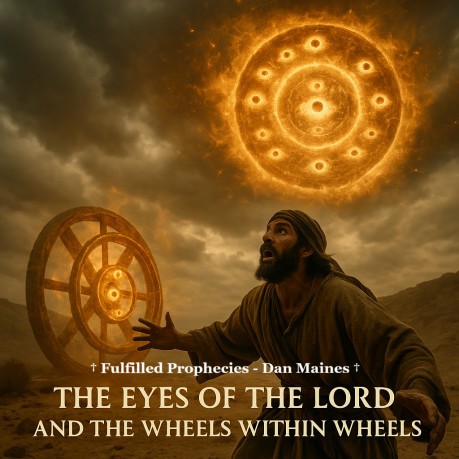
The Eyes of the Lord and the
Wheels Within Wheels Opening Theme Ezekiel's Vision of the Wheels † The wheels within wheels weren't mechanical
objects, they symbolized God's omnipresence and omniscience (Ezekiel
1:1, 1:5, 1:13-16, 1:26-28, 10:15, 10:20; Revelation 4:6-8). In the fulfilled sense, the vision revealed God's glory moving
beyond the confines of the physical temple to dwell among His people.
His presence was no longer bound to stone and gold but to living
temples made without hands (1 Corinthians 3:16; 2 Corinthians 6:16). The Lamb With Seven Eyes † The Lamb with seven eyes reveals the same
truth seen in Ezekiel's vision. The eyes represent the fullness of
God's Spirit and His complete awareness of everything that happens
among His people (Revelation 5:6; Zechariah 4:10; 2 Chronicles
16:9). The Lamb's eyes represent what the wheels symbolized in Ezekiel,
perfect vision and divine motion. What was once seen in symbol
through the chariot throne of God is now fulfilled in Christ who
reigns in His people. The Heavens and the Temple Pattern † This pattern reveals that the temple was a
model of heaven and earth, a visible image of God's dwelling with His
creation (Hebrews 9:1-5; Exodus 25:8-9; Psalm 78:69). The Connection of All Three Visions Together, these reveal one unified truth: God isn't bound to a
place. His presence moves freely through His redeemed people. The
glory that once filled the temple now fills the body of Christ
(Ephesians 2:19-22; 1 Corinthians 3:16-17). Additional Commentary on Ezekiel's Vision † The same vision reappears in Ezekiel 10,
where he identifies the living beings and the wheels as cherubim,
spiritual beings surrounding God's throne (Ezekiel 10:15, 10:20). The vision isn't about physical technology but about divine
mobility and awareness. God's presence moves freely through the
earth, and His eyes see in every direction. This reveals His
omnipresence and omniscience, the very attributes the wheels within
wheels were meant to symbolize (Jeremiah 23:23-24; Proverbs 15:3;
Psalm 139:7-10). How It Applies to Us Today † This is the fulfilled perspective we proclaim at
Fulfilled Prophecies † Source Index
By Dan Maines
Ezekiel saw the glory of God
in motion, a vision of divine presence that no longer depended on a
physical temple. John saw the same glory in the Lamb with seven eyes,
representing the fullness of the Spirit moving throughout the earth.
Together, these visions reveal how God's presence transitioned from
the old covenant temple to His new covenant temple, His people.
Ezekiel
1:15-21
Now as I looked at the living beings, behold,
there was one wheel on the earth beside the living beings, for each
of the four of them. The appearance of the wheels and their
workmanship was like sparkling beryl, and all four of them had the
same form, their appearance and workmanship being as if one wheel
were within another.
†
The Spirit of God could move in any direction, unrestricted by time,
space, or temple walls (Ezekiel 1:17, 1:20-21; Jeremiah 23:23-24;
Psalm 139:7-10).
† Ezekiel 1:20 says,
Wherever the spirit was about to go, they would go, because there the
spirit was to go. That means God's glory wasn't confined to
Jerusalem. Even in exile, He was present and active (Ezekiel 11:16;
Acts 7:48-50).
† The intersecting wheels
showed that God's plans operate perfectly in every direction, without
confusion or obstruction (Ezekiel 1:17, 1:21; Isaiah 46:10; Psalm
33:11).
Revelation
5:6
And I saw between the throne (with the four living
creatures) and the elders a Lamb standing, as if slain, having seven
horns and seven eyes, which are the seven Spirits of God, sent out
into all the earth.
† Revelation connects these seven eyes
with the seven churches, showing Christ's Spirit actively present in
each congregation (Revelation 1:20; Revelation 2-3).
†
Just as the wheels in Ezekiel could move in every direction, the
Spirit of Christ moves freely through His body, guiding, correcting,
and empowering His people (John 16:13; 1 Corinthians 12:4-11).
†
The number seven symbolizes divine completeness, the fullness of the
Spirit operating through the complete church (Revelation 4:5; Isaiah
11:2).
Josephus
recorded in Antiquities 3.6.4 that the tabernacle was constructed to
represent the order of creation itself. He wrote that the Holy of
Holies symbolized heaven, and the outer sanctuary symbolized the sea
and the land where man dwells.
†
When Peter spoke of the heavens and earth being reserved for fire (2
Peter 3:7), he referred to that covenant world, not the physical
planet (2 Peter 3:7, 10-13; Hebrews 12:26-28; Matthew 24:35).
†
When the temple was destroyed in AD 70, the old heaven and earth
passed away, and the new heavens and new earth were revealed, the
true dwelling of God with His people (Revelation 21:1-3; Isaiah
65:17-19; Luke 21:20-22).
†
Ezekiel saw the moving glory of God, a foretelling of a living,
mobile temple (Ezekiel 1:26-28; Ezekiel 10:18-19).
†
John saw the Lamb with seven eyes, the Spirit active and complete in
His people (Revelation 5:6; Revelation 2:1-3:22).
†
Josephus described the temple as heaven and earth, the very thing
that passed away when the new covenant came in fullness (Antiquities
3.6.4; Hebrews 8:13; Matthew 24:3, 34).
Some
have read Ezekiel's description as if he were seeing a physical craft
or some kind of flying object. However, Ezekiel himself makes it
clear that what he saw was a vision, not a literal event. Ezekiel 1:1
says, The heavens were opened and I saw visions of God. Throughout
the passage, he repeats words like likeness and appearance, showing
he was describing spiritual symbols, not physical machines (Ezekiel
1:1, 1:5, 1:26, 1:28).
†
The eyes within the wheels are the same as the eyes seen later in
Revelation 4:6 and 5:6, representing God's complete awareness and
presence throughout all creation (Revelation 4:6-8; Revelation 5:6;
Zechariah 4:10).
† The ability of the wheels
to move in every direction shows that God's Spirit is unrestricted.
His glory was no longer tied to the temple in Jerusalem but could
move with His people even into exile (Ezekiel 1:17-21; Ezekiel 11:16;
John 4:21-24).
† Other prophets also used
symbolic imagery to describe divine realities. Daniel saw beasts
representing kingdoms, Zechariah saw a flying scroll representing
judgment, and John saw a dragon representing Satan. Ezekiel's wheels
follow this same prophetic pattern (Daniel 7:3; Zechariah 5:1-2;
Revelation 12:3).
†
We're the living temple of God. His Spirit dwells within us
(Ephesians 2:19-22; 1 Corinthians 3:16; 2 Corinthians 6:16).
†
The same eyes that once moved through the wheels now see through His
body, the church (Revelation 5:6; Ephesians 1:22-23).
†
Nothing escapes His sight, and nothing can hinder His presence
(Hebrews 4:13; Psalm 33:13-15).
† The Lord's
glory is no longer behind a veil but alive in His people (2
Corinthians 3:16-18; John 17:22-23).
† His
kingdom is established, His light fills all, and His glory moves
without limit (Colossians 1:13; Revelation 21:23-24; Matthew
24:30-34).
© Fulfilled Prophecies - Dan
Maines.
† Ezekiel
1:1, 15-21; Ezekiel 10:15-20; Revelation 4:6, 5:6; Daniel 7:3;
Zechariah 5:1-2; 2 Peter 3:7; Ephesians 2:19-22
†
Josephus, Antiquities of the Jews, Book 3, Chapter 6, Section 4
†
Isaiah 19:1; Psalm 18:9-12
Links