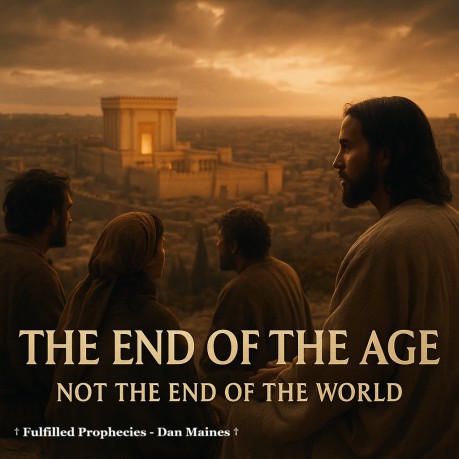
The End of the Age: Not the
End of the World Matthew 24:1-3 † The disciples asked about one event, the
destruction of the temple and called it the end of the age. Matthew 13:39-43 † Jesus identified the harvest as the end of
the age, not the end of the world. Hebrews 9:26 † The writer of Hebrews places Christ's
sacrifice at the "consummation of the ages," meaning the
closing of the old covenant era. 1 Corinthians 10:11 † Paul told the Corinthians that the end of the
ages had already come upon them. Hebrews 8:13 † The author of Hebrews wrote just before the
temple's destruction, declaring that the old covenant was "ready
to disappear." 2 Peter 3:10-13 † Peter used prophetic language drawn from
Isaiah to describe the end of the old covenant world. Revelation 21:1 † John's vision of the new heaven and earth
mirrors Peter's prophecy, both point to covenant renewal, not cosmic
destruction. How it applies to us today † This is the fulfilled perspective we proclaim at
Fulfilled Prophecies † Source Index
By Dan Maines
Jesus came out from the
temple and was going away when His disciples came up to point out the
temple buildings to Him. And He said to them, "Do you not see
all these things? Truly I say to you, not one stone here will be left
upon another, which will not be torn down." As He was sitting on
the Mount of Olives, the disciples came to Him privately, saying,
"Tell us, when will these things happen, and what will be the
sign of Your coming, and of the end of the age?"
†
The Greek word "aion" means age or era, not planet or
physical world.
† Jesus' prediction concerned
the end of the old covenant order, not the end of creation.
†
The temple's fall in AD 70 was the visible sign that the former age
had ended and the kingdom age had begun.
And the enemy who sowed
them is the devil, and the harvest is the end of the age; and the
reapers are angels. So just as the tares are gathered up and burned
with fire, so shall it be at the end of the age. The Son of Man will
send forth His angels, and they will gather out of His kingdom all
stumbling blocks, and those who commit lawlessness, and will throw
them into the furnace of fire; in that place there will be weeping
and gnashing of teeth. Then the righteous will shine forth as the sun
in the kingdom of their Father.
† The
separation of wheat and tares symbolizes the judgment of Israel, the
righteous were gathered into the kingdom while the wicked were cast
out.
† The furnace of fire represents the
destruction of Jerusalem, not eternal torment.
†
The righteous shining forth shows the new covenant people rising from
the ashes of the old system.
Otherwise, He would have needed
to suffer often since the foundation of the world; but now once at
the consummation of the ages He has been manifested to put away sin
by the sacrifice of Himself.
† The end of
the ages was not the end of time, but the fulfillment of all
prophetic purpose.
† Christ appeared once,
not at the end of creation, but at the turning point of redemptive
history.
† The cross was the dividing line
between the shadow and the substance, between the old world and the
new.
Now these things
happened to them as an example, and they were written for our
instruction, upon whom the ends of the ages have come.
† The
fulfillment was already in progress while the old covenant world was
still standing.
† This confirms that the end
of the age was a first-century event, not a future global
catastrophe.
† The old covenant's last
generation witnessed its close, just as Jesus promised in Matthew
24:34.
When He said, "A new
covenant," He has made the first obsolete. But whatever is
becoming obsolete and growing old is ready to disappear.
† That disappearance came
in AD 70 when the temple fell, ending sacrifices and priesthood
forever.
† The end of the age was the end of
Mosaic worship, not the end of human life.
†
What replaced it was the unending new covenant kingdom of Christ.
But the day of the Lord will
come like a thief, in which the heavens will pass away with a roar
and the elements will be destroyed with intense heat, and the earth
and its works will be burned up. But according to His promise we are
looking for new heavens and a new earth, in which righteousness
dwells.
†
The heavens and earth symbolize Israel's covenant structure, its
temple, priesthood, and sacrifices.
† The
"elements" destroyed were not physical atoms, but the
elements of the Mosaic law.
† The new heavens
and earth represent the new covenant order where righteousness
dwells.
Then I saw a new heaven and
a new earth; for the first heaven and the first earth passed away,
and there is no longer any sea.
† The "sea" in
prophetic language symbolizes separation and chaos; its removal shows
full reconciliation with God.
† The first
heaven and earth (the old covenant) passed away in AD 70, replaced by
the everlasting kingdom.
† The new creation
is spiritual and eternal, established forever in Christ.
†
We live in the new covenant world, the age that never ends.
†
The end of the age was not the end of creation but the dawn of God's
completed kingdom.
† Understanding this truth
brings peace, the world is not awaiting destruction, but redemption
already accomplished.
† The gospel is not
about escape but about inheritance, we are heirs of the fulfilled
kingdom of God.
† Heaven and earth have met
in Christ, and that union will never be undone.
© Fulfilled
Prophecies - Dan Maines
† Matthew
24:1-3; Matthew 13:39-43; Hebrews 9:26; 1 Corinthians 10:11; Hebrews
8:13; 2 Peter 3:10-13; Revelation 21:1
†
Josephus, Wars of the Jews, 6.4.5
† Eusebius,
Ecclesiastical History, Book 3
Links