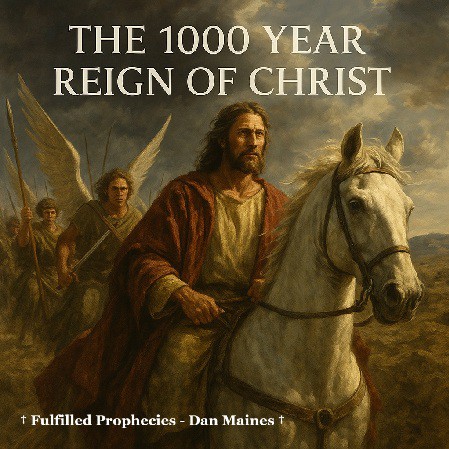
The 1000 Year Reign of Christ Revelation 20:1 Revelation 20:2 Revelation 20:3 Revelation 20:4 Revelation 20:5-6 Revelation 20:7-8 Revelation 20:9-10 How it applies to us today Historical Witnesses of the 1000-Year Reign † Irenaeus (Against Heresies, Book 5,
ch. 28-36) † Justin Martyr (Dialogue with Trypho,
ch. 110) † Athanasius (On the Incarnation, ch.
25-28) † Eusebius (Demonstratio Evangelica,
Book 3; Ecclesiastical History 3.5) † Clement of Rome (1 Clement
42-44) † Josephus (Wars 6.5.3) † Tertullian (Apology, ch. 32) † This is the fulfilled perspective we proclaim at
Fulfilled Prophecies † Source Index
By Dan Maines
Then I saw an angel coming
down from heaven, holding the key of the abyss and a great chain in
his hand.
† The angel symbolizes divine
authority and judgment from heaven, representing Christ's victory
over His enemies.
† The key and chain are not
literal but show His power to bind Satan, ending his authority
through the cross.
† In Luke 10:18, Jesus
said, "I saw Satan fall like lightning from heaven,"
showing this had already begun in His ministry.
†
This vision reveals the spiritual reality of Satan's defeat through
Christ's death and resurrection.
† The
binding began when Christ triumphed at the cross and continued
through the proclamation of the gospel until Jerusalem's destruction.
And he laid hold of the
dragon, the serpent of old, who is the devil and Satan, and bound him
for a thousand years.
† The "thousand
years" is symbolic of completeness, not a literal duration. It
represents the full period of Christ's reign through His kingdom.
†
During this reign, Satan could no longer deceive the nations as he
had under the old covenant system.
† The
gospel spread freely, unhindered by the powers that once held the
nations in darkness.
† Psalm 110:1-2 confirms
Christ rules in the midst of His enemies until all are subdued.
†
This reign is the present reign of Christ, not a future political
kingdom on earth.
And he threw him into the
abyss, and shut it and sealed it over him, so that he would not
deceive the nations any longer, until the thousand years were
completed; after these things he must be released for a short time.
†
The "abyss" signifies restraint, not annihilation. Satan's
influence was limited while the gospel advanced.
†
His later "release" represents the brief resurgence of
opposition before Jerusalem's fall.
† This
correlates with the persecution under Nero, when Satan stirred the
nations against the saints.
† The "short
time" was that final test before the old covenant world's end in
AD 70.
† Once the harlot city fell, his power
over the covenant people was forever broken.
Then I saw thrones, and they
sat on them, and judgment was given to them. And I saw the souls of
those who had been beheaded because of their testimony of Jesus and
because of the word of God… and they came to life and reigned with
Christ for a thousand years.
† These are the
martyrs of the early church, vindicated after their suffering.
†
They "reigned with Christ," meaning they shared in His
victory and authority in the spiritual kingdom.
†
Their "coming to life" is not a physical resurrection but
their vindication and participation in Christ's reign.
†
The first-century martyrs lived and reigned through the triumph of
the gospel and the fall of their persecutors.
†
This reign continues forever in the everlasting kingdom, not limited
to an earthly millennium.
The rest of the dead did
not come to life until the thousand years were completed. This is the
first resurrection. Blessed and holy is the one who has a part in the
first resurrection; over these the second death has no power.
†
The "first resurrection" is the resurrection into life
through faith in Christ, as John 5:24 says: "He who hears My
word… has passed from death to life."
†
Those in Christ are already resurrected spiritually and cannot be
touched by the second death.
† The "rest
of the dead" refers to those outside of Christ who remained
under judgment.
† The thousand-year period
represents the totality of Christ's reign in His body, the church.
†
His reign did not end but transitioned into the eternal kingdom at
the judgment of Jerusalem.
When the thousand years
are completed, Satan will be released from his prison, and will come
out to deceive the nations… Gog and Magog, to gather them together
for the war.
† This depicts the final
rebellion of the old covenant world against Christ and His church.
†
Gog and Magog represent the nations stirred against the saints before
the destruction of Jerusalem.
† Their
"surrounding the camp of the saints" parallels the Roman
siege of the holy city.
† This rebellion
ended in divine judgment, as fire came down from heaven and consumed
them.
† It was the end of the old world,
marking the full revelation of Christ's eternal reign.
And they came up on the
broad plain of the earth and surrounded the camp of the saints and
the beloved city, and fire came down from heaven and devoured them.
†
The "beloved city" was Jerusalem, which had rejected Christ
and persecuted His saints.
† The fire
represents God's judgment through Rome, fulfilling Christ's words in
Matthew 22:7.
† Satan's final defeat here
aligns with the full establishment of the kingdom.
†
From this point on, his power to deceive the nations was broken
forever.
† Christ's kingdom reigns eternally,
never to be replaced or repeated.
†
We live in the eternal phase of Christ's kingdom, where His reign has
no end (Luke 1:33).
† The thousand years were
symbolic of His complete victory, which now continues forever.
†
Satan has no authority over the believer, for the second death has no
power over us.
† The saints' rule with Christ
is spiritual and everlasting, not postponed to a future age.
†
We walk in the fullness of the new creation, where Christ is all in
all.
He spoke of the kingdom of Christ as already
inaugurated and spreading in the world. While his understanding
wasn't fully fulfilled-view, he affirmed that Christ's reign had
begun with His first coming, showing early awareness of a present
reign, not a postponed one.
Justin noted that the devil's power was broken
by the cross, connecting Satan's defeat to Christ's ministry, not a
future age. This supports Revelation 20:2 being fulfilled in the
gospel age.
Athanasius wrote that the idols of the nations
were falling, demons were fleeing, and the knowledge of God was
filling the world, proof to him that Satan had been bound and
Christ's reign was active and victorious through the gospel.
Eusebius explicitly
connected the destruction of Jerusalem with the end of the old
covenant age and the triumph of Christ's kingdom. He viewed this as
the "judgment of God upon that generation," confirming
Revelation 20's setting.
Clement emphasized Christ's continuing reign
through the apostles and the church, showing the early church's
conviction that His kingdom was already functioning in full
authority.
Described
the fire that devoured Jerusalem and the destruction that ended the
Jewish nation, directly aligning with Revelation 20:9's imagery of
fire consuming the enemies of God.
Declared
that Satan's power was "weakened and conquered by the name of
Christ," showing that early Christians recognized the devil's
restraint as a present spiritual fact.
© Fulfilled Prophecies - Dan Maines
† Revelation
20:1-10; Luke 10:18; Psalm 110:1-2; John 5:24; Matthew 22:7; Luke
1:33
† Josephus, Wars of the Jews 6.5.3
†
Eusebius, Ecclesiastical History 3.5; Demonstratio Evangelica 3
†
Athanasius, On the Incarnation 25-28
† Justin
Martyr, Dialogue with Trypho 110
† Clement of
Rome, 1 Clement 42-44
† Tertullian, Apology
32
† Irenaeus, Against Heresies 5.28-36
Links