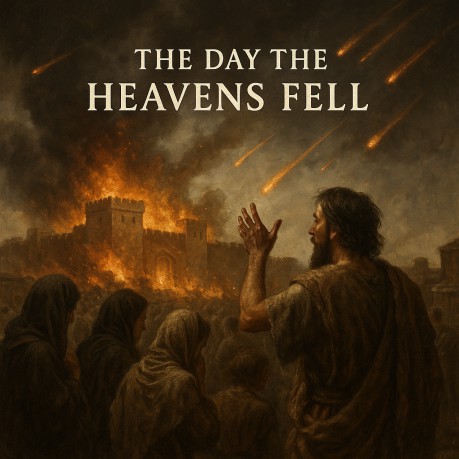
The Day the Heavens Fell Isaiah 13:9-10 † Isaiah describes the fall of Babylon in terms
of heavenly signs. These words were not meant to predict literal
cosmic destruction but covenantal judgment expressed in prophetic
language. Isaiah 13:11-13 † The "world" here refers to
Babylon's empire, not the planet. God's judgment on Babylon caused
its heavens to tremble, its rulers and powers fell. Matthew 24:29 † Jesus borrowed this same prophetic imagery to
describe the fall of Jerusalem. Revelation 6:12-14 † This vision continues the same prophetic
symbols used in Isaiah and Jesus' words. Acts 2:19-20 † Peter quotes Joel 2 to explain the events
surrounding Pentecost and the last days of the old covenant. Haggai 2:6-7 † Haggai prophesied a final shaking that
Hebrews 12 confirms was fulfilled in the first century. How it applies to us today † This is the fulfilled perspective we proclaim at
Fulfilled Prophecies † Source Index
By Dan Maines
Behold, the day of the Lord
is coming, cruel, with fury and burning anger, to make the land a
desolation, and He will exterminate its sinners from it. For the
stars of heaven and their constellations will not flash forth their
light, the sun will be dark when it rises, and the moon will not shed
its light.
† The darkening of sun, moon, and
stars symbolizes the fall of rulers and nations. God used this same
language whenever a kingdom was judged.
† The
"day of the Lord" was a known phrase for national judgment,
not the end of the physical world.
† This
pattern is repeated throughout scripture, proving that cosmic terms
were used to describe earthly upheavals under divine wrath.
Thus I will punish the world
for its evil and the wicked for their iniquity; I will also put an
end to the arrogance of the proud and abase the haughtiness of the
ruthless. I will make mortal man scarcer than pure gold and mankind
than the gold of Ophir. Therefore I will make the heavens tremble,
and the earth will be shaken from its place at the fury of the Lord
of hosts in the day of His burning anger.
†
The shaking of heaven and earth is symbolic of political and
covenantal collapse.
† God's fury caused the
heavens to be darkened because He withdrew His favor and light from
them.
† The same pattern of language appears
later in Haggai 2 and Hebrews 12, showing continuity in how God
describes the fall of old systems and kingdoms.
But immediately after the
tribulation of those days the sun will be darkened, and the moon will
not give its light, and the stars will fall from the sky, and the
powers of the heavens will be shaken.
† The "powers
of the heavens" refer to the rulers, priests, and authorities of
Israel who would lose their place in the old covenant order.
†
The "stars falling" is covenantal language meaning the
leaders of Israel would fall from their positions of authority.
†
Jesus was quoting directly from Isaiah, applying the same pattern of
judgment language to Israel as Isaiah did to Babylon.
I looked when He broke
the sixth seal, and there was a great earthquake, and the sun became
black as sackcloth made of hair, and the whole moon became like
blood, and the stars of the sky fell to the earth, as a fig tree
casts its unripe figs when shaken by a great wind. The sky was split
apart like a scroll when it is rolled up, and every mountain and
island were moved out of their places.
†
The earthquake represents the shaking of the covenant world, the old
temple order being removed.
† The heavens
departing as a scroll symbolize the end of the Mosaic system, which
once served as a covering or firmament between God and man.
†
The mountains and islands moving represent nations being shaken as
the old covenant world collapsed in AD 70.
And I will display wonders in
the sky above and signs on the earth below, blood, and fire, and
vapor of smoke. The sun will be turned into darkness and the moon
into blood, before the great and glorious day of the Lord shall come.
†
These signs were fulfilled in the first century, not the future. The
"day of the Lord" arrived with the destruction of
Jerusalem, ending the old age.
† The imagery
of darkness and blood shows the transition from law to grace, from
shadow to light.
† Pentecost marked the
dawning of the new heavens and new earth, while the old heavens were
in their final decline.
For thus says the Lord of
hosts, Once more in a little while, I am going to shake the heavens
and the earth, the sea also and the dry land. I will shake all the
nations, and they will come with the wealth of all nations, and I
will fill this house with glory, says the Lord of hosts.
†
This shaking was not of the physical world but of the covenantal
order. God removed the old to establish the new.
†
When Christ's kingdom was revealed, all temporary systems were
removed, leaving only what cannot be shaken, the everlasting
kingdom.
† This is the same "fall of the
heavens" spoken of by Isaiah, Jesus, and John.
†
The heavens that fell were not those above our heads, but the
symbolic heavens of the old covenant world.
†
When that system ended, a new creation began, one that cannot fall or
fade.
† The sun, moon, and stars that went
dark were the old authorities of Israel. Today, Christ alone is our
light, our unshakable sun.
† We now live
under the unending light of the New Covenant, where heaven and earth
are one in Christ.
† The day the heavens fell
was the day the true kingdom rose in fullness, never to be shaken
again.
† Isaiah
13:9-13; Matthew 24:29; Revelation 6:12-14; Acts 2:19-20; Haggai
2:6-7
† Hebrews 12:26-28
†
Josephus, Wars of the Jews, 6.5.3
† Tacitus,
Histories 5.13
Links