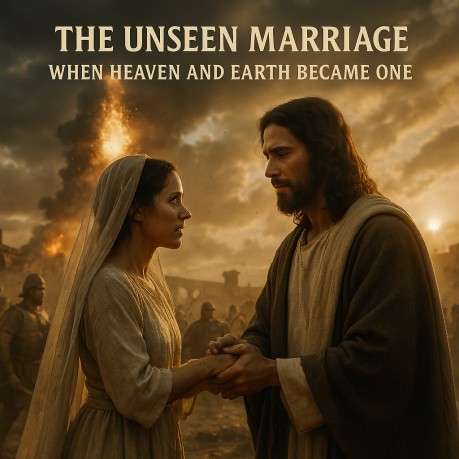
New
Jerusalem - The Unseen Marriage: When Heaven and Earth Became One Revelation 21:2 † John saw not a literal city, but the Church,
descending in covenantal union with her Lord. The "holy city"
represents the people of God, now purified and indwelt by His
presence. Revelation 21:9-10 † The same angel who poured out judgment now
reveals glory, showing that judgment and restoration are two sides of
the same event. The fall of old Jerusalem made way for the descent of
the new. Ephesians 5:31-32 † Paul takes the first marriage in Genesis and
applies it directly to Christ and His Church. Adam and Eve's union
foreshadowed the greater spiritual marriage that would unite heaven
and earth. Genesis 2:21-24 † The first marriage prefigured Christ and the
Church. Just as Eve came from Adam's side, the Church came from
Christ's side when blood and water flowed at His death (John
19:34). Matthew 22:1-14 † The wedding feast represents the arrival of
the kingdom in its fullness. The son's marriage points to the union
between Christ and His Church. How it applies to us today † This is the fulfilled perspective we proclaim at
Fulfilled Prophecies † Source Index
By Dan Maines
And I saw the holy city, new
Jerusalem, coming down out of heaven from God, made ready as a bride
adorned for her husband.
† The imagery of "coming down
out of heaven" shows that this is a divine creation, not man's
work. The new Jerusalem isn't built by human hands, but revealed from
heaven when the old covenant system fell.
†
The bride imagery points back to covenant language throughout
Scripture. In the prophets, Israel was often called God's wife
(Jeremiah 3:14, Hosea 2:19). The new Jerusalem is the restored,
faithful bride, the redeemed body of Christ.
†
The word "adorned" speaks of completed readiness. She is
not waiting to become the bride, she already is, clothed in
righteousness through Christ's finished work.
Then one of the seven
angels who had the seven bowls full of the seven last plagues came
and spoke with me, saying, "Come here, I will show you the
bride, the wife of the Lamb." And he carried me away in the
Spirit to a great and high mountain, and showed me the holy city,
Jerusalem, coming down out of heaven from God.
† The bride is clearly identified as
the city, confirming that the "new Jerusalem" is symbolic
for the Church, not a geographical location.
†
Being "carried in the Spirit" links this vision to
prophetic revelation, like Ezekiel's temple vision (Ezekiel 40). The
"mountain" represents God's kingdom, which Isaiah said
would be established above all nations (Isaiah 2:2).
†
The descent of the city shows the moment when heaven and earth became
one. The dwelling place of God is now with men (Revelation 21:3). The
separation caused by sin and the temple veil is forever removed.
For this reason a man
shall leave his father and mother and shall be joined to his wife,
and the two shall become one flesh. This mystery is great, but I am
speaking with reference to Christ and the church.
† The leaving of father and mother
mirrors Christ leaving the glory of heaven to join Himself to His
bride. The union in "one flesh" symbolizes the covenantal
oneness believers now share with Him.
† The
"great mystery" reveals that human marriage was never the
final picture, but a shadow of divine union. The Church is now bone
of His bone, flesh of His flesh (Ephesians 5:30).
†
This covenantal marriage was fully realized when the Old Covenant
system was dissolved, removing the former "wife" that
played the harlot (Jerusalem) and revealing the faithful bride.
So the Lord God caused a
deep sleep to fall upon the man, and he slept; then He took one of
his ribs and closed up the flesh at that place. The Lord God
fashioned into a woman the rib which He had taken from the man, and
brought her to the man. The man said, "This is now bone of my
bones, and flesh of my flesh; she shall be called Woman, because she
was taken out of Man." For this reason a man shall leave his
father and his mother, and be joined to his wife; and they shall
become one flesh.
† Adam's deep sleep represents death,
from which God brought forth his bride. Christ's death brought forth
His own bride, the Church, born from His sacrifice.
†
The phrase "one flesh" reveals the covenant unity between
the two. This was never about biology alone, but a picture of
complete covenantal union.
† The typology
moves from creation to redemption, from Adam to Christ. The new
creation is the fulfillment of that first pattern.
Jesus spoke to them again in
parables, saying, "The kingdom of heaven may be compared to a
king who gave a wedding feast for his son."
† The
destruction of the murderers and their city (verse 7) matches the
judgment of Jerusalem in AD 70, clearing the way for the wedding
feast to begin.
† Those invited but unworthy
represent Israel under the old covenant, while the new guests
gathered from the highways are the nations entering the New Covenant
kingdom.
† The garment requirement (verse 11)
points to righteousness in Christ. The new bride is clothed in fine
linen, which is the righteous acts of the saints (Revelation 19:8).
†
We live in the completed union of heaven and earth. The dwelling of
God is with His people, not in a building or future city, but within
us as His new creation.
† The Church is the
bride, already married to Christ, enjoying the privileges of that
oneness. We're not waiting for a future wedding, we're living in the
marriage now.
† Our worship is heavenly
because we are seated with Him in heavenly places (Ephesians 2:6).
There is no longer a veil between God and man.
†
Every act of faith, every word of truth, and every work of love now
flows from this marriage union, heaven expressing itself through
redeemed humanity.
† When the world sees the
Church living as one with Christ, they see heaven and earth united
before their eyes.
† Genesis
2:21-24; Matthew 22:1-14; Ephesians 5:31-32; Revelation 21:2, 9-10
†
Hosea 2:19; Jeremiah 3:14; Isaiah 2:2
†
Clement of Alexandria, Stromata, Book 6
†
Barnabas, Epistle of Barnabas, ch. 16
†
Athanasius, On the Incarnation, ch. 40
Links