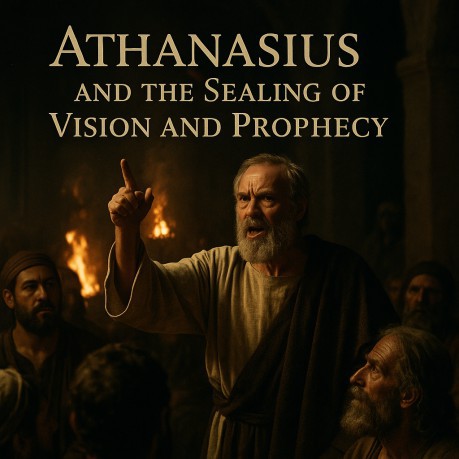
Athanasius and the Sealing of
Vision and Prophecy Athanasius, the 4th-century Bishop of Alexandria, stood boldly for
truth when most of the world opposed him. In his work On the
Incarnation of the Word, chapters 39-40, he confirmed that Daniel's
prophecy of seventy weeks was already fulfilled in Christ, that
vision and prophecy had ceased, and that Jerusalem's destruction
proved the end of the old covenant. His testimony stands as powerful
historical evidence that the early church understood fulfillment, not
futurism. Daniel's Prophecy and Its Completion Daniel 9:24 declares, "Seventy weeks have been decreed for
your people and your holy city, to finish the transgression, to make
an end of sin, to make atonement for iniquity, to bring in
everlasting righteousness, to seal up vision and prophecy, and to
anoint the most holy place." Athanasius recognized that this
prophecy reached its fulfillment in the first century through
Christ's coming, sacrifice, and the destruction of Jerusalem. He
rightly saw that Daniel's words pointed to a specific time when sin
would be atoned for, righteousness established, and prophecy brought
to completion. † Daniel's seventy weeks weren't left open or
pushed into the future, but completed when the Messiah came. That's
why Athanasius pointed to the ceasing of prophecy and vision as a
clear sign that Christ had fulfilled all things spoken by the
prophets. The ending of the prophetic era marked the beginning of the
everlasting kingdom of Christ. The End of the Shadows † Athanasius wrote that prophecy and vision
ceased from Israel because Christ, the Holy of Holies, had come. Once
the reality appeared, there was no more need for shadow. The prophets
were raised up to foretell His coming, but when He came, the purpose
of prophecy was fulfilled. The temple, sacrifices, and priesthood all
foreshadowed the Word made flesh. When He fulfilled the Law and the
Prophets, the old order passed away. † The temple was destroyed because its purpose
was finished. Everything that once pointed forward to Christ found
completion in Him. The end of Jerusalem and its priesthood wasn't a
tragedy but the visible sign that the shadow had given way to the
substance. † This is why, after His coming, Jerusalem was
destroyed. The prophetic gift, once active among Israel, ceased
because its purpose was complete. There was no longer a need for the
sign when the thing signified had arrived. Athanasius said it was "a
sign and an important proof of the coming of the Word of God that
Jerusalem no longer stands, nor is any prophet raised up." The
silence of prophecy was itself a witness that Christ had accomplished
redemption and sealed the covenant. † Josephus, the Jewish historian, wrote that
the temple was utterly destroyed and not one stone left upon another
(Wars 6.4.5), confirming the Lord's words in Matthew 24:2. Eusebius
later recorded that the desolation of Jerusalem marked the close of
the prophetic age, just as Daniel and Athanasius declared. Even the
Roman historian Tacitus described Jerusalem's ruin as final, proving
that vision and prophecy were sealed exactly as foretold. † The silence after Jerusalem's fall wasn't
absence but evidence. The same God who had spoken through the
prophets now spoke through His Son, and no new revelation was needed
because the truth had come in full. The Anointed One and the End of the Old Age † Daniel's seventy weeks culminated in the
anointing of the "Holy of Holies." Athanasius identifies
this not with a building or a future temple, but with Christ Himself.
He's the anointed sanctuary, the dwelling place of God among men.
When He came, the earthly anointings ended. The kings and priests of
Israel existed only until the true King and High Priest was anointed
by the Spirit at His baptism and glorified through His resurrection. † Christ is the Holy of Holies anointed in
Daniel's prophecy. His death and resurrection brought an end to the
old priesthood and established a new and everlasting covenant. What
was temporary has passed, and what's eternal has been revealed. † The ceasing of the kingship and prophecy in
Israel wasn't a loss, but a transition from type to fulfillment.
Christ's kingdom is everlasting and spiritual. His priesthood is
eternal, "not according to the law of a fleshly commandment, but
according to the power of an indestructible life" (Hebrews
7:16). † The visible kingdom of Israel ended so the
invisible and everlasting kingdom of Christ could be revealed. The
Law, the prophets, and the kingship all served their purpose until
the anointed One came to reign forever. Why Prophecy Ceased † Athanasius rebuked the Jews of his time,
saying, "Why are they so irreligious and so perverse as to see
what has happened and yet deny Christ who has brought it all to
pass?" Indeed, the very absence of prophets and kings after
Christ stands as undeniable proof that Daniel's prophecy was
fulfilled. Vision and prophecy were sealed, not postponed. The
seventy weeks were accomplished when the Messiah came, was cut off,
and made an end of sin through His death and resurrection. † The absence of prophecy after Christ isn't
silence but completion. When the Word Himself has spoken, no new
message is needed. His life and resurrection are the final revelation
of God's plan. † From that point forward, no new revelation
was needed, for "the Word became flesh and dwelt among us"
(John 1:14). God's revelation reached its completion in the person of
Christ, and the destruction of the temple in AD 70 marked the final
removal of the old system that had served only as a shadow of the
true. † The fall of Jerusalem confirmed Daniel's
prophecy. It marked the close of the age, the sealing of vision, and
the visible sign that the old covenant had passed away and the
kingdom of Christ had taken its place. The Man Behind the Words: Who Was Athanasius? † Athanasius was one of the most important
early Christian theologians and church fathers. He lived from about
AD 296 to 373 and served as the Bishop of Alexandria in Egypt for
more than 45 years, though much of that time he spent in exile
because of his defense of biblical truth against heresy. † He's best known for standing firmly against
the Arian controversy, which denied the full divinity of Jesus
Christ. Arius and his followers claimed that the Son was a created
being, not eternal with the Father. Athanasius fought tirelessly to
uphold the truth that the Son is of the same essence (homoousios) as
the Father. His defense of this doctrine helped shape the Nicene
Creed, which became the foundation of orthodox Christian belief. † His most famous work is On the Incarnation of
the Word, where he explains how God took on human flesh in Christ to
redeem mankind. The words quoted in this sermon come from the end of
that work, where Athanasius argues that the coming of Christ
fulfilled prophecy, ended the old covenant, and brought about the
sealing of vision and prophecy spoken of in Daniel 9. † Athanasius' understanding of Daniel 9 proves
that early Christians viewed the seventy weeks as completed. He saw
the end of prophecy, the fall of Jerusalem, and the coming of the
Messiah as one continuous fulfillment of God's plan. † Athanasius was exiled five times by Roman
emperors because of his unwavering faith, yet he never compromised.
His nickname in history is Athanasius Contra Mundum ("Athanasius
against the world") because even when the majority of bishops
sided with Arianism, he stood alone for the truth of the Word. † His steadfastness serves as an example for
all who stand for truth today. Even when the world denied him, he
held fast to the Word of God, proving that truth isn't determined by
majority but by faithfulness. † He died in Alexandria in AD 373, and his
writings remain among the most influential in early Christian
theology. His teachings on the incarnation, redemption, and
fulfillment of prophecy continue to affirm that Christ's coming
completed all that had been foretold in the Law and the Prophets. † Athanasius' testimony confirms that even in
the early centuries, faithful teachers recognized that Daniel's
seventy weeks were fulfilled, prophecy sealed, and Christ's eternal
kingdom established. His witness from history stands as a powerful
ally to the fulfilled perspective today. The Fulfilled Perspective † Christ's coming brought the close of the
prophetic age and the beginning of the everlasting kingdom. Prophecy
served its divine purpose until the arrival of the Righteous One. Now
the Word of God, once spoken through the prophets, speaks to us
through the Son (Hebrews 1:1-2). The sealing of vision and prophecy
isn't a loss of divine communication, but the perfection of it in the
revelation of Jesus Christ. † The prophetic age has ended, but the kingdom
of Christ has no end. What Daniel foresaw and what Athanasius
confirmed remains the same truth today: the promises of God have been
fulfilled in Christ, and His kingdom stands forever. † The seventy weeks are complete, the atonement
made, the everlasting righteousness brought in, and the Holy of
Holies anointed. The Word has fulfilled what was written, and the
proof of that fulfillment stands in history itself: Jerusalem
destroyed, prophecy ceased, and Christ exalted. How It Applies Today † Today, we live in the fullness of that
kingdom. The faith once delivered to the saints has been completed,
and Christ reigns as the eternal High Priest and King. We no longer
look for another revelation or a rebuilt temple, because the true
temple is His body, and we're living stones within it. † The message of Athanasius reminds us that
history itself bears witness to the truth of fulfillment. The
destruction of the temple, the ending of vision and prophecy, and the
rise of the eternal kingdom all declare that the promises have been
realized in Christ. Our call now isn't to wait, but to walk in the
righteousness He brought, proclaiming the finished work of redemption
to all nations. † This is the fulfilled perspective we proclaim at
Fulfilled Prophecies † Source Index
By Dan Maines
† Daniel
9:24-27, Hebrews 1:1-2, Hebrews 7:16, John 1:14, Matthew 24:2
†
Athanasius, On the Incarnation of the Word, Chapters 39-40
†
Josephus, Wars of the Jews 6.4.5; Eusebius, Ecclesiastical History
3.5; Tacitus, Histories 5.13
Links