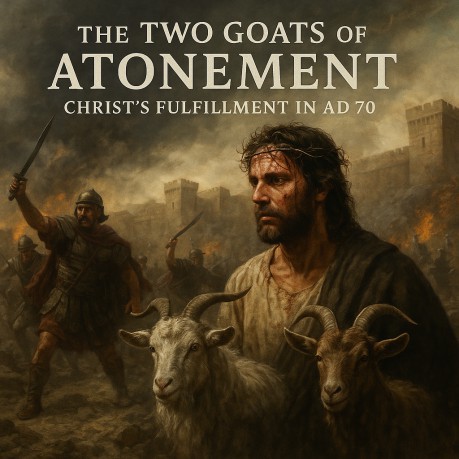
The Two Goats of Atonement:
Christ's Fulfillment in AD 70 Leviticus 16:7-10 Hebrews 9:11-12 Hebrews 9:26 Hebrews 10:1-4 † The Day of Atonement was the most sacred day
in the entire Levitical system. Two goats were chosen, one to be
slain for sin, and one to carry those sins away into the wilderness.
The first symbolized the death that was required, the second
symbolized the removal of guilt from among the people. Together, they
pointed to a single complete act of redemption. † The slain goat represented Christ as the
offering for sin, His blood presented before God in the true
tabernacle, not the earthly copy. The scapegoat, released into the
wilderness, represented the complete removal of sin from the covenant
community. † Under the old covenant, this ceremony had to
be repeated every year, proving that the sin problem hadn't been
permanently solved. The blood of animals could only cover, not
remove, the guilt. But Christ, appearing at the consummation of the
ages, did what the law could never do. † When the veil of the temple was torn at His
death, it showed that the way into the true Most Holy Place was now
open. Yet the full end of the old covenant system came forty years
later, in AD 70, when the earthly sanctuary was destroyed, and the
priesthood ceased forever. That was the final sign that the old
atonement system was gone, and Christ's work stood alone. † The two goats together form a perfect picture
of Christ's completed mission, one died, showing the price of sin,
the other lived, showing that sin was removed. Both were fulfilled in
Him. His death satisfied justice, and His resurrection and ascension
declared that the sin-bearing work was complete. † The scapegoat was led into the wilderness, a
place symbolizing separation. Likewise, the sins of the covenant
people were cast out, never to return. The destruction of Jerusalem
confirmed that the old sins tied to temple worship, law-keeping, and
continual sacrifice were forever removed. † Just as the high priest came out to bless the
people after sprinkling the blood, Christ appeared to His disciples
after offering Himself, declaring peace and forgiveness. This wasn't
symbolic only, it was covenantal reality. † The law and its sacrifices were only a
shadow. Christ was the substance. When the shadow passed away in AD
70, what remained was the eternal reality of the new covenant, no
more yearly atonement, no more reminder of sins, no more veil
separating man from God. † Israel's Day of Atonement was a prophecy
acted out for centuries until its fulfillment came in Christ. Its
final cancellation by the destruction of the temple was the physical
witness that heaven and earth, the old covenant world, had passed
away. How It Applies to Us Today † We no longer stand outside waiting for a
priest to take our sins away year after year. Christ has already
entered once for all. We live in the presence of a finished
atonement. † There's no need for another scapegoat,
another sacrifice, or another ritual. Every reminder of guilt has
been removed. Our worship today isn't a shadow, it's fellowship in
the reality of His accomplished redemption. † The world no longer needs an earthly temple,
for the true temple, the body of Christ, remains forever. We're the
living stones of that temple, reconciled to God and walking in the
freedom that the old system could never give. † The two goats of atonement were a foreshadow
of Christ's single perfect work. What was once symbolically carried
outside the camp was literally fulfilled when the old covenant was
cast away, and the new stood alone, pure and everlasting. † This is the fulfilled perspective we proclaim at
Fulfilled Prophecies † Source Index
By Dan Maines
He shall take the two
goats and present them before the Lord at the doorway of the tent of
meeting. Aaron shall cast lots for the two goats, one lot for the
Lord and the other lot for the scapegoat. Then Aaron shall offer the
goat on which the lot for the Lord fell and make it a sin offering.
But the goat on which the lot for the scapegoat fell shall be
presented alive before the Lord, to make atonement upon it, to send
it into the wilderness as the scapegoat.
But when Christ appeared as
a high priest of the good things to come, He entered through the
greater and more perfect tabernacle, not made with hands, that is to
say, not of this creation, and not through the blood of goats and
calves, but through His own blood, He entered the holy place once for
all, having obtained eternal redemption.
Otherwise, He would have needed
to suffer often since the foundation of the world, but now once at
the consummation of the ages He has been manifested to put away sin
by the sacrifice of Himself.
For the Law, since it has
only a shadow of the good things to come and not the very form of
things, can never, by the same sacrifices which they offer
continually year by year, make perfect those who draw near.
Otherwise, would they not have ceased to be offered, because the
worshipers, having once been cleansed, would no longer have had
consciousness of sins? But in those sacrifices there is a reminder of
sins year by year. For it is impossible for the blood of bulls and
goats to take away sins.
† Leviticus
16:7-10
† Hebrews 9:11-12, 26; 10:1-4
†
Josephus, Antiquities of the Jews, Book 3; Wars of the Jews, Book 6
†
Philo, On the Life of Moses, II.11
† Tacitus,
Histories, 5.13
Links