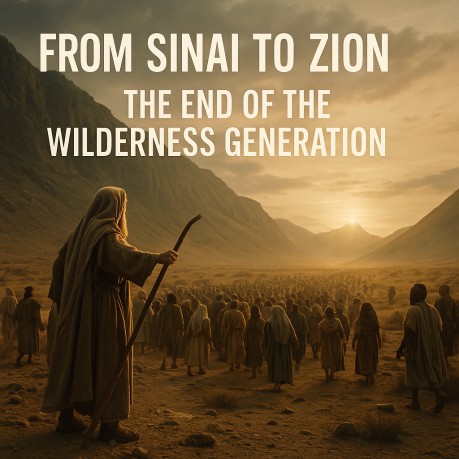
From Sinai to Zion: The End
of the Wilderness Generation Hebrews 3:7-11 † The writer of Hebrews reminds his readers
that the rebellion in the wilderness wasn't only historical, it was
typological. Israel's unbelief during Moses' generation foreshadowed
another wilderness generation that would again be tested. † Just as those who left Egypt never entered
the promised land, those who rejected Christ in the first century
were wandering in the same pattern of unbelief, about to perish
outside the promise. † The forty years from Pentecost to AD 70
formed the true wilderness period of the new covenant transition. The
old system was dying, and the promise of rest was being prepared for
those who endured to the end. Hebrews 3:12-14 † The warning to remain steadfast wasn't about
a lifetime of wavering faith, it was about surviving the transition
period. The end was near, and the true rest was about to be revealed. † Joshua couldn't give them rest because the
promise of rest pointed forward to Christ's completed redemption, not
to the land of Canaan. † Those who fell in the wilderness symbolized
those who turned back to the Law during the last days, refusing to
follow Christ into the new covenant rest. Hebrews 4:8-11 † The "Sabbath rest" wasn't a day of
the week but the eternal rest of the fulfilled kingdom. † Just as God rested when His work of creation
was finished, so believers entered rest when the work of redemption
was finished. † The destruction of Jerusalem marked the end
of labor under the old law and the full entrance into covenantal rest
in Christ. Numbers 14:33-34 † This forty-year judgment became a prophetic
shadow of the generation Jesus addressed in Matthew 23 and 24. He
declared that all these things would come upon "this
generation." † The first wilderness lasted forty years from
the Exodus to Canaan. The second wilderness lasted forty years from
the cross to AD 70. † Both ended with the death of the unbelieving
and the entrance of the faithful into the promised rest. The Forty-Year Proof from Pentecost to AD 70 † Jesus' death and resurrection occurred in AD
30, with Pentecost following about fifty days later, beginning the
New Covenant era (Acts 2). The destruction of Jerusalem came in AD
70, exactly forty years later, confirmed by Josephus (Wars 6.9.3). † Numbers 14 and Psalm 95 define a generation
as forty years. Hebrews 3-4 applies that pattern to the first-century
believers, proving their generation was the final wilderness. † Matthew 23:36 and 24:34 place the end within
that generation, matching the same forty-year span. † Hebrews 8:13 says the old covenant was "ready
to vanish away," written near the end of the period, and by AD
70 it did. † James 5:8, 1 Peter 4:7, and Revelation
repeatedly declare the end was "near," all written in the
60s AD as the period closed. † The number forty marks divine testing and
completion throughout Scripture, forty days of flood, forty years in
the wilderness, forty days on Sinai, forty days of temptation, and
finally forty years from Pentecost to AD 70. † The pattern is exact, both biblically and
historically, showing that the forty years from Pentecost to AD 70
was the true covenantal wilderness, ending in the destruction of the
Old Covenant system and the full revelation of the kingdom rest. Psalm 95:7-11 † The Psalmist looked forward to another
"Today." That Today came in the first century, when the
call to faith in Christ separated those who'd enter rest from those
who wouldn't. † The Holy Spirit applied this Psalm to that
very generation through the book of Hebrews, marking the end of the
old wilderness journey and the dawn of the kingdom rest. How it applies to us today † We're not wandering through transition, we
live in the land of promise. The kingdom has come, and the rest
remains eternal. † We no longer look for a future exodus, we're
dwelling in Zion, where the presence of God is with His people
forever. † The warning that once stood against unbelief
now stands as a testimony of victory, that the promise God made to
Abraham was fulfilled in Christ and realized in His kingdom. † Because the wilderness has ended, our walk of
faith is no longer one of waiting but of living. We live in God's
rest, where forgiveness, righteousness, and access to His presence
are already ours. † Every believer today stands in the reality
the apostles longed for. We don't march toward Zion, we live in it.
Our faith isn't a journey to rest, it's life within rest itself. † The true land of promise isn't found in a
physical territory but in the covenantal presence of God with His
redeemed people, now and forever. † This is the fulfilled perspective we proclaim at
Fulfilled Prophecies † Source Index Why This Cannot Be Refuted † The forty-year period from Pentecost to AD 70
is a matter of historical record. Pentecost began in AD 30 (Acts 2),
and Jerusalem fell in AD 70 (Josephus, Wars 6.9.3). This equals
exactly forty years, the same period God used to judge the first
wilderness generation. † Hebrews 3 and 4 apply Psalm 95 directly to
the first-century church, not to future generations. The writer says
"Today," linking the warning to those then living. This
shows that their forty-year span was the true covenantal wilderness. † Jesus Himself identified that generation as
the one that would see all the prophetic judgments fulfilled (Matthew
23:36; 24:34). His words were not symbolic or postponed. That
prophecy was completed within the same forty-year window. † Hebrews 8:13 confirms the Old Covenant was
already "becoming obsolete" and "ready to vanish
away." It had not yet disappeared when Hebrews was written,
proving the overlap period was still active and about to close. † The apostles repeatedly declared that the end
was "near" (James 5:8; 1 Peter 4:7; Revelation 1:1-3).
These are time statements, not general warnings. They show that the
end of the Old Covenant age was at hand, not two thousand years away. † The number forty is used consistently
throughout Scripture for periods of testing and transition, forty
days of flood, forty years of wandering, forty days on Sinai, forty
days of Jesus' temptation, and finally forty years from Pentecost to
AD 70. † Josephus and Eusebius both confirm that
Jerusalem's destruction ended the Old Covenant world. The believers
who fled to Pella survived because they obeyed Jesus' prophecy (Luke
21:20-21). † The sermon's conclusion that the kingdom rest
is present, not future, is based on Hebrews 4:9-11, where the writer
says the rest "remains" for the people of God, not "will
come." The saints entered that rest when the shadow system was
removed. † Every verse used in the sermon comes from the
New Testament's own interpretation of Old Testament prophecy. No
opinions or assumptions are inserted, only direct fulfillment through
the timeline God already set in place. † To deny this forty-year fulfillment is to
deny the pattern God established in Numbers 14:33-34 and repeated in
history. The type and antitype match perfectly, Moses to Christ,
wilderness to kingdom, unbelief to rest.
By Dan Maines
Therefore, just as the Holy
Spirit says, TODAY IF YOU HEAR HIS VOICE, DO NOT HARDEN YOUR HEARTS
AS WHEN THEY PROVOKED ME, AS IN THE DAY OF TRIAL IN THE WILDERNESS,
WHERE YOUR FATHERS TRIED ME BY TESTING ME, AND SAW MY WORKS FOR FORTY
YEARS; THEREFORE I WAS ANGRY WITH THIS GENERATION, AND SAID, THEY
ALWAYS GO ASTRAY IN THEIR HEART, AND THEY DID NOT KNOW MY WAYS; AS I
SWORE IN MY WRATH, THEY SHALL NOT ENTER MY REST.
Take care, brethren, that
there not be in any one of you an evil, unbelieving heart that falls
away from the living God. But encourage one another day after day, as
long as it's still called TODAY, so that none of you will be hardened
by the deceitfulness of sin. For we've become partakers of Christ, if
we hold fast the beginning of our assurance firm until the end.
For if Joshua had given them
rest, He wouldn't have spoken of another day after that. So there
remains a Sabbath rest for the people of God. For the one who's
entered His rest has himself also rested from his works, as God did
from His. Therefore let's be diligent to enter that rest, so that no
one will fall, through following the same example of disobedience.
Your sons shall be
shepherds for forty years in the wilderness, and they'll suffer for
your unfaithfulness, until your corpses lie in the wilderness.
According to the number of days which you spied out the land, forty
days, for every day you'll bear your guilt a year, even forty years.
For He is our God, and we're
the people of His pasture and the sheep of His hand. Today, if you'd
hear His voice, don't harden your hearts, as at Meribah, as in the
day of Massah in the wilderness. When your fathers tested Me, they
tried Me, though they'd seen My work. For forty years I loathed that
generation, and said they're a people who err in their heart, and
they don't know My ways. Therefore I swore in My anger, truly they'll
not enter into My rest.
† Hebrews
3-4, Numbers 14:33-34, Psalm 95:7-11, Matthew 23:36, Matthew 24:34,
Hebrews 8:13, James 5:8, 1 Peter 4:7, Revelation 1:1-3
†
Josephus, Wars of
the Jews 6.9
† Eusebius,
Ecclesiastical History 3.5
Links