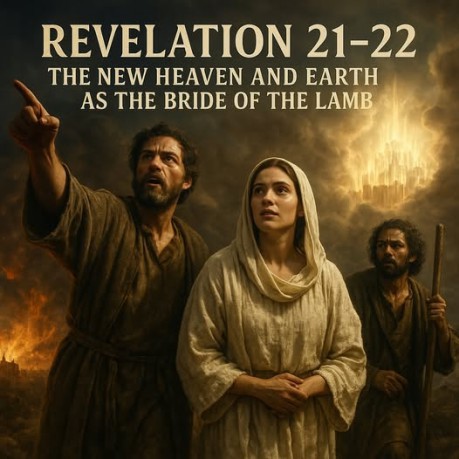
Revelation 21-22: The New
Heaven and Earth as the Bride of the Lamb Revelation 21:1-2 † J. Marcellus Kik once said, "Just a
little reflection will show that to take Revelation 21 and 22 in a
literal way is to make utter foolishness of that which John revealed.
In that figurative passage you cannot say that the 'new heaven and
new earth' is a material concept while the rest is to be taken in a
figurative way. The 'new heaven and new earth' is but the same as
'the holy city' and 'the Lamb's bride.'" † The "new heaven and new earth"
speaks of a new order, a new dwelling place of God with man, not a
physical world made over, but a new covenantal reality where
righteousness dwells (2 Peter 3:13). The old heaven and earth
represented the Old Covenant world of temple, priesthood, and
sacrifice that passed away in AD 70 when Jerusalem fell. That world
was shaken and removed so that what couldn't be shaken might remain
(Hebrews 12:26-28). † The "holy city" and "bride of
the Lamb" are one and the same. Revelation 21:9-10 confirms this
plainly: "Come here, I will show you the bride, the wife of the
Lamb. And he carried me away in the Spirit to a great and high
mountain, and showed me the holy city, Jerusalem, coming down out of
heaven from God." † The language of a "new heaven and earth"
mirrors Isaiah 65:17, which foretold a time when former troubles
would be forgotten, and joy and righteousness would fill the land.
Isaiah's prophecy wasn't about cosmological renewal, but about
covenant renewal, God's people restored in righteousness and peace
under the Messiah's reign. † When Revelation says there's "no more
sea," it's not describing an altered planet but symbolizing the
removal of separation. The sea in Hebrew thought represented chaos,
unrest, and the Gentile nations (Isaiah 57:20; Daniel 7:3). In the
New Covenant, those divisions are gone. There's now one body, one new
man in Christ (Ephesians 2:14-16). † The beauty of Kik's observation is that it
keeps us from fragmenting the vision. We can't claim that the "new
heaven and new earth" is literal while the "bride" is
spiritual. The passage rises and falls together in its symbolism.
It's a picture of redemption completed, God's dwelling now among His
people, the fullness of covenant communion restored. † Revelation 21-22 closes the story begun in
Genesis. Man was banished from the garden, from the tree of life, and
from God's presence. Through Christ, that fellowship is restored. The
"bride adorned for her husband" is humanity redeemed,
united with her Creator. The "river of life" and "tree
of life" represent the life and healing that flow from the
Spirit through the body of Christ, not physical elements in a future
world but spiritual realities in the fulfilled kingdom. † The tabernacle of God is now with men, not in
a temple made with hands but within His people (1 Corinthians 3:16; 2
Corinthians 6:16). That's the glory of the New Jerusalem, not golden
streets and jeweled walls, but a people purified, indwelt by God,
radiating His light to the nations. † Revelation 21 and 22 therefore describe the
triumph of redemption, not a planetary reconstruction. It's the
revelation of the bride, the covenant community of the redeemed,
living in the eternal presence of her Lord. How It Applies to Us Today † We now live in that new heaven and new earth
that John saw, not physically, but spiritually in the reality of
Christ's kingdom. God's dwelling is with us because His Spirit lives
in His people. We don't look for a rebuilt planet, we live in a
renewed covenant. † The old order of law, sacrifice, and temple
is gone. We no longer come to God through priests or buildings, but
directly through Christ. Every believer is now part of that holy
city, that radiant bride, through whom God's light shines to the
world. † This understanding gives us peace and
confidence. We're not waiting for God to come down again, He already
has made His home with us. We're not looking for a city built with
hands, we are that city, His living temple, reflecting His glory
through faith and obedience. † When we understand Revelation 21 and 22
through the fulfilled perspective, we see that the story of
redemption is complete, and we're now called to live in the reality
of that fulfilled promise, walking in righteousness, peace, and
communion with our Lord. † This is the fulfilled perspective we proclaim at
Fulfilled Prophecies † Source Index
By Dan Maines
Then I saw a new heaven
and a new earth, for the first heaven and the first earth passed
away, and there is no longer any sea. And I saw the holy city, new
Jerusalem, coming down out of heaven from God, made ready as a bride
adorned for her husband.
†
His statement gets directly to the heart of the fulfilled
perspective. If we take every detail of Revelation 21 and 22 as
literal geography and architecture, we'll end up contradicting the
very symbols that define the New Covenant order. John's vision wasn't
about the reconstruction of the planet, but about the transformation
of covenantal relationship.
This isn't two different entities, but
one, the church, the body of Christ, the New Jerusalem from above
(Galatians 4:26; Ephesians 2:19-22).
† Revelation
21:1-2, 9-10; Isaiah 65:17; Hebrews 12:26-28; 2 Peter 3:13; Ephesians
2:14-22; Galatians 4:26; Daniel 7:3; Isaiah 57:20; 1 Corinthians
3:16; 2 Corinthians 6:16.
† J. Marcellus Kik,
An Eschatology of Victory (Presbyterian and Reformed, 1971).
Links