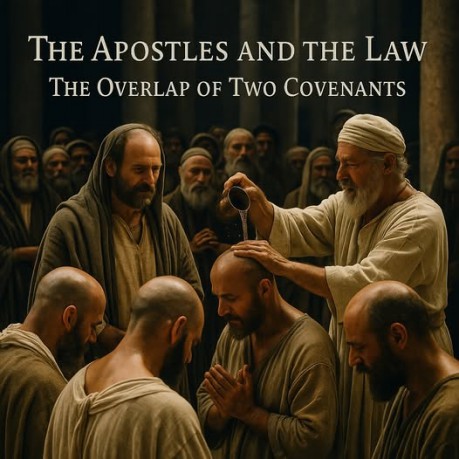
The Apostles and the Law, The
Overlap of Two Covenants Acts 21:20-26 † The early church stood in a time of
transition, when both the Old and New Covenants overlapped. Though
Christ had fulfilled the Law on the cross, the temple still stood,
and many Jewish believers continued in its customs. This period
reveals God's patience as He moved Israel from the shadow to the
substance, from ritual to reality. † Paul's actions in Acts 21 weren't a return to
the Law for justification, but an act of peace and unity among Jewish
believers who were slow to understand the change. He didn't
compromise the gospel; he demonstrated wisdom in bridging the gap
between covenants. 1 Corinthians 9:20 says, To the Jews I became as a
Jew, so that I might win Jews; to those who are under the Law, as
under the Law though not being myself under the Law, so that I might
win those who are under the Law. † This shows that Paul understood the Law's end
through Christ, yet out of love and prudence, he adapted to those
still under its influence. The temple was still active, priests still
offered sacrifices, and old traditions still functioned. But the
gospel had already declared these things obsolete (Hebrews 8:13). † The apostles lived during the overlap of two
worlds. On one side stood the physical temple, priesthood,
sacrifices, and feast days; on the other stood the new covenant
reality of faith, grace, and spiritual worship. They lived in a
unique generation when both covenants operated side by side until the
old physically vanished in AD 70. † The Jerusalem Council in Acts 15 confirmed
this transition. Jewish believers continued in their customs, but the
Gentiles weren't placed under the Law. Peter declared, Why do you put
God to the test by placing upon the neck of the disciples a yoke
which neither our fathers nor we have been able to bear? (Acts
15:10). The gospel made clear that salvation was through grace, not
through Moses. † James, Peter, and the elders recognized the
sensitivity of the time. Jewish Christians could still visit the
temple, offer vows, and observe customs, but none of it added to
their righteousness. It was part of a fading age, the old covenant
still standing, yet declared ready to vanish away. † Paul's vow in Acts 21:26 and his earlier vow
in Acts 18:18 were personal acts of devotion, not means of
justification. They reflected Jewish heritage and gratitude, but he
knew that righteousness was in Christ alone. Philippians 3:8-9 says,
I count all things to be loss in view of the surpassing value of
knowing Christ Jesus my Lord, and may be found in Him, not having a
righteousness of my own derived from the Law, but that which is
through faith in Christ. † Peter himself once struggled with this
balance. In Galatians 2:11-14, Paul rebuked him for withdrawing from
Gentiles out of fear of those of the circumcision. Even Peter, an
apostle, found it difficult to fully separate from the old order. Yet
through correction, he too stood firm in grace. † The existence of temple worship until AD 70
doesn't mean God still honored those sacrifices. Rather, it shows His
patience as Israel's old system came to a physical close. God allowed
that generation to see both the end and the fulfillment side by side,
until judgment fell on Jerusalem and the temple was destroyed. † The apostles kept the old law as well. Acts
21:20-26 shows Paul participating in a vow and purification, and
Peter and James continued in Torah observance among Jewish believers.
Acts 15 clearly distinguishes the obligations for Gentiles. This
supports the reality of the overlap between the two covenants. † Romans 14 reveals how believers were to
handle differences in observance. Some still kept days or dietary
rules, others didn't. Paul wrote, One person regards one day above
another, another regards every day alike. Each person must be fully
convinced in his own mind. He who observes the day, observes it for
the Lord. The goal was not division but peace, knowing that Christ
had fulfilled it all. † Hebrews 9:8-9 confirms this overlap: The Holy
Spirit is signifying this, that the way into the holy place hasn't
yet been disclosed while the outer tabernacle is still standing,
which is a symbol for the present time. The writer saw that the
temple's continued existence represented a system that was about to
disappear. † When the temple fell in AD 70, the shadow
finally gave way to the substance. The Law's rituals could no longer
continue, and the gospel stood alone as the everlasting covenant.
What the apostles witnessed wasn't contradiction but completion, the
passing of one age and the full revealing of the new. † This history explains why we find Paul in the
temple and Peter among observant Jews even after the resurrection.
They were walking through the closing moments of an era, leading
others out of the old into the new. They honored God's patience, His
unfolding plan, and His faithfulness to fulfill all things in Christ. † Today, we look back at that overlap and see
the wisdom of God. He didn't destroy the old covenant abruptly, but
let it fade as the light of Christ grew brighter. The apostles'
temporary observance of certain customs wasn't a denial of grace, but
a testimony of unity and patience during the great transition of the
ages. † In Christ, the Law has found its fulfillment.
Romans 10:4 says, Christ is the end of the Law for righteousness to
everyone who believes. The apostles lived in the time between the
promise and its completion, showing that God's plan moved from shadow
to reality exactly as He ordained. How It Applies to Us Today † The example of the apostles teaches us that
God works through transition with patience and mercy. He didn't
demand instant understanding from His people but guided them step by
step from the shadows of the Law into the light of Christ's
fulfillment. In the same way, we should show patience toward those
still learning the truth of the fulfilled covenant. † Just as the apostles lived faithfully during
a time of change, we also live in a world where many still hold to
the old ways of religious systems, rituals, and fear-based obedience.
Our calling isn't to condemn but to teach, showing that Christ's work
has already completed redemption. We walk in the reality of His
kingdom, not in the shadows of tradition. † Romans 6:14 reminds us, For sin shall not be
master over you, for you're not under law but under grace. The Law
pointed to Christ, but now we live in the fulfillment of His grace.
The temple, sacrifices, and ceremonies are gone, yet the heart of
worship remains. We now serve God in spirit and truth, through a
living relationship with Christ. † Galatians 5:1 says, It was for freedom that
Christ set us free; therefore keep standing firm and don't be subject
again to a yoke of slavery. We're not bound by the rituals or burdens
of the old covenant, but walk freely in the righteousness He's
already provided. † The apostles' temporary observance of the Law
reminds us to stay grounded in love and understanding. While the old
has vanished, many still cling to it out of habit or tradition. Our
task is to help others see the finished work of Christ, not by force
but by truth and grace, leading them into the joy of complete
redemption. † Today, our worship isn't in temples made with
hands, but in hearts made new. We honor God, not through old rituals,
but through faith, thanksgiving, and love. Every act of grace and
unity among believers is the fruit of living under the fulfilled
covenant. † This is the fulfilled perspective we proclaim at
Fulfilled Prophecies † Source Index
By Dan Maines
And when they heard it they
began glorifying God; and they said to him, You see, brother, how
many thousands there are among the Jews of those who have believed,
and they are all zealous for the Law; and they have been told about
you, that you are teaching all the Jews who are among the Gentiles to
forsake Moses, telling them not to circumcise their children nor to
walk according to the customs. What, then, is to be done? They will
certainly hear that you have come. Therefore do this that we tell
you. We have four men who are under a vow; take them and purify
yourself along with them, and pay their expenses so that they may
shave their heads; and all will know that there is nothing to the
things which they have been told about you, but that you yourself
also walk orderly, keeping the Law. But concerning the Gentiles who
have believed, we wrote, having decided that they should abstain from
meat sacrificed to idols and from blood and from what is strangled
and from fornication. Then Paul took the men, and the next day,
purifying himself along with them, went into the temple giving notice
of the completion of the days of purification until the sacrifice was
offered for each one of them.
† Acts 21:20-26, Acts 18:18,
Acts 15:10, 1 Corinthians 9:20, Romans 10:4, Romans 14:5-6, Galatians
2:11-14, Philippians 3:8-9, Hebrews 8:13, Hebrews 9:8-9, Romans 6:14,
Galatians 5:1
Links