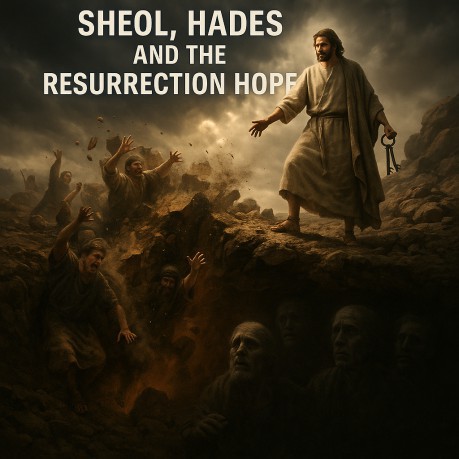
Sheol, Hades, and the
Resurrection Hope Numbers 16:33 † Korah and his followers went down alive into
Sheol, showing that Sheol is not merely a pile of dirt but a realm
that receives both body and soul. Job 26:5-6 † Job confirms that Sheol is not mere dirt. He
describes trembling spirits, not unconscious nothingness. Psalm 16:10 † David distinguishes between the soul in Sheol
and the body undergoing decay. Luke 16:19-31 † Jesus Himself gives us the clearest picture
of Sheol or Hades in this parable of the rich man and Lazarus. Ecclesiastes 9:4-5, 10 † Solomon is speaking from the perspective of
life under the sun. He is describing what man sees outwardly. Revelation 20:14 † Death and Hades are destroyed, not because
they were illusions or mere dirt, but because they were real powers
holding mankind. Revelation 1:18 † Jesus holds the keys, meaning He rules over
both death and Hades. How This Applies To Us Today † The false teaching of annihilation robs the
gospel of its power. If there were no conscious existence after death
(in the OT), Jesus' words about Hades would be meaningless. † This is the fulfilled perspective we proclaim at
Fulfilled Prophecies † Source Index
By Dan Maines
They went down alive into
Sheol, with everything that belonged to them; and the earth closed
over them, and they perished from the midst of the assembly.
† If Sheol
were only the grave, the text would simply say they died and were
buried. Instead, it emphasizes that they went down alive, and only
afterward did the earth close over them.
†
This matches the consistent biblical picture of Sheol as the place of
the departed, not annihilation.
† Josephus,
Antiquities 4.3.3, describes this same event and says that the rebels
were swallowed alive into the earth, emphasizing the divine judgment
and the sudden descent, which early Jews understood as going into the
underworld, not mere burial.
† Rabbinic
commentary, Midrash Rabbah Numbers 18:20, says the earth's mouth was
created at the beginning of creation for this very judgment, and that
Korah and his company still cry out from beneath the earth. This
directly opposes the annihilation view.
The departed spirits tremble
under the waters and their inhabitants. Sheol is naked before Him,
and Abaddon has no covering.
†
Sheol is naked before God. It is a place under His sovereign sight,
not a void where existence ceases.
† If Sheol
were only a grave, spirits would not be trembling, nor would it
require God's oversight.
† The Dead Sea
Scrolls, 4Q491 Songs of the Sage, also describe the realm of spirits
trembling before God's presence, which reflects this same ancient
understanding of Sheol as a conscious realm.
†
The Talmud, Berakhot 28b, speaks of Sheol as a place where both the
righteous and the wicked are brought, but with different outcomes.
The wicked suffer, while the righteous are comforted. This parallels
Jesus' teaching in Luke 16.
For You will not abandon my soul
to Sheol; You will not allow Your Holy One to undergo decay.
† Sheol is
where the soul goes, the grave is where the body decays. The psalm
ties both together but does not confuse them.
†
This verse finds its fulfillment in Christ's resurrection. His body
did not decay, and His soul was not abandoned to Hades.
†
Peter quotes this passage in Acts 2:27-31, applying it directly to
Jesus, showing that the early church believed Sheol or Hades was the
realm of souls, not a simple grave.
† The
Mishnah, Avot 4:17, says, Better is one hour of repentance and good
deeds in this world than all the life of the world to come, and
better is one hour of the bliss of the world to come than all the
life of this world. This shows Jewish teachers expected conscious joy
beyond death, not annihilation.
Now there was a rich man, and
he habitually dressed in purple and fine linen, joyously living in
splendor every day...
†
The rich man, in Hades, is conscious, aware, and in torment. He
speaks, remembers, and feels.
† He sees
Abraham, recognizes Lazarus, and pleads for mercy. This is not
annihilation, but conscious existence after death.
†
The division between comfort, Abraham's bosom, and torment in Hades
shows there was no single fate of unconsciousness for all.
†
1 Enoch 22 also describes Sheol as divided into compartments, where
the righteous and wicked wait separately, which matches Jesus'
teaching and shows His parable was consistent with the Jewish
worldview of the time.
† Rabbinic tradition
in the Talmud, Shabbat 152b, says, The body returns to the dust, but
the soul returns to God, and is judged. This agrees with the biblical
teaching that the soul continues beyond death in awareness.
†
Justin Martyr, Dialogue with Trypho 5, insists that souls remain in
awareness after death, awaiting the final resurrection. He directly
rejects the idea that they cease to exist.
†
Origen, On First Principles 2.10, argues that Hades is a place of
conscious waiting, where souls are kept until judgment. He says it is
unreasonable to think God would create man with a soul only for it to
vanish into non existence.
For whoever is joined
with all the living, there is hope; surely a live dog is better than
a dead lion. For the living know that they will die, but the dead do
not know anything. Whatever your hand finds to do, do it with all
your might, for there is no activity, planning, knowledge, or wisdom
in Sheol where you are going.
†
The dead cannot act in this world, cannot plan, labor, or exercise
wisdom here. That does not mean they cease to exist, only that their
place in this realm is ended.
† To conclude
from this passage that there is no afterlife is to misread the
literary purpose of Ecclesiastes, which shows the futility of
striving apart from God.
† Other scriptures
reveal the conscious existence of the dead, proving Ecclesiastes is
speaking of earthly perspective, not ultimate reality.
†
Wisdom of Solomon 3:1 says, The souls of the righteous are in the
hand of God, and no torment will ever touch them. This Jewish text
shows that even before Christ, many Jews believed in conscious
existence after death.
† Rabbinic commentary
in the Midrash, Genesis Rabbah 100:7, speaks of Jacob not being truly
dead but alive in the world to come, showing that Jewish thought
always maintained consciousness after death.
†
Tertullian, On the Soul 55, writes that Hades is a temporary
receptacle of souls until the resurrection, where both the righteous
and wicked remain in awareness. He argues that to deny this is to
deny Christ's own teaching in Luke 16.
†
Augustine, City of God 13.2, teaches that death separates body and
soul but does not annihilate either. He says the souls of the dead
retain consciousness in Hades until the resurrection.
Then death and Hades were
thrown into the lake of fire. This is the second death, the lake of
fire.
† If Sheol were only the
grave, how does dirt get thrown into fire. This is symbolic of the
destruction of the realm of the dead itself.
†
In Christ's finished work, the dead are judged, and death's dominion
is broken. This is why Paul can write in 2 Timothy 1:10 that Christ
abolished death and brought life and immortality to light through the
gospel.
† With Hades abolished, no longer
does man wait in that realm. Instead, after death comes immediate
judgment and destiny.
† Early church writers
like Clement of Rome and Irenaeus also recognized that the
destruction of death and Hades meant the completion of Christ's
victory over the power of death, not mere soil in the ground.
†
Tacitus, though a pagan, noted in Annals 6.22 that Romans feared the
judgment of the dead and honored spirits with rites, showing that
even the unbelieving world believed death led to continued conscious
existence.
† The Greek world itself, from
Homer's Odyssey to Plato's writings, always understood Hades as the
realm of the departed souls. Homer describes Odysseus encountering
shades of the dead in Hades, all conscious and speaking. Plato in the
Phaedo and Gorgias teaches of judgment after death in Hades. This
shows that when the Septuagint translated Sheol as Hades, they were
intentionally drawing on the Greek concept of an underworld of souls,
not a pile of dirt.
† Hippolytus, Against
Plato, On the Cause of the Universe 1, describes Hades in detail as a
place of awareness, where both the righteous and the wicked await
judgment. He explicitly rejects the view that death is annihilation.
I was dead, and behold, I am
alive forevermore, and I have the keys of death and of Hades.
† This shows Hades is
more than just the dirt in the ground. One does not need keys to
unlock dirt.
† Christ's victory over death
and Hades is central to the gospel. What once held mankind in fear
has been conquered in Him.
† Eusebius in
Ecclesiastical History records the early church boldly proclaiming
that Christ's resurrection proved He had authority over death and
Hades, reinforcing this truth.
†
Sheol and Hades remind us that death was once an enemy holding
mankind in waiting, but Christ defeated that enemy.
†
For the believer, death is no longer a fearful unknown. There is no
annihilation, but a conscious presence with Christ. Paul assures us
in Philippians 1:23 that to depart and be with Christ is very much
better.
† For the unbeliever, the warning
remains that death without Christ leads to judgment. But in Christ,
death and Hades are powerless to hold us.
†
The witness of Scripture, the Jewish writings, rabbinic tradition,
the Roman historians, the Greek philosophers, and the early Christian
apologists all agree. Sheol and Hades were real, conscious realms of
the dead, but Christ has conquered them, bringing us assurance and
hope.
† Josephus - Antiquities,
Jewish War
† Tacitus - Annals
† Philo - On the Soul,
Questions on Genesis
† Eusebius - Ecclesiastical History
†
Clement of Rome - Letter to the Corinthians
† Irenaeus -
Against Heresies
† Justin Martyr - Dialogue with Trypho
†
Tertullian - On the Soul
† Hippolytus - Against Plato, On the
Cause of the Universe
† Origen - On First Principles
†
Augustine - City of God
† Dead Sea Scrolls - 4Q491 Songs of
the Sage
† 1 Enoch 22
† Wisdom of Solomon 3
†
Homer - Odyssey
† Plato - Phaedo, Gorgias
† Septuagint
- translation of Sheol as Hades
† Mishnah - Avot
†
Talmud - Berakhot, Shabbat
† Midrash Rabbah - Numbers,
Genesis
† Scripture: Numbers 16, Job 26, Psalm 16, Luke 16,
Ecclesiastes 9, Revelation 20, Revelation 1, 2 Timothy 1, Philippians
1, Acts 2
Links