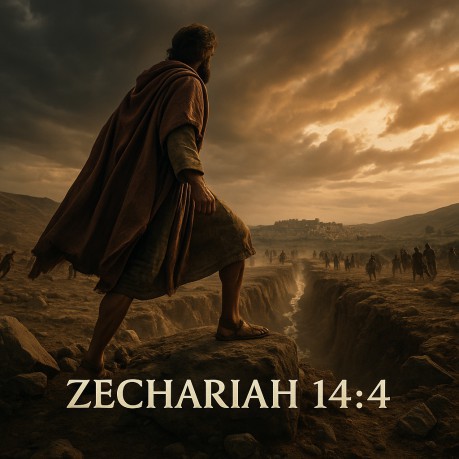
Zechariah 14:4 Zechariah 14:4 † Symbolic language shows God's presence and
the dramatic upheaval of covenantal change. Jesus often taught on the
Mount of Olives and foretold this very destruction in Matthew 24. † Jewish tradition links the Mount of Olives to
the coming of the Lord (Mishnah, Sukkah 5:4), a belief fulfilled
spiritually in AD 70. † Geological studies show an ancient fault line
beneath the Mount, interesting though not required for symbolic
meaning. † The valley imagery points to God providing a
way of deliverance for His faithful. † The prophets often used dramatic imagery to
describe the shaking of old orders and the establishment of new ones.
This verse isn't a prophecy of a literal mountain cracking in half,
but symbolic of the monumental covenantal shift that was about to
take place. God was showing Israel that His presence would once again
stand on the Mount of Olives, the very place where Jesus wept over
Jerusalem (Luke 19:41), taught of its fall (Matthew 24:3), and
ascended into heaven (Acts 1:9-12). † To say that His feet will stand on the Mount
of Olives is to say that God Himself will bring judgment and
vindication through the Messiah. This was fulfilled when Christ
brought covenantal judgment upon Jerusalem in AD 70, exactly as He
foretold. His Olivet Discourse is a direct prophetic commentary on
Zechariah 14, spoken from the very same mountain. † The splitting of the Mount into a vast valley
is a picture of dramatic deliverance and escape. In ancient times,
valleys were places of refuge and protection in times of war.
Zechariah is showing that God would provide a way out for His
faithful remnant while judgment fell upon the city. Jesus confirmed
this when He told His disciples to flee to the mountains when they
saw Jerusalem surrounded (Luke 21:20-21). † Jewish tradition, as recorded in the Mishnah
(Sukkah 5:4), associates the Mount of Olives with the coming of the
Lord. The Jews expected the Lord to appear there in judgment. That
expectation was fulfilled, not in a visible bodily return, but in
covenantal judgment when Jerusalem fell. Christ, as the Lord, stood
in authority, and His prophetic words given on that mountain came to
pass within that generation (Matthew 24:34). † The language of mountains splitting and earth
quaking is used frequently in Scripture to describe divine
intervention. Micah 1:3-4 says, For behold, the Lord is coming forth
from His place. He will come down and tread on the high places of the
earth. The mountains will melt under Him, and the valleys will be
split, like wax before the fire. No one reads Micah as literal
geography, but as a picture of God's presence shaking nations and
bringing judgment. Zechariah is using the same prophetic style. † The Mount of Olives stood east of Jerusalem,
the direction of God's glory in Ezekiel's vision. Ezekiel 11:23 says,
The glory of the Lord went up from the midst of the city and stood
over the mountain which is east of the city. That mountain was the
Mount of Olives. In Zechariah 14, God returns in glory to bring
judgment and renewal. Christ fulfilled this when He returned in glory
through judgment in AD 70, restoring His presence with His people in
the New Covenant. † Some point to geological fault lines under
the Mount of Olives as proof of literal fulfillment. While this is
interesting, it misses the prophetic point. God's word isn't
dependent on natural science to be true. The imagery of the mountain
splitting is covenantal, not seismic. The mountain represents
Jerusalem's religious system being broken apart. The valley
represents God making a way of escape for the faithful. † The valley also represents access and
openness. The Old Covenant system was a mountain barrier, keeping
Gentiles outside the covenant. In Christ, the mountain is split, and
a new way is opened for all nations to come into the kingdom. This
aligns with Hebrews 12:22, But you've come to Mount Zion and to the
city of the living God, the heavenly Jerusalem. The new valley isn't
a place of destruction, but a pathway into God's presence. † This passage can't be applied to a future
physical return of Christ without ignoring the context of the
prophets, the words of Jesus, and the historical fulfillment of AD
70. Futurism reads wooden literalism into the text, but the prophets
themselves teach us how to interpret such imagery. Every time
mountains shake, split, or melt in Scripture, it symbolizes divine
judgment and covenantal transition. † Therefore, Zechariah 14:4 isn't about geology
or a future cataclysm. It's about the dramatic covenantal change that
came when Christ stood in judgment over Jerusalem, splitting the Old
Covenant mountain, and opening a valley of deliverance for His
faithful people. That valley is the New Covenant, wide and
accessible, where both Jew and Gentile can enter freely. † Much prophecy is fulfilled in both symbolic
and physical ways. Apocalyptic language is by nature poetic and
hyperbolic, yet that doesn't mean it's empty of physical connection.
Zechariah 14:4 is a prime example, where the imagery carries
covenantal significance, and the physical landscape itself testifies
to its fulfillment. † Symbolically, the Mount of Olives represents
the meeting place between God and His people. It's where Jesus gave
the Olivet Discourse foretelling Jerusalem's destruction (Matthew
24), where He wept over the city (Luke 19:41), and where He ascended
(Acts 1:9-12). To say His feet would stand there is to declare that
the Lord Himself would preside over judgment. The splitting of the
mountain signifies the breaking apart of the Old Covenant order and
the opening of a way of deliverance. † Physically, history confirms the Mount of
Olives was cut through the middle by a Roman road dating back to the
first century. This road, running north to south, creates the
appearance of a valley between two ridges of the mountain. Thus, the
prophecy speaks with accuracy, both symbolically of covenantal
upheaval and literally of the mountain being divided. † Eusebius, the early church historian, records
that the believers in Jerusalem were warned by revelation to flee
before the war began, relocating to Pella east of the Jordan. He
writes, the members of the Jerusalem church, by means of an oracle
given by revelation to acceptable persons there, were ordered to
leave the city before the war began and settle in a town in Peraea
called Pella. This valley imagery in Zechariah points directly to
that flight, God making a way of escape for His faithful. † The route to Pella confirms this fulfillment.
The natural way eastward required crossing over the Mount of Olives
and descending toward the Jordan River. This path provided not only
an accurate guide but also a source of water for travelers. The
Jordan then led northward toward Pella. It's no coincidence that
Zechariah's vision describes a valley opening from east to west,
providing deliverance. The Christians who obeyed Christ's warning in
Matthew 24:16-21 would have walked this very route, crossing the
Mount of Olives and finding refuge as promised. † Josephus describes the horrors that befell
those who stayed in Jerusalem, contrasting sharply with the
deliverance of the faithful who fled. In Wars of the Jews 6.3.4 he
records, Now the number of those that were carried captive during
this whole war was collected to be ninety-seven thousand, as was the
number of those that perished during the whole siege, eleven hundred
thousand. As for the seditious, they were all slain, and the
multitude that was with them was also destroyed. † Tacitus, the Roman historian, likewise
testifies of the city's ruin in Histories 5.13, writing, The temple
was filled with the bodies of the slain, and the steps of the altar
flowed with streams of blood. The flames surrounding the sanctuary
made the hill one sheet of fire, and the blood was greater in
quantity than the flames. † The valley of escape was open for those who
listened to Christ, while the city itself became a furnace of
judgment. Zechariah foresaw both, the mountain splitting to provide a
way, and the city collapsing under wrath. How it applies to us today † God's word is never empty. What He speaks
comes to pass both in the grand movements of history and in the
details of geography. The prophecy of Zechariah shows us the unity of
symbolic vision and physical reality. † Finally, we learn to trust the promises of
our Lord. Just as He provided deliverance for the remnant of
Jerusalem, He's provided deliverance for us in His kingdom. We aren't
left on a shaking mountain of uncertainty, but set in the open valley
of His covenant, where His presence is sure. Application contrast † This is the fulfilled perspective we proclaim at
Fulfilled Prophecies † Source Index
By Dan Maines
On that day His feet will
stand on the Mount of Olives, which is in front of Jerusalem on the
east, and the Mount of Olives will be split in its middle from east
to west, forming a very large valley, so that half of the mountain
will move toward the north and the other half toward the south.
†
God always provides an escape for His people. In the first century,
He provided a literal path through the Mount of Olives and east to
Pella. Today, He's given us an eternal refuge in Christ, a New
Covenant valley of safety where His people dwell secure.
†
Those who heeded Christ's words and fled to Pella became the true
heirs of the promises, carried safely into the New Covenant order.
Those who rejected His warnings remained in the city and perished in
judgment. The split in the Mount of Olives was not only a symbol of
covenant transition, it was the dividing line between life and death,
between covenant faithfulness and covenant wrath. The faithful
remnant walked into deliverance, while the unbelieving multitude met
destruction. This is the covenantal meaning of Zechariah 14:4
fulfilled in history.
† Zechariah
14:4; Matthew 24:3-34; Luke 19:41; Luke 21:20-21; Acts 1:9-12; Micah
1:3-4; Ezekiel 11:23; Hebrews 12:22
†
Josephus, Wars of the Jews 6.3.4, 6.5
†
Tacitus, Histories 5.13
† Eusebius,
Ecclesiastical History 3.5
† Mishnah, Sukkah
5:4
Links