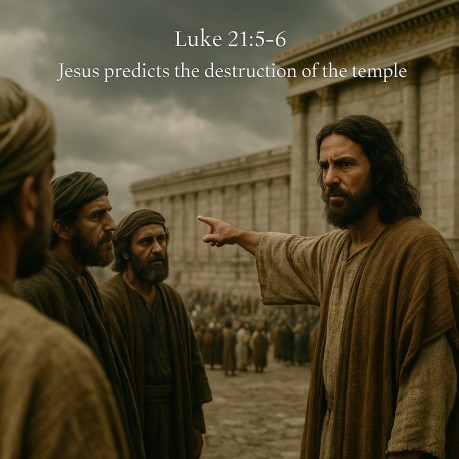
Luke 21:5-6 - Jesus predicts
the destruction of the temple We've had a lot of new members join lately, so this post
is for you. If the fulfilled perspective is new to you, get ready to
learn and enjoy. For those already familiar with fulfillment, you'll
notice I'm starting with Luke instead of Matthew this time, and I'll
explain why as we go. Luke 21:5-6 † The disciples marveled at the glory of the
temple, yet Christ revealed that even the most sacred and magnificent
structure of their covenant would soon be destroyed. † In all three synoptic gospels (Matthew
24:1-2, Mark 13:1-2, Luke 21:5-6) Christ tells His disciples that the
temple would be destroyed. This consistency shows the weight of the
prophecy. Matthew 24:3 - Tell us, when will these things happen, and what
will be the sign of Your coming, and of the end of the age? † Matthew's account connects the destruction of
the temple with the coming of Christ and the end of the age. That age
was the Old Covenant age. Hebrews 8:13 confirms this, saying the
covenant was becoming obsolete and ready to disappear. † Mark and Luke, however, wrote more for
Gentile audiences. Since Gentiles weren't bound to Israel's covenant
system, they recorded the prophecy of destruction without emphasis on
the end of the Jewish age. † We can prove this from scripture. Matthew was
clearly writing to Jews. He begins his gospel with the genealogy of
Jesus traced through Abraham and David (Matthew 1:1-17), showing
Christ as the heir to Israel's promises. Matthew uses Jewish
expressions like "kingdom of heaven" rather than "kingdom
of God," and he constantly quotes Old Testament prophecy to show
fulfillment (Matthew 2:5-6, 2:15, 2:17, 2:23). † Luke, on the other hand, was writing to
Gentiles. His gospel begins with a direct address to Theophilus, a
Greek name, to assure him of the certainty of what he was taught
(Luke 1:1-4). Luke traces Jesus' genealogy all the way back to Adam
(Luke 3:23-38), presenting Him as the Savior of all mankind, not just
Israel. Luke also emphasizes the inclusion of outsiders, Samaritans,
and Gentiles (Luke 2:32, Luke 4:25-27, Luke 7:9, Luke 10:33, Luke
17:16). His focus was to show the good news spreading beyond Israel
to the nations. † This is why Matthew stresses the destruction
of the temple as the "end of the age," the Old Covenant
age, while Luke simply records the prophecy without using that
language. Luke was concerned with showing Gentiles that judgment on
Jerusalem was part of God's plan, while Matthew was showing Jews that
this destruction was the fulfillment of their own covenant
scriptures. † That is why I chose to begin this study with
Luke. It introduces the prophecy in a straightforward way for those
new to fulfillment, while Matthew adds the heavier covenant context.
Starting with Luke lets new members ease into the teaching, while
those familiar with fulfillment can see how the gospels together give
a full picture. 70 AD, the temple destroyed † Christ spoke these words to His generation,
and they came true exactly as He said. If His prophecy about the
temple was fulfilled, why would the following events He described be
any different? The significance of the temple † The fall of the temple wasn't just the fall
of a building. It was the end of the covenant order. When the temple
fell, the age of the Law gave way to the New Covenant of Christ. False messiahs and signs † Christ warned His disciples not to be
deceived by false messiahs or false timing. Many impostors rose in
the first century (Acts 5:36, Acts 8:9-10, Acts 21:38, 1 John 2:18). † Josephus records that the land was filled
with magicians and impostors who led people astray with false
promises of miracles. † Yet Christ told His disciples that when they
saw these events truly begin, then they could know their redemption
was near (Luke 21:28). Near to them, not to us 2,000 years later. Wars, famines, earthquakes † The book of Acts records famine (Acts
11:28). † These weren't global end-of-world events, but
local and regional judgments fulfilling Christ's words to that
generation. Persecution † The book of Acts testifies of the apostles
being arrested, imprisoned, and beaten (Acts 4:3, Acts 16:23-24, Acts
9:23-24). † Most apostles were martyred, and others, like
John, were exiled. This persecution wasn't for a future church
thousands of years later, but for His disciples living in that
generation. The days of vengeance † The Roman armies surrounded Jerusalem in 66
AD and finally destroyed it in 70 AD. Christ's words came to pass
with exact accuracy. † These were the days of vengeance, fulfilling
all that was written in the prophets about the covenant curses
(Deuteronomy 28, Isaiah 65-66, Daniel 12:7). † Josephus himself admitted that no greater
calamity had ever happened, saying the destruction of Jerusalem was
"the greatest of all calamities since the beginning of the
world" (Wars 6.9.4). That matches Christ's words in Matthew
24:21. The coming of the Son of Man † Christ's coming in judgment was covenantal,
not physical descent. He came on the clouds just as God came in
judgment on nations in the Old Testament (Isaiah 19:1, Psalm
18:7-12). † The disciples were told to look up because
their redemption was near. Not distant, but near in their lifetime. Application for us today † The destruction of the temple wasn't the end
of the world, but the end of the Jewish age. The New Covenant stands
forever, and our access to God isn't through temples made with hands,
but through Christ Himself (Hebrews 9:11-12). † This fulfilled prophecy strengthens our
faith, for if He kept His word then, He keeps His word now. † This is the fulfilled perspective we proclaim at
Fulfilled Prophecies † Source index
By Dan Maines
5 And while some were talking about the temple,
that it was decorated with beautiful stones and votive gifts, He
said,
6 As for these things which you are observing, the days
will come when there will not be left one stone upon another, which
will not be torn down.
Mark
13:4 - Tell us, when will these things be, and what will be the sign
when all these things are going to be fulfilled?
Luke 21:7 -
Teacher, when therefore will these things happen? And what will be
the sign when these things are about to take place?
†
In 70 AD the temple was destroyed by the Romans. This is a historical
fact recorded by Josephus and Tacitus. Nobody can deny this.
†
To Israel, the temple was the center of covenant life. It was where
priests interceded, sacrifices were made, and God's presence was
sought.
Luke 21:8 - See to
it that you are not misled, for many will come in My name, saying, 'I
am He,' and, 'The time is near.' Do not go after them.
Luke 21:10-11 -
Nation will rise against nation, and kingdom against kingdom, and
there will be great earthquakes in various places, plagues, and
famines.
† Josephus and Tacitus recorded
widespread famine and earthquakes during the reign of Claudius and
Nero. Seneca wrote of cities swallowed by earthquakes across Asia,
Achaea, Syria, and Judea. Revelation 6:12 also records a great
earthquake before 70 AD.
Luke 21:12-13 - But before all
these things, they will lay their hands on you and persecute you…
Luke 21:20-22 - When
you see Jerusalem surrounded by armies, then recognize that her
desolation is near. For these are days of vengeance, so that all
things which are written will be fulfilled.
Luke 21:27-28 -
Then they will see the Son of Man coming in a cloud with power and
great glory. But when these things begin to take place, straighten up
and lift up your heads, because your redemption is drawing near.
†
Christ's words prove His faithfulness. He spoke judgment upon the old
covenant order, and it happened exactly as He said.
† Luke
21:5-28, Matthew 24:1-3, Mark 13:1-4, Acts 4:3, 9:23-24, 11:28,
16:23-24, 21:38, 1 John 2:18, Deuteronomy 28, Isaiah 19:1, 65-66,
Daniel 12:7, Hebrews 8:13, Revelation 6:12
†
Matthew 1:1-17, Matthew 2:5-6, 2:15, 2:17, 2:23
†
Luke 1:1-4, Luke 2:32, Luke 3:23-38, Luke 4:25-27, Luke 7:9, Luke
10:33, Luke 17:16
† Josephus, Wars of the
Jews, Books V-VI, 6.9.4
† Tacitus, Annals,
Book 12
† Seneca, Natural Questions, Book VI
Links