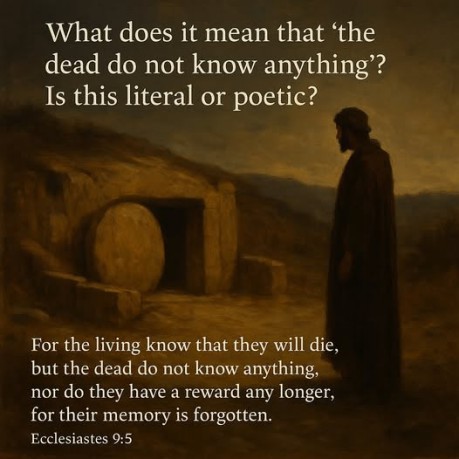
What does it mean that "the dead
do not know anything"(Ecclesiastes 9:5)? Is this literal or
poetic ? The phrase "the dead do not know
anything" in Ecclesiastes 9:5 is best understood poetically, not
literally. Here's why: 1. Context of Ecclesiastes: The book often speaks from an “under
the sun” perspective, that is, from the human point of view, apart
from divine revelation. Ecclesiastes wrestles with life’s apparent
meaninglessness when viewed strictly from an earthly standpoint. In that view, the dead no longer
participate in the world of the living. They don't know or experience
the things of this life anymore, no love, no hatred, no toil, no
reward under the sun (verse 6). 2. Figurative Expression of Finality: Solomon is not denying the afterlife.
He’s saying that in this world, the dead are cut off. They are no
longer conscious or aware here. Their lives have ended, their earthly
influence fades, and their memory eventually disappears (Ecclesiastes
1:11, 9:6). 3. Not a Denial of the Soul’s
Existence: If taken literally, this verse would
contradict other scriptures that describe awareness after death: Luke 16:22-23 – The rich man and
Lazarus are both aware in the afterlife. Revelation 6:9-10 – Souls under the
altar cry out for justice. Philippians 1:23 – Paul desired to
depart and be with Christ. 2 Corinthians 5:8 – To be absent from
the body is to be present with the Lord. Conclusion: The verse is poetic and reflects the
human experience of death, a picture of silence, stillness, and
disconnection from the world. It doesn’t teach soul annihilation or
unconsciousness after death. It simply shows that once someone dies,
their earthly journey is over. From this earthly perspective, "they
do not know anything."
By Dan Maines
Links