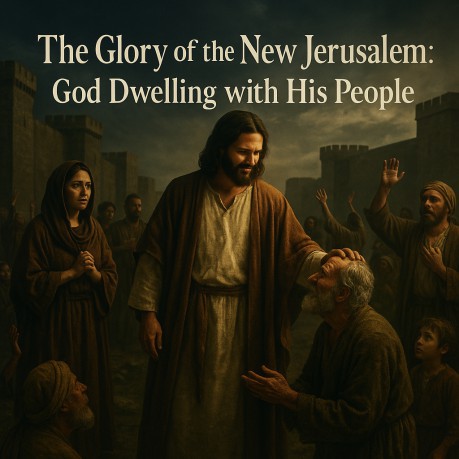
The Glory of the New
Jerusalem: God Dwelling with His People Revelation 21:1-4; Isaiah 65:17-19; John 14:23; Ephesians 2:19-22 † The greatest moment in redemptive history is
God Himself choosing to live with His people. The New Jerusalem isn't
a physical city waiting to descend, it's the covenant reality of
God's presence with His redeemed, fully unveiled after the Old
Covenant system passed away in AD 70. † Revelation 21 shows a new heaven and a new
earth, language drawn from Isaiah 65. This is covenantal: the old
heaven and earth (the Mosaic system) passed, and the New Covenant
creation stood alone. † John hears, Behold, the tabernacle of God is
among men. Paul echoes this in Ephesians 2:19-22: believers are the
dwelling place of God through the Spirit. † Jesus promised in John 14:23 that the Father
and Son would make their dwelling with those who love Him. After the
temple fell, nothing hindered that presence. † Josephus recorded the temple's fiery end in
AD 70, a visible sign that the old order was finished. † Early church writers like Eusebius testified
that the church flourished after the destruction, seeing God's
promises as fulfilled. † Ezekiel 37:27 declares, My dwelling place
also will be with them; and I'll be their God, and they'll be My
people, confirming that God's presence among His people was always
His plan. † Matthew 18:20 assures us, For where two or
three have gathered together in My name, I'm there in their midst,
reinforcing the reality of His dwelling. † Hebrews 12:22-24 shows that believers have
already come to the heavenly Jerusalem, the city of the living God,
the true New Jerusalem fulfilled in Christ. † Early testimonies such as Clement of Rome and
the Didache also recognized that the destruction of the temple
signaled the end of the old order and the full arrival of God's New
Covenant dwelling with His people. † Leviticus 26:11-12 says, Moreover, I will
make My dwelling among you, and My soul will not reject you. I will
also walk among you and be your God, and you shall be My people,
showing God's plan from the very beginning. † Zechariah 2:10-11 proclaims, Sing for joy and
be glad, O daughter of Zion; for behold I am coming and I will dwell
in your midst, declares the Lord, directly anticipating Revelation
21. † 2 Corinthians 6:16 reminds us, For we are the
temple of the living God; just as God said, I will dwell in them and
walk among them; and I will be their God, and they shall be My
people, confirming the church as God's temple. † Colossians 1:27 declares, Christ in you, the
hope of glory, a powerful statement of God's present indwelling. † Philo of Alexandria often described God
dwelling with the righteous, another Jewish voice of the era that
echoes this covenant presence. † The Dead Sea Scrolls community anticipated
God's coming to dwell with His people, setting a historical backdrop
showing how first-century Jews longed for what was fulfilled in
Christ. How it applies to us today † This is the fulfilled perspective we proclaim at
Fulfilled Prophecies † Source Index
By Dan Maines
†
We live now as citizens of the New Jerusalem. God's dwelling isn't a
future hope, it's our present reality.
† Our
worship isn't tied to a place but to a Person. Wherever believers
gather, the city of God is alive.
† This
truth gives unshakable confidence, no earthly crisis can remove His
presence from His people.
† His presence
means our prayers reach Him directly, no temple veil stands between
us and the Father.
† Every act of love and
service reflects the New Jerusalem now shining in the world.
†
Prayer and fellowship are active experiences of the New Jerusalem as
God dwells with His people now.
† Every act
of reconciliation and love in the church today is a visible sign of
God dwelling with His people.
† Revelation
21:1-4; Isaiah 65:17-19; John 14:23; Ephesians 2:19-22; Ezekiel
37:27; Matthew 18:20; Hebrews 12:22-24; Leviticus 26:11-12; Zechariah
2:10-11; 2 Corinthians 6:16; Colossians 1:27
† Josephus, Wars
of the Jews 6.4-6
† Eusebius, Ecclesiastical History 3.5
†
Clement of Rome, 1 Clement
† The Didache
† Philo of
Alexandria
† Dead Sea Scrolls
Links