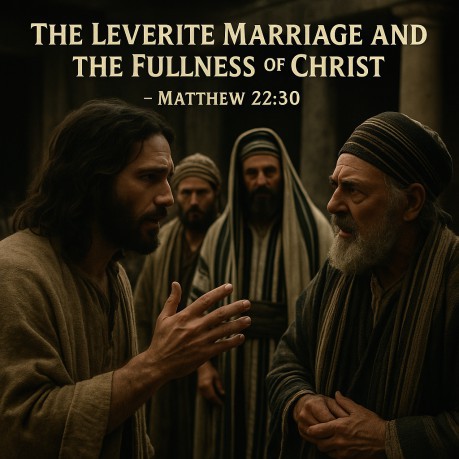
The Leverite Marriage and the
Fullness of Christ – Matthew 22:30 Matthew 22:30 † The Sadducees came to Jesus with a question
about the Leverite marriage law (Deuteronomy 25:5-10). This law
commanded that if a man died without children, his brother was to
marry the widow to raise offspring in his brother's name. They
thought they could trap Jesus by presenting a scenario where a woman
married seven brothers in succession. † Their question was meant to expose what they
believed was an absurdity in the doctrine of resurrection. They
denied the resurrection and sought to discredit it. But Jesus' answer
revealed their ignorance of the Scriptures and the power of God. † Jesus declared that in the resurrection there
is no marriage as we know it. Those who attain to that age are like
the angels of God, not because they lose their identity or become
bodiless spirits, but because the covenant purpose of earthly
marriage is fulfilled. Marriage was a shadow pointing to Christ and
His Church. When the new covenant kingdom came in its fullness, the
need for that shadow ended. Fulfillment in Christ † The resurrection Jesus speaks of is not about
fleshly procreation but about covenant life in Him. By AD 70, the old
covenant age ended, and the true marriage of the Lamb (Revelation
19:7) was consummated. Believers became part of the eternal family
where death and earthly lineage no longer define inheritance. † Jesus' words do not mean we become immaterial
or cease to be human. They mean that in the age of the fulfilled
kingdom, the covenantal purpose of marriage is complete. We share in
His eternal life, where physical reproduction is no longer the means
of building God's people. How It Applies to Us Today † This truth frees us from fear about earthly
status. Whether single, married, widowed, or childless, every
believer stands complete in Christ. Our worth is not measured by
family connections but by the eternal union we share with the Lord. † It also reshapes how we view family. While we
cherish our natural households, we recognize the greater family of
God that spans nations and generations. Fellowship in Christ becomes
the highest bond, one that death cannot break. † Knowing that covenant marriage has been
fulfilled keeps our hope anchored. We do not wait for another age or
another covenant. We already live in the kingdom where the Bridegroom
reigns and where the new creation is our present reality. Historical and Scriptural Reinforcement † Hosea 2:19-20 foretold a time when God would
betroth His people to Himself forever in righteousness and
faithfulness. This prophecy finds its fullness in Christ, showing
that the true covenant marriage was always God joining Himself to His
people, not the perpetuation of earthly family lines. † Early Jewish writings also reflect an
expectation of a transformed life beyond the Mosaic order. The Dead
Sea Scrolls (for example, 1QS 4:22-23) speak of an everlasting
community where death is no more, paralleling Jesus' teaching that
resurrection life transcends natural marriage. Further Scriptural Links † 1 Corinthians 15:42-49 explains that the
resurrection body is spiritual, imperishable, and in the image of the
heavenly Man. This complements Jesus' statement that covenant heirs
are like angels, emphasizing transformation without loss of personal
identity. † Hebrews 12:22-24 reveals that believers have
already come to Mount Zion, the city of the living God, and to
myriads of angels. This directly parallels the idea that in the
resurrection we join the heavenly assembly where earthly marriage no
longer defines fellowship. † Isaiah 54:5 calls the Lord the Husband of
Israel, anticipating the ultimate union of God with His people that
replaces earthly marriage as the covenant sign. † Revelation 21:2 shows the holy city as a
bride adorned for her husband, sealing the picture of the church as
the true and eternal spouse of the Lamb. † This is the fulfilled perspective we proclaim at
Fulfilled Prophecies † Source Index
By Dan Maines
For in the resurrection they
neither marry nor are given in marriage, but are like angels in
heaven.
†
Paul explains in Ephesians 5:31-32 that marriage points to the great
mystery of Christ and His Church. The Leverite law protected the
family name and inheritance within Israel until the promised Seed
arrived (Galatians 3:16). Once the true Bridegroom came and gave
Himself for His bride, the old covenant structures were no longer
necessary.
†
We live in the reality of that fulfilled kingdom. Our identity and
inheritance are secure in Christ, not in earthly bloodlines. Marriage
is still a gift for companionship and witness on earth, but it is no
longer a covenant requirement for preserving a family name.
†
The Sadducees accepted only the Torah and rejected the Prophets and
Writings. This explains why Jesus quoted Exodus 3:6 to them (Matthew
22:31-32). God's declaration to Moses--"I am the God of Abraham,
and the God of Isaac, and the God of Jacob"--proves that the
patriarchs were alive to Him, demonstrating the certainty of
resurrection life.
†
Daniel 12:2-3 describes many awakening to everlasting life and
shining like the stars. Jesus' words in Matthew 22:30 about being
like angels echo this promise, showing that the righteous share the
glory of the heavenly host in the fulfilled kingdom.
† Matthew
22:23-33; Deuteronomy 25:5-10; Ephesians 5:31-32; Galatians 3:16;
Revelation 19:7
† Exodus 3:6; Hosea 2:19-20;
Daniel 12:2-3; 1 Corinthians 15:42-49; Hebrews 12:22-24; Isaiah 54:5;
Revelation 21:2
† Dead Sea Scrolls 1QS
4:22-23
† Josephus, Antiquities 4.8.23
(background on Leverite customs)
Links