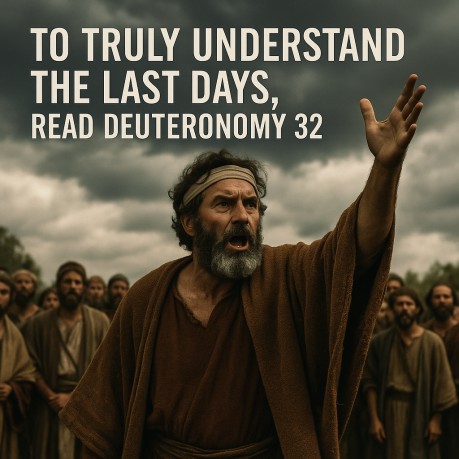
To Truly Understand the Last
Days, Read Deuteronomy 32 Scripture Reading Deuteronomy 32:29 Deuteronomy 32:43 † The true "last days" of scripture
weren't about the end of humanity, the end of time, or the
destruction of planet earth. They were about Israel in her end and
her latter end. Moses prophesied this to the
covenant people. When we read Deuteronomy 32 carefully, it's
impossible to miss the covenantal focus. God warned a specific nation
of their latter end because they'd reject Him. This
isn't a global prophecy of the end of creation, but a covenant
lawsuit against Old Covenant Israel. A Covenant Song of Witness † The "last days" are therefore the
last days of that covenant nation. Hebrews 1:1-2 confirms this: God,
after He spoke long ago to the fathers in the prophets in many
portions and in many ways, in these last days has spoken to us in His
Son. Those last days were the final days of the Old Covenant, not the
end of the material universe. Connection to Revelation 19:2 Light to the Nations Judgment and Deliverance The Wedding Offspring Perverse Generation Connection Vengeance for the Blood of His Servants Hiding of God's Face Jealous God and Strange Gods Rock of Salvation Rejected Nations Rejoicing with His People Application for Today Historical Context and Additional Evidence † This is the fulfilled perspective we proclaim at
Fulfilled Prophecies † Source Index
By Dan Maines
Deuteronomy 32:20
Then
He said, I will hide My face from them, I will see what their end
will be; For they are a perverse generation, Sons in
whom is no faithfulness.
Would that they were wise, that they
understood this, That they would discern their latter end!
Rejoice, O nations, with His people;
For He will avenge the blood of His servants, And
will render vengeance on His adversaries, And will atone for His land
and His people.
†
Deuteronomy 32 is called the "Song of Moses," given to
Israel as a witness. God told Moses to teach this song so that when
Israel broke the covenant and disaster fell, they'd know that the
Lord Himself had foretold it (Deuteronomy 31:19-22). This song is a
courtroom declaration. Heaven and earth are called to witness
Israel's unfaithfulness (Deuteronomy 32:1). The song speaks of
Israel's corruption, their provoking of the Lord with strange gods,
and the judgment that would follow.
†
Deuteronomy 32:43 finds its fulfillment in Revelation 19:2: because
His judgments are true and righteous; for He has judged the great
harlot who was corrupting the earth with her immorality, and He has
avenged the blood of His bond-servants on her. The
avenging of the blood of His servants, the rendering
of vengeance on His adversaries, and the atoning for His land and
people all point to the judgment of apostate Jerusalem. Jesus Himself
said that all the righteous blood from Abel to Zechariah would come
upon that generation (Matthew 23:35-36).
†
Israel was called to be a light to the world (Isaiah 42:6; 49:6).
Their covenant story was meant to reveal the character and glory of
God to every nation. Yet they turned inward, making the covenant
about themselves. Their story is mankind's story of rebellion and
God's faithfulness. We've got to learn from their history and stop
searching for earthly fulfillments of their last days.
†
Deuteronomy 32 makes a sharp distinction between the apostate and the
faithful. Apostate Israel was judged and condemned. Righteous Israel,
the remnant who trusted God's Messiah, was saved and delivered. Paul
calls this remnant the "Israel of God" (Galatians 6:16).
These faithful ones became the foundation of the New Covenant people,
Jews and Gentiles together in Christ.
†
Revelation 19 moves from judgment to celebration: the marriage supper
of the Lamb. The destruction of the Old Covenant harlot opened the
way for the New Covenant bride. We're the offspring of that wedding.
The New Jerusalem, described in Revelation 21, is the church, the
dwelling of God with His people. Hebrews 12:22-24 shows that
believers have already come to this city.
†
Deuteronomy 32:5 describes Israel as a perverse generation
who acted corruptly toward God. Later in the same song God says, I
will hide My face from them, I will see what their end will be; For
they are a perverse generation, sons in whom is no
faithfulness (Deuteronomy 32:20). Jesus applied this same language to
His contemporaries when He said, O unbelieving and perverse
generation, how long shall I be with you and put up with you
(Matthew 17:17; Luke 9:41). Peter echoed it at Pentecost, warning his
hearers, Be saved from this perverse generation
(Acts 2:40). Paul called the Philippian believers to shine as lights
in the midst of a crooked and perverse generation
(Philippians 2:15).
† The thread is
unmistakable. Moses first used the phrase as a covenant indictment of
Israel. Jesus and the apostles then applied it to the final
generation of the Old Covenant, showing that the corruption Moses
foresaw had reached its climax in their day. Those who rejected the
Messiah fulfilled the prophecy of Deuteronomy 32 and came under the
judgment of that song, while those who followed Christ became the
faithful remnant shining in the world.
†
Deuteronomy 32:43 promises that God will avenge the blood
of His servants. Jesus warned that all the righteous blood shed on
earth would come upon that generation (Matthew 23:34-36). Revelation
records the martyrs crying out for this vengeance (Revelation 6:10)
and celebrates its fulfillment when the great harlot is judged
(Revelation 18:20; 19:2). The Song of Moses looks forward to the same
judgment realized in the fall of Jerusalem.
†
God declares, I will hide My face from them (Deuteronomy 32:20).
Isaiah echoes this truth, Your iniquities have made a separation
between you and your God (Isaiah 59:2). Jesus speaks it directly to
Jerusalem, Your house is left to you desolate (Luke 13:35). When the
covenant people rejected the Messiah, the Lord removed His protective
presence, fulfilling this warning.
†
Deuteronomy 32:16-21 describes Israel provoking God to jealousy with
strange gods. Stephen recounts this in Acts 7:41-42, showing how
Israel turned to idols and God gave them over. Paul applies the same
pattern to the nations in Romans 1:21-23, revealing that idolatry
always brings divine judgment.
†
The Song of Moses calls the Lord the Rock (Deuteronomy 32:4, 15, 18)
and laments that Israel neglected the Rock who begot them. Paul
identifies this Rock with Christ (1 Corinthians 10:4) and Peter shows
Him as the stone the builders rejected (1 Peter 2:6-8). Israel's
rejection of Jesus perfectly fulfills this prophetic image.
†
Moses commands the nations to rejoice with His people (Deuteronomy
32:43). Paul cites this to prove the inclusion of the Gentiles
(Romans 15:10). Revelation 21:24-26 depicts the nations bringing
their glory into the New Jerusalem, fulfilling the covenant promise
that all peoples would share in God's salvation.
†
We've got to read scripture in its covenant context. The "last
days" were the final days of the Mosaic age. Jesus fulfilled the
promises and the judgments. We live in the everlasting kingdom that
can't be shaken (Hebrews 12:28). Stop looking for earthly
fulfillments of their last days. Instead, shine as
lights in the world (Philippians 2:15), proclaiming the completed
work of Christ and the eternal reign of our King.
†
Josephus, Wars of the Jews 6.4.5, records the destruction of
Jerusalem in vivid detail, describing the burning of the Temple and
the slaughter of more than a million people. This matches Jesus'
warning in Matthew 24:2 that not one stone will be left upon
another.
† Roman historian Tacitus (Histories
5.13) likewise testifies that Jerusalem fell under extraordinary
judgment, calling it a calamity surpassing all previous ones.
†
Daniel 9:24-27 foretold that seventy weeks are decreed for Israel to
finish transgression, make atonement, and bring in everlasting
righteousness. The prophecy concludes with the destruction of the
city and sanctuary, language perfectly fulfilled in AD 70.
†
Isaiah 65:17 speaks of God creating new heavens and a new earth, a
covenant renewal echoed in Hebrews 12:26-28, showing the transition
from the old order to the unshakable kingdom.
†
Eusebius (Ecclesiastical History 3.5) noted that the Christians in
Jerusalem, heeding Jesus' words in Luke 21:20-21, fled to Pella
before the Roman siege, proving that the prophecy was recognized and
acted on by the first-century church.
†
Clement of Rome (c. AD 96) wrote that the apostles were fully assured
through the resurrection of our Lord Jesus Christ and appointed
leaders everywhere, witnessing to the establishment of the New
Covenant community immediately after the Temple's fall.
†
Deuteronomy 31:19-22; Deuteronomy 32:1, 4, 5, 15, 16-21, 18, 20, 29,
43; Isaiah 42:6; Isaiah 49:6; Isaiah 59:2; Isaiah 65:17; Daniel
9:24-27; Matthew 17:17; Matthew 23:34-36; Matthew 23:35-36; Matthew
24:2; Luke 9:41; Luke 13:35; Luke 21:20-21; Acts 2:40; Acts 7:41-42;
Romans 1:21-23; Romans 15:10; 1 Corinthians 10:4; 1 Peter 2:6-8;
Hebrews 1:1-2; Hebrews 12:22-24; Hebrews 12:26-28; Galatians 6:16;
Philippians 2:15; Revelation 6:10; Revelation 18:20; Revelation 19:2;
Revelation 21:2; Revelation 21:24-26; Josephus Wars of the Jews
6.4.5; Tacitus Histories 5.13; Eusebius Ecclesiastical History 3.5;
Clement of Rome c. AD 96
Links