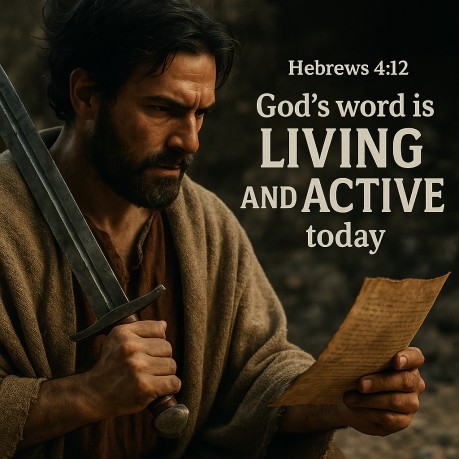
Hebrews 4:12 God's word is
LIVING AND ACTIVE today For the word of God is living and active and sharper than any
two-edged sword, and piercing as far as the division of soul and
spirit, of both joints and marrow, and able to judge the thoughts and
intentions of the heart. † The writer of Hebrews reminds his audience
that God's word is not a dead letter but a living force. It is
active, always at work, and sharper than any sword used in battle.
This sword is not meant for physical combat but for cutting through
the deepest parts of our being. † "Living and active" speaks to the
ongoing power of God's revelation. His word never grows stale or
outdated. It brings life, convicts, and exposes. Just as God breathed
life into creation, He breathes life into His word. † "Sharper than any two-edged sword"
shows how the word pierces to the division of soul and spirit. No
part of our inner life is hidden. God's word reaches where no human
blade or human wisdom can go. † It discerns the thoughts and intentions of
the heart. This means it lays bare our motives, not just our actions.
It confronts hypocrisy, reveals hidden sin, and shows us where we
stand in His covenant. Historical Context † The original audience faced pressure to
return to the old covenant system. The author uses this verse to warn
them that God's word will judge their hearts. They cannot hide behind
rituals or outward obedience. The living word of God sees beyond the
veil. † Early Christians understood this as the power
of the gospel message. The apostles proclaimed it with confidence
because it cut through culture, tradition, and unbelief. † Hebrews was written before the destruction of
the Temple around AD 65. This timing underscores the urgency for that
generation to heed God's living word before the old covenant system
passed away. † Clement of Rome (c. AD 96) wrote that the
Scriptures are "true utterances of the Holy Spirit,"
confirming the early church's understanding that God's word is alive
and authoritative. † The mention of "word of God" would
have resonated with Jews who saw God's word create the universe
(Genesis 1; Psalm 33:6). Hebrews ties that same creative power to the
gospel now fulfilled in Christ. † John 1:1-4 shows Jesus Himself as the living
Word. The written word and the incarnate Word work together,
reinforcing that the message is alive because the Messiah lives. † Ignatius of Antioch (early 2nd century) urged
believers to "heed the prophets and the gospel" as one
united living message, showing that the first generations of
Christians viewed the word as active and covenant-fulfilling. How it applies to us today † We cannot hide from the searching gaze of
God's word. It reveals our true thoughts and motives, calling us to
faithfulness. It challenges us to remain in the fulfilled covenant of
Christ and to let His word shape every choice. † The same word that exposes sin also comforts
the faithful, assuring us that God's promises are already fulfilled
in Christ. † Because the old covenant has passed, the
living word now calls us to walk in the completed kingdom, not to
wait for another age or temple. † This is the fulfilled perspective we proclaim at
Fulfilled Prophecies † Source Index † Hebrews 4:12; Jeremiah 23:29; John 6:63; 1
Thessalonians 2:13; Psalm 119:105; Genesis 1; Psalm 33:6; John
1:1-4
By Dan Maines
† Clement of Rome, 1 Clement (c. AD
96)
† Ignatius of Antioch, Epistle to the
Philadelphians (early 2nd century)
Links