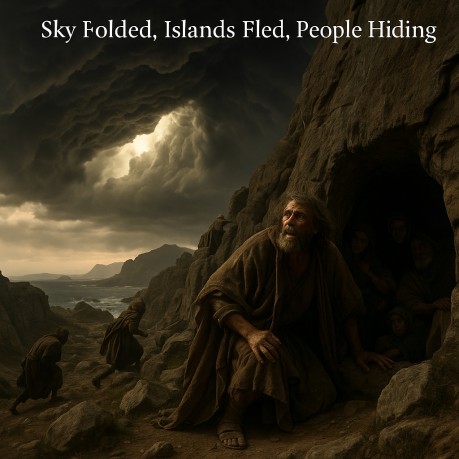
Sky Folded, Islands Fled,
People Hiding † Revelation 6:12-17 describes
the great shaking when the Lamb opened the sixth seal. The sun became
black, the moon turned blood red, the stars fell to earth, the sky
rolled up like a scroll, and every mountain and island was moved.
Kings, commanders, the rich and the strong hid in caves and rocks,
crying for the mountains to fall on them to escape the wrath of the
Lamb. This isn't the end of the physical universe, but covenantal
judgment language. † Isaiah 34:4 shows identical
imagery. When Edom was judged the prophet said, "All the host of
heaven will wear away, and the sky will be rolled up like a scroll."
God used cosmic language to describe the fall of a nation. Revelation
borrows this pattern to describe the shaking of the Old Covenant
world. † Nahum 1:5 declares that
mountains quake and the earth heaves at the Lord's presence. The
prophets consistently used earth-shaking symbols to portray God's
judgments on nations. These descriptions pointed to real historical
upheavals, not a literal tearing of the sky. † Hebrews 12:26-28 explains
the meaning. God promised to shake heaven and earth so that only the
unshakable kingdom would remain. This was the transition from the Old
Covenant to the everlasting New Covenant kingdom that can't be
shaken. † Roman records tell of cities fleeing to caves
during invasions, mirroring Revelation's picture of people hiding
from God's wrath. History confirms that during the Jewish War and
Rome's campaigns, the land shook with terror and multitudes hid in
caves and fortresses. † This passage points to the AD 70 judgment
that ended the Old Covenant age. The "sky" represented the
covenantal heavens, the ruling powers and priestly system that were
folded away. The "islands" and "mountains"
symbolized nations and authorities that fled before the coming
kingdom of Christ. How it applies to us today † This is the fulfilled perspective we proclaim at
Fulfilled Prophecies † Source Index
By Dan Maines
† This sixth seal vision
echoes Old Testament descriptions of national collapse. The "sun,
moon, and stars" often represented rulers and governing powers.
Their falling portrays the overthrow of authorities in Jerusalem and
the temple system.
† The people hiding show
how even the most powerful couldn't stand against Christ's judgment.
From Caesar down to the commoner, all were equally subject to the
Lamb's wrath.
† Josephus records that during
the siege of Jerusalem, terror and chaos drove many to hide in
underground passages and tombs. This historical event matches the
prophetic imagery of people seeking refuge in rocks and caves.
† Isaiah's prophecy against Edom was
fulfilled in history, not by the literal unraveling of the universe.
This proves that similar cosmic signs in Revelation also point to
real earthly judgment.
† By reusing this
language, John ties the destruction of Jerusalem to the same type of
covenantal collapse that befell Edom. It's a warning that God judges
covenant breakers the same way throughout history.
†
The scroll imagery highlights the end of an era. Just as a scroll is
rolled up and put away when its purpose is complete, so the Old
Covenant was being closed to make way for the New.
†
Isaiah 13:10 says the stars won't give their light and the sun will
be dark when God judged Babylon, yet history shows Babylon fell
without the literal sun or stars going dark.
†
Joel 2:10 describes the earth quaking and the heavens trembling when
God judged Jerusalem in earlier invasions, again showing covenantal
imagery.
† Ezekiel 32:7-8 uses the same
darkened-sky language for Egypt's downfall, reinforcing that this
prophetic style signals national judgment, not cosmic destruction.
†
Nahum's prophecy against Nineveh shows that when God rises to judge,
creation language is used to display His power over all the earth.
†
Mountains represented strongholds and kingdoms. Their quaking
illustrates the collapse of human power before divine judgment.
†
The consistency of this language across the prophets reinforces the
truth that Revelation is describing the end of the Jewish world
order, not the destruction of the planet.
† The writer of Hebrews quotes Haggai
to show that this shaking was imminent for his first-century
audience. It wasn't a distant future event.
†
The "heaven and earth" to be shaken refers to the
covenantal system of temple worship and priesthood, which would soon
be removed.
† The unshakable kingdom is
Christ's reign, established at His ascension and fully revealed when
the old order fell in AD 70.
† Early church
writers like Irenaeus, Clement of Alexandria, and others mention that
John wrote Revelation during Nero's reign or shortly after, which
places it before AD 70.
† Revelation
repeatedly refers to the temple as still standing (Revelation
11:1-2), which makes the most sense if the temple hadn't yet been
destroyed.
† The repeated statements that
these things would happen "soon" and that "the time is
near" (Revelation 1:1, 3) support a first-century fulfillment
rather than a prophecy thousands of years in the future.
† Tacitus describes how
panic swept the region as Roman armies advanced, and how many sought
refuge in mountains and underground places.
†
Josephus details how rebels and citizens alike hid in tunnels and
caves as Jerusalem burned, fulfilling the vision of people crying to
the mountains and rocks.
† This historical
evidence shows that the prophecy wasn't only symbolic but also
witnessed in dramatic reality during the fall of Jerusalem.
† The destruction of the
temple marked the end of the sacrificial system, proving that
Christ's sacrifice alone stands.
† The flight
of islands and mountains shows that no earthly power, near or far,
could stand when God judged His covenant people.
†
These events confirmed Jesus' own words in Matthew 24, where He
promised that all these things would happen within that generation.
†
We stand in the unshakable kingdom. No power of earth or heaven can
remove what Christ has established. The same God who shook the old
order secures our place in His everlasting reign. Our call is to live
as citizens of this kingdom, steadfast and unafraid.
†
Knowing that God keeps His promises strengthens our confidence. He
judged when He said He would, proving His faithfulness and His
control over history.
† We can face modern
upheavals without fear, knowing that our hope rests in a kingdom that
can't be moved.
† Our mission is to proclaim
this fulfilled work, inviting others to the security and peace found
only in Christ.
† Revelation
6:12-17; Isaiah 34:4; Isaiah 13:10; Joel 2:10; Ezekiel 32:7-8; Nahum
1:5; Hebrews 12:26-28
† Revelation 11:1-2;
Revelation 1:1, 3
† Josephus, Jewish War 6;
Tacitus, Histories 5; Early testimonies of Irenaeus and Clement of
Alexandria
Links