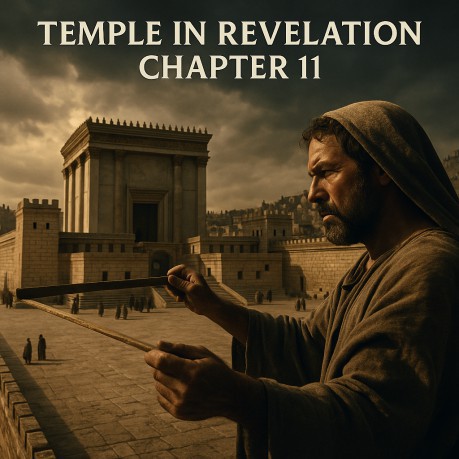
Temple in Revelation Chapter
11 † Revelation 11:1-2 shows John
told to measure the temple of God while the outer court is given to
the nations for forty-two months. The command to measure signals
God's protection of His true worshippers, even as the visible
structure faced coming destruction. † Ezekiel 40-48 uses temple
measurement to symbolize preservation of God's true worshippers. † Luke 21:5-6 records Jesus'
prophecy that the temple would be torn down, stone by stone. † The forty-two months match the
three-and-a-half year siege of Jerusalem, showing Revelation was
written before AD 70. † Josephus confirms the temple still stood when
the siege began and was destroyed after about three and a half
years. † Revelation opens by saying the events "must
soon take place" and that "the time is near"
(Revelation 1:1, 3). These words meant something immediate to John's
first readers, showing the prophecy concerned their own generation. † Some argue the temple in Revelation 11 is
only heavenly or symbolic. But John is told to measure a specific
court and to note that the outer court will be trampled by the
nations for forty-two months, which fits the historical siege of
Jerusalem. How it applies to us today † This is the fulfilled perspective we proclaim at
Fulfilled Prophecies † Source Index
By Dan Maines
†
Measuring sets apart what belongs to the Lord. The inner temple
represents those who worship in spirit and truth, while the outer
court given to the nations pictures the judgment about to fall on
unbelieving Israel.
† This passage confirms
that the temple was still standing when John wrote, proving the
prophecy pointed to the imminent fall of Jerusalem.
†
The forty-two months align with the length of the Roman siege,
marking a definite period of covenantal judgment.
†
In Ezekiel's vision, careful measuring revealed God's plan to protect
and restore a faithful people even as judgment came on the
unfaithful.
† John's vision follows the same
pattern: the true worshippers are secure though the physical building
would be lost.
† This shows that God's
dwelling is with His people, not in stones and walls.
†
Jesus' words were direct and literal, fulfilled when the Roman armies
leveled the magnificent temple in AD 70.
†
John's vision reinforces that this destruction was near and certain,
not a distant future event.
† Christ's
prophecy and John's measurement join to declare the end of the Old
Covenant order.
† This exact time span
strengthens the case for an early date, since it matches the
historical siege led by Rome.
† The precision
of this period highlights God's control over history and His
faithfulness to His warnings.
† It assures
believers that no detail of His plan fails.
† His detailed account provides
eyewitness proof that aligns with Revelation's timeline.
†
The historian describes how Roman forces encircled the city, cut off
supplies, and finally burned the temple, exactly as Jesus foretold.
†
This convergence of scripture and history leaves no doubt that the
vision was fulfilled in the first century.
†
Revelation 11:1-2 speaks of the temple as still standing, which
supports a date before AD 70 when the temple was destroyed.
†
Early church writers like Clement of Alexandria and the Muratorian
fragment place John's visions during Nero's reign, again pointing to
a pre-70 date.
† Even if someone insists on a
symbolic meaning, the clear time markers and the prophecy's
fulfillment in the first-century destruction of the physical temple
remain undeniable.
†
God's true temple is His people. Our worship isn't tied to a building
but to the living Christ who dwells in us.
†
We can trust that God protects His own even when institutions
collapse and nations rage.
† The fall of the
temple reminds us that the New Covenant kingdom cannot be shaken.
†
Our call is to worship in spirit and truth, knowing that Christ
Himself is our sanctuary.
† Revelation
11:1-2; Ezekiel 40-48; Luke 21:5-6; Revelation 1:1, 3
†
Josephus, Jewish War; Clement of Alexandria; Muratorian fragment
Links