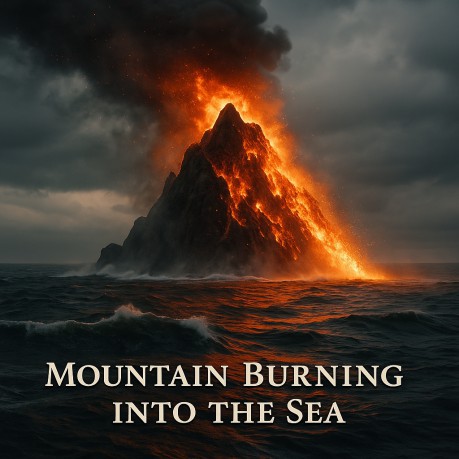
Mountain Burning into the Sea † Revelation 8:8 says
something like a great mountain burning with fire was thrown into the
sea. This second trumpet vision follows the covenantal pattern of
judgment language. A mountain, symbol of power and stability, cast
into the sea shows the downfall of a mighty dominion and the turmoil
that follows. † Jeremiah 51:25 calls Babylon
a destroying mountain that God would roll down from the cliffs and
make a burned-out mountain. John draws on this Old Testament image to
describe the downfall of a powerful world system. † Zechariah 4:7 speaks of a
great mountain becoming a plain before the Lord, another prophetic
picture of nations brought low. † This symbol points to the fall of a mighty
kingdom, fulfilled in the collapse of Rome's naval power and commerce
during the Jewish revolt. † Roman naval defeats and trade disruptions
during the war illustrate the prophetic sign. † Revelation opens with the clear statement
that the events "must soon take place" and that "the
time is near" (Revelation 1:1, 3). These words carried immediate
meaning for John's first readers, showing that the prophecy concerned
their own generation. How it applies to us today † This is the fulfilled perspective we proclaim at
Fulfilled Prophecies † Source Index
By Dan Maines
† Throughout scripture,
mountains represent kingdoms or ruling powers. To see a flaming
mountain hurled into the sea points to a nation's authority
collapsing under the fiery wrath of God.
†
The sea often represents the restless nations. When the burning
mountain falls into it, it signals a kingdom's ruin that causes
widespread upheaval among surrounding peoples.
†
This trumpet aligns with Jesus' words in Luke 21:25, where the sea
and the waves roar in distress as nations are shaken.
†
Jeremiah spoke of Babylon's pride and its sudden humiliation. In the
same way, Revelation uses the burning mountain to show that no empire
stands secure when God decrees judgment.
†
Just as Babylon's commerce and influence crumbled, Rome's maritime
might and trade routes would soon face devastation.
†
The language assures believers that the Lord rules over the strongest
earthly kingdoms and can reduce them to ash in an instant.
†
Isaiah 13:10 describes the stars darkening and the sun being obscured
when Babylon fell, yet history shows this was fulfilled without
literal cosmic collapse.
† Ezekiel 32:7-8
uses identical language of the heavens darkening for Egypt's
judgment, reinforcing the prophetic pattern.
†
Joel 2:10 pictures the earth quaking and the heavens trembling during
God's judgment on Jerusalem in earlier centuries, proving that this
imagery consistently points to national upheaval, not the end of the
planet.
† The angel's
message to Zerubbabel showed that obstacles as high as mountains are
nothing when God acts.
† This reinforces the
Revelation vision: what appears immovable to men is leveled when God
fulfills His plan.
† It reminds us that the
might of empires is temporary, while God's kingdom endures.
† Roman naval
defeats disrupted shipping in the Mediterranean, striking at the
heart of Rome's economy and prestige.
† The
Jewish War saw ports blockaded and fleets destroyed, fulfilling the
image of a blazing mountain crashing into the sea.
†
Ancient historians note that these conflicts sent shockwaves through
trade and supply lines across the empire.
†
Josephus records naval battles on the Sea of Galilee where Roman
forces struggled and suffered heavy losses.
†
Grain shipments from Egypt to Rome were interrupted, bringing famine
fears and economic distress.
† These real
events demonstrate the precision of the prophetic imagery, Rome's
seeming mountain of power was cast down and its strength scattered
across the sea.
† Revelation 11:1-2
speaks of the temple as still standing, which strongly supports a
date before AD 70 when the temple was destroyed.
†
Early Christian writers like Clement of Alexandria and others report
that John received the visions during Nero's reign, again pointing to
a pre-70 date.
†
God still topples proud powers. What the world sees as unshakable, He
can burn and cast aside.
† We live in the
unshakable kingdom Christ established, so we don't fear when nations
rage or markets fail.
† The downfall of
earthly empires reminds us to set our trust in the Lord's eternal
reign.
† Our calling is to remain steadfast,
proclaiming His sovereignty as kingdoms rise and fall.
† Revelation
8:8; Jeremiah 51:25; Zechariah 4:7; Luke 21:25; Revelation 1:1, 3;
Revelation 11:1-2
† Isaiah 13:10; Ezekiel
32:7-8; Joel 2:10
† Josephus, Jewish War;
Roman naval records of the first-century Mediterranean
†
Early testimonies of Clement of Alexandria and other first-century
witnesses
Links