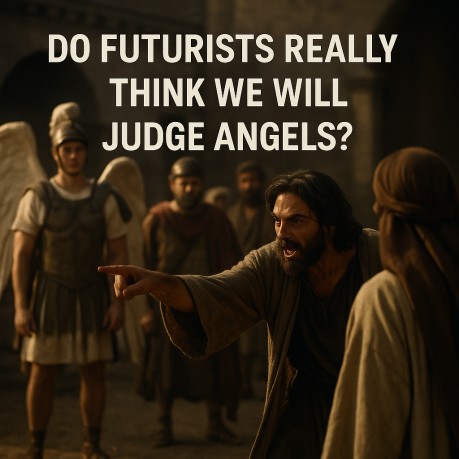
Do Futurists Really Think We
Will Judge Angels? 1 Corinthians 6:3 † Paul rebuked the Corinthians because they
were dragging one another before pagan courts. He reminded them of
their high position in Christ. If the saints would "judge
angels," then surely they were capable of handling simple
disputes among themselves without Roman judges. † To "judge" means to rule, discern,
or pronounce sentence. Paul's words fit the first century transition
when Christ placed all enemies under His feet (1 Corinthians
15:24-26). At His coming in AD 70 He removed the old covenant system
and defeated the principalities and powers (Colossians 2:15).
Believers who endured to the end joined Him in that judgment (Daniel
7:21-22). † "Angels" here points to spiritual
rulers, not heavenly messengers who remained faithful. Scripture
calls the law "ordained through angels" (Galatians 3:19;
Acts 7:53; Hebrews 2:2). Those angelic powers were tied to the Sinai
covenant. When the old covenant passed away, those angelic
authorities were judged. The saints, joined to Christ, participated
in that verdict. † Revelation shows this clearly. In Revelation
12:7-10 the dragon and his angels were cast down. In Revelation 20
the accuser was bound. These are the angels Paul said the saints
would judge. Through their faithful witness, the church stood with
Christ as the old order of angels fell. † The early church understood this. Daniel
foresaw that "the saints took possession of the kingdom"
(Daniel 7:22). Hebrews 2:5 declares that "the world to come is
not subjected to angels." Jesus told His apostles they would sit
on thrones judging the tribes of Israel (Matthew 19:28). That
judgment arrived when Jerusalem fell and the kingdom was fully given
to the saints. † This is not about believers someday sitting
in a cosmic courtroom to pronounce sentences on holy angels. The
context is the first century victory of Christ. Futurists miss Paul's
point and turn a completed reality into a future fantasy. The saints
already share in Christ's rule (Ephesians 2:6). We reign with Him
now. † Immediate Context of 1 Corinthians 6 † Angels as Law Mediators † Christ Alone Judges the World † Completed Cosmic Battle † Saints' Present Reign † No Biblical Picture of Saints Judging Holy
Angels † Early Church Understanding How it applies to us today † This is the fulfilled perspective we proclaim at
Fulfilled Prophecies † Source Index
By Dan Maines
Do you not know that we
will judge angels? How much more matters of this life?
Paul's
argument is practical and present: if they can one day "judge
angels," they should certainly judge trivial earthly matters now
(1 Corinthians 6:1-5). He's not forecasting a far off cosmic court,
he's rebuking them for running to pagan judges. The contrast is
between their current spiritual authority and their present
immaturity.
Acts 7:53,
Galatians 3:19, and Hebrews 2:2 all say the old covenant was
delivered "through angels." These angelic authorities were
tied to the Sinai administration. When that covenant ended, those
powers were rendered obsolete. The "judgment" is the
removal of their authority, not a future trial of faithful heavenly
beings.
John 5:22
says "the Father has given all judgment to the Son."
Revelation 20 shows Christ as the only one seated on the great white
throne. There is no scene where glorified humans sentence holy
angels. Any judgment we share is derivative, already accomplished in
Him (Ephesians 2:6).
Revelation
12:7-10 describes the dragon and his angels cast down at Christ's
ascension. That war is finished. Paul speaks as if this overthrow is
certain and believers share in the verdict because they are united
with the Victor, not because they later preside over celestial
trials.
Daniel 7:21-22 and
Ephesians 1:20-23 show that the saints received the kingdom when the
Son of Man came to the Ancient of Days. We reign with Him now
(Revelation 1:6). Our "judging" is reigning, exercising
kingdom authority, not running a courtroom.
Every text that speaks of angels at final judgment shows
them carrying out God's sentences (Matthew 13:41-42; 25:31), never
standing trial before humans.
Early
Christian writers like Clement of Rome and the Epistle of Barnabas
speak of believers reigning with Christ and overcoming evil powers,
but none describe saints sitting to condemn holy angels. Their
witness supports the fulfilled, covenantal reading.
†
We live in the finished work of Christ. The demonic powers are
judged, and we walk in the authority of His kingdom. We do not wait
for a distant day to exercise judgment, we display His justice now by
resolving disputes in the church, living holy lives, and declaring
the gospel that exposes the darkness (John 16:11; Ephesians 3:10).
† 1
Corinthians 6:1-5, 6:3; 1 Corinthians 15:24-26; Colossians 2:15;
Galatians 3:19; Acts 7:53; Hebrews 2:2, 2:5; Revelation 12:7-10;
20:1-3; Daniel 7:21-22; Matthew 19:28; Ephesians 1:20-23; 2:6; 3:10;
John 5:22; 16:11; Revelation 1:6; Matthew 13:41-42; 25:31; Clement of
Rome, Epistle of Barnabas
Links