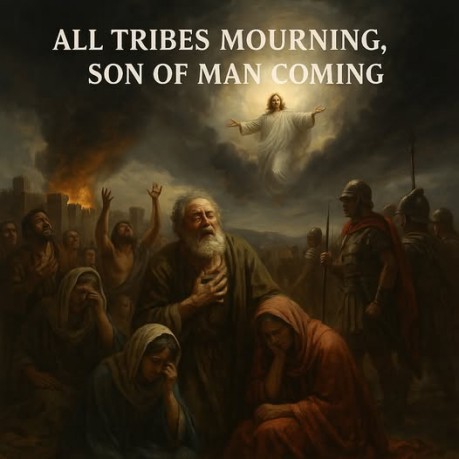
All
Tribes Mourning, Son of Man Coming Matthew
24:30 Zechariah 12:10-14 Matthew 24:30 (connection to
Zechariah) Matthew 26:64 Revelation 1:7 "Tribes of the Land" The Sanhedrin's Witness Coming on the Clouds Application for Us Today † This is the fulfilled
perspective we proclaim at Fulfilled Prophecies † Source Index
By Dan Maines
† Jesus speaks of the sign of
the Son of Man appearing in the sky, bringing mourning to all the
tribes of the land. This is covenantal language aimed at Israel, not
the entire globe. The Greek word gē means land, pointing to the
promised land of Israel. The visible sign of His authority was the
coming judgment on Jerusalem in AD 70, confirming His kingdom
rule.
† The prophets often used cosmic
imagery for national judgment (Isaiah 13, Ezekiel 32). The "clouds
of the sky" represent the presence of God in judgment as at
Sinai and in the wilderness (Exodus 19:9, Psalm 104:3). Jesus
promised this would occur before that generation passed away
(Matthew 24:34), and history records the Roman siege and the fall of
the temple exactly as He foretold.
†
Matthew's use of "gē" often points to the land of Israel
in context, see Matthew 2:6 and Matthew 2:20-21, which supports a
covenant land scope for "all the tribes of the land."
†
This prophecy gives the backdrop for Jesus' words. The Spirit of
grace and supplication is poured out so that they look on the one
they pierced and mourn deeply, each family apart. It describes
national repentance and lament as judgment approaches. The tribes of
Israel grieve over rejecting their Messiah, showing that the
fulfillment is focused on them, not the nations of the world.
†
John 19:37 directly quotes Zechariah 12:10 about "the one they
pierced," tying the piercing and the mourning to the first
century events surrounding Jesus.
†
Josephus, an eyewitness of the war, records scenes of despair and
mourning within Jerusalem during the siege (Jewish War 5.1, 5.13).
This historical witness shows how vividly the prophecy came to life
as families were separated, starving, and weeping while their city
burned.
† Jesus intentionally
recalls Zechariah, declaring that all the tribes of the land will
mourn. He ties the old covenant prophecy to His own generation
(Matthew 24:34). The destruction of the temple and the end of the
old covenant age are the sign of His power and glory.
†
Jesus anchors fulfillment to His contemporaries, "this
generation will not pass away," Matthew 24:34, matching
Zechariah's tribal mourning within Israel.
†
Early Christian writers such as Eusebius (Ecclesiastical History
3.5) testified that the church remembered Jesus' warning and fled to
Pella before the final siege, confirming that the disciples
recognized this prophecy as a first century event.
†
Standing before the Sanhedrin, Jesus told the high priest, "you
will see the Son of Man sitting at the right hand of Power, and
coming on the clouds of heaven." This is courtroom language of
vindication from Daniel 7. Those judging Him would themselves see
His exaltation and the events proving His authority within their
lifetime.
† His resurrection and ascension
to the Father's right hand (Acts 2:33-36) were the heavenly
realities, while the judgment on Jerusalem served as the earthly
sign that their verdict against Him was overturned by God Himself.
†
Psalm 110:1 stands behind "right hand of Power," and is
preached as fulfilled in Acts 2:34-36, showing enthronement as a
present reality seen in the events that followed.
†
John declares that Jesus is coming with the clouds and that every
eye will see Him, even those who pierced Him. This is a direct link
to Zechariah's prophecy. The ones who pierced Him were the first
century leaders of Israel. They would witness the judgment on their
city, the fall of the temple, and the unmistakable sign that Jesus
now reigns.
† The "all tribes of the
land" phrase mirrors Zechariah's language of family-by-family
mourning, showing that Revelation carries forward the same covenant
focus. It is not a worldwide spectacle but the vindication of Christ
before the very generation that rejected Him.
†
Revelation's own timing markers, "what must shortly take
place," and "the time is near," Revelation 1:1-3,
22:6, 22:10, lock the expectation to the first century audience.
†
This phrase anchors the prophecy to Israel's covenant people.
Zechariah's vision of families mourning apart is not about the
entire earth but about the descendants of Jacob facing the end of
their covenant world. The Roman siege of AD 70 fulfilled this
exactly as foretold, bringing the old covenant to its close.
†
The Greek phrase "phylai tēs gēs" mirrors the
Septuagint's wording in Zechariah 12, keeping the focus on Israel's
tribes rather than all nations.
† Ancient
historians such as Tacitus (Histories 5.10-13) described the terror
and signs in the heavens that preceded the fall of Jerusalem,
reporting phenomena that the people understood as divine judgment.
†
The very council that condemned Jesus could not escape the
fulfillment of His words. They saw the gospel's rapid spread, the
miraculous signs of the early church, and finally the destruction of
their own temple. Each event was a declaration of the Son of Man's
authority.
† Their political power ended
when the temple fell. No longer could they enforce their traditions
or maintain sacrifices. This irreversible shift proved that the old
covenant system they defended had passed away.
†
Matthew 23:35-36 places the blood-guilt reckoning upon "this
generation," confirming that the council's own generation would
see the vindication of the Son of Man.
†
This is prophetic imagery from Daniel 7:13-14 and Isaiah 19:1,
showing divine judgment and enthronement. God "rides the
clouds" when He judges nations. Jesus' coming on the clouds is
His ascension to the Father to receive the kingdom, made visible by
the destruction of Jerusalem and the temple.
†
Just as Yahweh "came on the clouds" to judge Egypt (Isaiah
19:1) without physically descending, Jesus' coming was a covenantal
visitation of judgment and glory, demonstrating that He reigns as
King of kings.
† Isaiah 19:1, Nahum 1:3,
Micah 1:3-4, and Psalm 18:7-12 show the prophetic pattern of "cloud
coming" as judicial visitation, not a geographic descent to
earth.
†
The mourning of Israel is a warning and a testimony. Rejecting
Christ brings certain ruin, but His fulfilled promises show that He
is faithful. He reigns now at the right hand of Power. Our call is
to live as citizens of His unshakable kingdom, confident that every
promise is fulfilled in Him.
† Knowing these
prophecies were fulfilled strengthens our trust. We can face trials
with assurance that Jesus keeps His word and rules over every nation
and every age.
† Because these things were
fulfilled, believers stand in a kingdom that cannot be shaken,
Hebrews 12:22-28, living out the realities of the New Covenant,
Jeremiah 31:31-34, Hebrews 8-10.
†
Zechariah 12:10-14, Matthew 24:30, 26:64, Revelation 1:7, Daniel
7:13-14, Isaiah 19:1, Matthew 2:6, Matthew 2:20-21, John 19:37, Acts
2:33-36, Acts 2:34-36, Matthew 23:35-36, Revelation 1:1-3,
Revelation 22:6, Revelation 22:10, Revelation 11:1-2, Psalm 110:1,
Psalm 18:7-12, Nahum 1:3, Micah 1:3-4, Hebrews 12:22-28, Jeremiah
31:31-34, Hebrews 8-10, Josephus Jewish War 5.1, 5.13, Tacitus
Histories 5.10-13, Eusebius Ecclesiastical History 3.5
Links