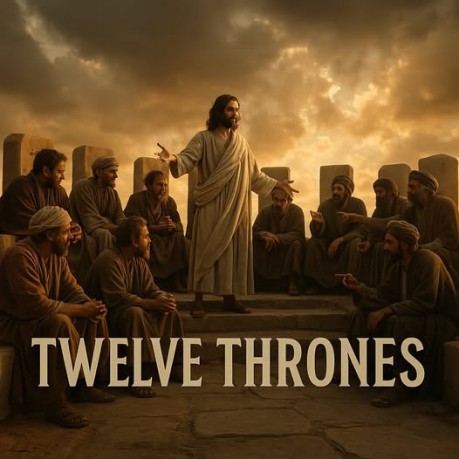
Twelve
Thrones Matthew
19:28 Luke 22:28-30 Acts 2:32-36 Ephesians 2:20 Covenantal Judgment Historical Fulfillment Additional Scriptural
Witnesses Early Church Testimony Historical Context Validation Notes How It Applies to Us Today † This is the fulfilled
perspective we proclaim at Fulfilled Prophecies † Source Index
By Dan Maines
Jesus told His apostles, "Truly I say to
you, that you who have followed Me, in the regeneration, when the
Son of Man will sit on His glorious throne, you also shall sit upon
twelve thrones, judging the twelve tribes of Israel."
†
This promise shows the apostles sharing in Christ's royal authority.
The "regeneration" speaks of the New Covenant order that
began when the old covenant system passed away. Their thrones were
not physical seats in a future millennium, but positions of
covenantal authority as Christ reigned from heaven.
On
the night before His death, Jesus confirmed this promise. "You
are those who have stood by Me in My trials, and just as My Father
has granted Me a kingdom, I grant you that you may eat and drink at
My table in My kingdom, and you will sit on thrones judging the
twelve tribes of Israel."
† To eat and
drink at His table is New Covenant fellowship. The apostles, as
witnesses of His resurrection, would declare who belonged to the
true Israel of God. Their judging was not about condemning nations
with swords, but about pronouncing covenant blessings and curses
through the gospel.
After
the resurrection and ascension, Peter proclaimed that God had made
Jesus "both Lord and Christ." The apostles immediately
exercised the authority Jesus promised. Their preaching called
Israel to repentance, separating those who embraced Messiah from
those who rejected Him. This fulfilled the role of judging the
tribes.
† Peter's proclamation at Pentecost
was the public confirmation that Jesus now reigned on David's throne
in heaven. By declaring Him "both Lord and Christ," the
apostles announced that the promised kingdom had already begun, not
as an earthly monarchy, but as the New Covenant reign of the risen
Messiah.
† Their call to "repent and be
baptized" divided Israel covenantally. Those who received the
Spirit became the true Israel of God, while those who rejected the
message remained under judgment.
† This
preaching was itself an act of judgment, just as Jesus said in John
12:48 that His word would judge the last day. The apostles' Spirit
filled testimony drew the boundary line between the old covenant
nation and the new covenant people of God, fulfilling the promise
that they would sit on twelve thrones judging the twelve tribes.
Paul
states the church is "built on the foundation of the apostles
and prophets, Christ Jesus Himself being the cornerstone."
†
Their foundational role means their authority endures through their
inspired teaching. The twelve thrones represent this unshakable
foundation on which the New Covenant temple is built.
†
Their judgment was covenantal, not political. Galatians 6:16 calls
believers the "Israel of God." Through their Spirit
empowered preaching and writing, the apostles identified the true
people of God. Those who rejected their witness remained under the
old covenant curse. Those who believed were gathered into the New
Jerusalem.
†
By AD 70 the old covenant order collapsed. Jerusalem and the temple
were destroyed, confirming the apostles' authority and Christ's
reign. Josephus records the horrors of the siege, a visible sign
that the verdict they proclaimed had come to pass.
†
The apostles' words, preserved in scripture, still judge. As Hebrews
4:12 says, "the word of God is living and active,"
discerning the thoughts and intentions of the heart.
† Revelation 21:12-14
shows the New Jerusalem with twelve foundation stones bearing the
names of the twelve apostles of the Lamb, a direct picture of their
continuing covenantal authority.
† Matthew
16:19 records Jesus giving Peter the keys of the kingdom,
symbolizing the apostolic role of opening and closing covenant
access.
† Daniel 7:13-14, 27 foretells the
Son of Man receiving everlasting dominion and the saints sharing the
kingdom, fulfilled when Christ ascended and the apostles ruled with
Him.
† 1 Corinthians 6:2 reminds believers
that "the saints will judge the world," echoing the
apostles' first century judgment of Israel.
†
Clement of Rome (c. AD 96) wrote that the apostles, "fully
assured through the resurrection of our Lord Jesus Christ,"
appointed leaders in every place, a witness to their governing role
in the early church.
† The Epistle of
Barnabas (early 2nd century) speaks of the apostles laying the
foundation of the spiritual temple, confirming their foundational
authority.
†
Tacitus, Histories 5.13, describes Jerusalem's destruction as a
divine judgment, reflecting the very verdict the apostles announced.
†
Promise and role, Matthew 19:28, Luke 22:28-30, define the judging
of Israel as an apostolic, covenantal task tied to Christ's
enthronement.
† Inauguration, Acts 2:32-36,
with Daniel 7, shows enthronement fulfilled in the ascension, the
saints sharing His kingdom.
† Boundaries by
the word, John 12:48, Hebrews 4:12, explain judgment through the
apostolic gospel, not civil courts.
†
Structure and permanence, Ephesians 2:20, Revelation 21:12-14,
ground the church on the apostles, matching the twelve thrones
image.
† First century outcome, Josephus and
Tacitus, aligns with covenant judgment on old Jerusalem in AD 70,
confirming the apostolic verdict.
†
We stand on the same foundation. The apostles' doctrine defines the
true church. Their writings still separate belief from unbelief.
†
We are called to remain faithful to their testimony, knowing Christ
reigns and His kingdom is present.
† The
twelve thrones remind us that God's plan is complete. The covenant
they announced is everlasting, and the true Israel of God continues
in every believer who follows the Lamb.
†
Matthew 19:28; Luke 22:28-30; Acts 2:32-36; Ephesians 2:20;
Galatians 6:16; Hebrews 4:12; Revelation 21:12-14; Matthew 16:19;
Daniel 7:13-14, 27; 1 Corinthians 6:2; John 12:48; Clement of Rome,
1 Clement 42-44; Epistle of Barnabas 4; Josephus, Jewish War 6.4,
6.9; Tacitus, Histories 5.13
Links