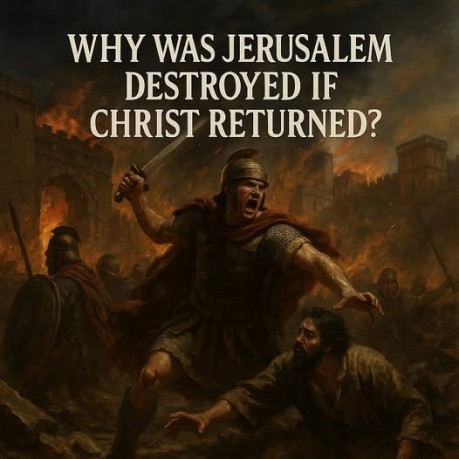
Why
Was Jerusalem Destroyed If Christ Returned? Matthew
22:7 Luke 21:20-24 Hebrews 12:28 John 18:36 Luke 21:22 AD 70 Judgment: Prophets,
Historians, and Archaeology Prove Christ's Return How it applies to us today † This is the fulfilled
perspective we proclaim at Fulfilled Prophecies † Source Index
By Dan Maines
But the king was enraged, and he sent his armies
and destroyed those murderers and set their city on fire.
†
Jesus spoke this parable against the leaders of Israel who rejected
Him.
† The "armies" are the Roman
legions who, in AD 70, burned Jerusalem just as Christ foretold.
†
Roman historian Tacitus confirms the city's burning and wholesale
slaughter, showing that the prophecy was fulfilled in history.
†
The parable proves the destruction wasn't an accident of politics
but a divine verdict on those who killed the Son.
But
when you see Jerusalem surrounded by armies, then recognize that her
desolation is near. Then those who are in Judea must flee to the
mountains, and those who are in the midst of the city must leave,
and those who are in the country must not enter the city, because
these are days of vengeance, so that all things which are written
will be fulfilled. Woe to those who are pregnant and to those who
are nursing babies in those days, for there will be great distress
upon the land and wrath to this people, and they will fall by the
edge of the sword, and will be led captive into all the nations, and
Jerusalem will be trampled underfoot by the Gentiles until the times
of the Gentiles are fulfilled.
† This
prophecy was fulfilled with chilling accuracy.
†
Josephus records that Titus' army encircled the city, fulfilling
"surrounded by armies."
†
Christians fled to Pella in obedience to Christ's warning and were
spared.
† Over a million Jews perished
according to Josephus, and the survivors were sold as slaves,
exactly matching "led captive into all the nations."
†
Gentile control of the site began then and still continues in
various forms today.
Therefore,
since we receive a kingdom which can't be shaken, let's show
gratitude, by which we may offer to God an acceptable service with
reverence and awe.
† The Old Covenant order
with its earthly temple was shaken and removed, but the kingdom of
Christ endured.
† This proves that His reign
is spiritual and indestructible.
† The
tearing down of Jerusalem's temple was the visible sign that the
unshakable kingdom had come and could never be overthrown.
Jesus
answered, My kingdom is not of this world. If My kingdom were of
this world, My servants would be fighting so that I wouldn't be
handed over to the Jews, but as it is, My kingdom is not of this
realm.
† Christ refused all earthly power
because His kingdom was never tied to stone walls or human
thrones.
† The fact that no palace was
raised and no rebellion was waged proves that His return was to
establish a heavenly reign, not a political state.
†
The fall of Jerusalem showed the end of the old system and the full
arrival of His heavenly kingdom.
Because
these are days of vengeance, so that all things which are written
will be fulfilled.
† Jesus declared that
every prophetic warning of judgment, from Moses through the
prophets, would find completion in that generation.
†
Isaiah, Jeremiah, and Daniel all foresaw a climactic destruction
tied to covenant breach.
† The Roman siege
is the historical event that closed the prophetic canon with
undeniable finality.
†
Historical witnesses such as Josephus in The Jewish War and Tacitus
in Histories record the famine, fire, and unparalleled devastation
of AD 70.
† Source: Josephus, The Jewish
War, Books 5–6; Tacitus, Histories, Book 5, sections 10–13.
†
Their independent testimonies, written from different perspectives,
agree that the slaughter and destruction were unlike anything
before.
† Source: Josephus, The Jewish War;
Tacitus, Histories.
† Suetonius, in his Life
of Titus, records the conquest of Jerusalem and the triumph that
followed, confirming the fire and complete destruction described by
Jesus.
† Source: Suetonius, Life of Titus,
sections 5–8.
† His Roman perspective
reinforces the gospel accounts from outside the Christian
community.
† Old Testament prophecies
connect directly to these events.
† Daniel
9:26–27 foretold the destruction of the city and the sanctuary and
the ending of sacrifice.
† Micah 3:12
predicted Zion would be plowed like a field and Jerusalem become
ruins.
† Deuteronomy 28:49–57 warned of a
foreign nation coming like an eagle, bringing siege, famine, and
unspeakable distress.
† All of these align
with the Roman siege, the famine Josephus describes, and the end of
temple sacrifice.
† Rabbinic testimony also
supports this fulfillment.
† Source: Talmud,
Gittin 56–57; Talmud, Yoma 39b.
† The
Talmud (Gittin 56–57) preserves Jewish memory of the catastrophe
and dispersion.
† Source: Talmud, Gittin
56–57.
† Yoma 39b recounts ominous signs
in the Temple for forty years before the destruction, which later
rabbis recognized as foreshadowing the end of the Second Temple
era.
† Source: Talmud, Yoma 39b.
†
Early Christian writers give further confirmation.
†
Source: Eusebius, Ecclesiastical History, Book 3, chapter 5; Epistle
of Barnabas, chapter 16.
† Eusebius, in
Ecclesiastical History 3.5, records that the church in Jerusalem
fled to Pella before the siege, showing believers trusted Christ's
prophecy and were preserved.
† Source:
Eusebius, Ecclesiastical History, Book 3, chapter 5.
†
The Epistle of Barnabas 16 interprets the Temple's fall as proof
that God was finished with the old house, confirming the covenant
shift.
† Source: Epistle of Barnabas,
chapter 16.
† Archaeological findings add
physical proof.
† Source: First-century
destruction layer documented in Jerusalem excavations, including
burn debris, collapsed masonry, and Roman siege stones.
†
Excavations in Jerusalem show a first-century destruction layer with
widespread burn evidence, collapsed masonry, and Roman siege
stones.
† Source: Jerusalem excavation
reports of the Temple Mount and City of David.
†
We live in the unshakable kingdom foretold by the prophets and
secured by Christ's finished work.
† No
earthly turmoil can remove us from His reign.
†
Just as the first-century believers trusted His words and were
delivered, we trust His promises now, knowing He rules over every
power and nation.
† The destruction of
Jerusalem stands as a permanent reminder that God keeps every word
He speaks, both in judgment and in salvation.
†
Matthew 22:7 Luke 21:20-24 Hebrews 12:28 John 18:36 Luke 21:22
Josephus, The Jewish War Tacitus, Histories 5.10-13 Suetonius, Life
of Titus 5-8 Eusebius, Ecclesiastical History 3.5 Epistle of
Barnabas 16 Talmud Gittin 56-57 Talmud Yoma 39b Daniel 9:26-27 Micah
3:12 Deuteronomy 28:49-57
Links