Euphrates River Revelation 1:19 Revelation 16:12 , The Euphrates River Jerusalem as Babylon Kings of the East Symbolic Depth Historical Writers Application for Today † This is the fulfilled perspective we proclaim at
Fulfilled Prophecies † Source Index
By Dan Maines
† John
was told, "Therefore write the things which you have seen, and
the things which are, and the things which will take place after
these things."
† This command divides
the book into three parts: what John had already seen, what was
happening at that moment, and what was about to take place.
†
The text shows that much of Revelation was already being fulfilled
when John wrote. The past, the present, and the immediate future were
all in view.
† Nothing in this verse suggests
a delay of thousands of years. The events were near and pressing.
†
Revelation's own timing markers confirm nearness, not a distant age,
see Revelation 1:1-3, 22:6, 22:10, 22:12, 22:20.
†
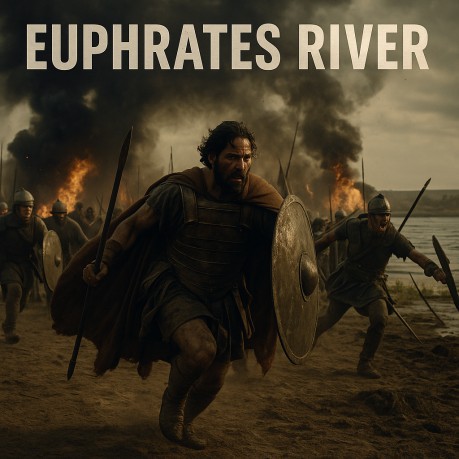
The sixth bowl judgment mirrors the sixth trumpet. In the Old
Testament, the Persians diverted the Euphrates to conquer Babylon in
539 B.C. The riverbed dried and Cyrus' forces marched under Babylon's
walls with ease (Daniel 5).
† God once used
the Red Sea (Exodus 14:21-22) and the Jordan River (Joshua 3:9-17;
4:22-24) to rescue His people. Here He uses a similar picture to
judge His enemies.
† Many see the Babylon of
Revelation as Rome and point to the empire's fall in the fifth
century A.D. But Revelation's timeline points to the first century
destruction of Jerusalem, spiritual Babylon.
†
The Euphrates River was the eastern boundary of the Roman Empire, a
natural defense line and a constant symbol of the edge of power. To a
first century audience, the drying of this great river pictured the
removal of a mighty barrier, opening the way for armies to cross.
†
In the ancient world the Euphrates was seen as the life source of
Mesopotamia, feeding cities and trade routes. To dry it up was to
signal the collapse of an entire system of strength and supply.
†
Prophets like Jeremiah (Jeremiah 46:10) and Isaiah (Isaiah 11:15)
spoke of the Lord striking or drying the Euphrates to make a path for
His judgment. John draws on that same prophetic tradition.
†
Revelation links the Euphrates at 9:14 and 16:12, showing a
consistent first century theater for the sixth trumpet and sixth
bowl.
† Josephus records that reinforcements
for Titus came from the Euphrates region. These troops crossed the
river to join the siege of Jerusalem, a literal fulfillment of the
picture John describes.
† Ancient records
show that Rome kept legions stationed along the Euphrates to guard
against Parthian invasions. When those troops were summoned west to
Judea, the Euphrates became the route of judgment.
†
Revelation 17 pictures a prostitute riding a seven-headed beast. The
beast is Rome. The woman is Jerusalem, joined to Rome in an
adulterous alliance.
† 1 Corinthians 6:16
says, "The one who joins himself to a prostitute is one body
with her. For He says, 'The two shall become one flesh.'"
Jerusalem became one flesh with Rome, taking on Rome's symbolic name:
Babylon.
† Like ancient Babylon, Rome
destroyed the temple and scattered the people. Jerusalem's called
Babylon because she united with the beast and shared its fate.
† From
John's vantage point on Patmos, the "kings of the east"
were real rulers east of Asia Minor. History records Sohaemus of
Sophene and Antiochus of Commagene aiding Titus during the siege of
Jerusalem.
† The kings of the east fits at
minimum Sohaemus and Antiochus, eastern client kings who aided Titus
during the siege of Jerusalem.
† Josephus
writes that Roman reinforcements came from the region of the
Euphrates. Thousands of auxiliaries from the Euphrates frontier
joined Titus, turning the river corridor into a highway of
judgment.
† The Euphrates, once a barrier,
became a highway for judgment, just as it had been for Cyrus against
Babylon.
† The drying of the Euphrates
signals God's direct action: He removes what nations trust for
protection and lets His decree of judgment flow unhindered.
† The
phrase "kings of the east" also recalls the ancient
Babylonian empire east of Israel, reinforcing the image of Jerusalem
as the new Babylon.
† Rome itself is called
Babylon in Revelation. Though west of Israel geographically, Rome
took on the symbolic title. The drying of the Euphrates poetically
points to both the literal river and the spiritual fall of those
cities called Babylon.
† The Euphrates stands
as a covenantal marker: when God dries it, He shows that no earthly
boundary can block His purpose. The river that once protected empires
becomes the very path of their defeat.
Several well-known
ancient writers describe the Euphrates River and events tied to it.
Here are some key examples that connect directly to the historical
background of Revelation 16:12:
† Josephus
(1st century A.D.) In Jewish War 5.1 and 5.13 he reports that Roman
reinforcements for Titus came from the region of the Euphrates.
Troops stationed along the river crossed west to join the siege of
Jerusalem. This matches the image of "kings from the east"
crossing the Euphrates.
† Tacitus (1st
century A.D.) In Histories 5.10-13 he notes that Roman forces and
auxiliaries from Syria and the Euphrates frontier were sent to crush
the Jewish revolt. He records the Euphrates as a key military
boundary of the empire.
† Pliny the Elder
(1st century A.D.) In Natural History 6.26-32 he describes the
Euphrates' geography, its trade routes, and how engineers controlled
or diverted its waters for irrigation and military strategy,
illustrating how armies could manipulate the river.
†
Herodotus (5th century B.C.) In Histories 1.191 he details how Cyrus
diverted the Euphrates to enter Babylon, the classic precedent John
alludes to when the river is "dried up."
These
accounts show that the Euphrates was famous both as a life-giving
river and as a strategic military highway. Early readers of
Revelation would have known these records and recognized that John's
vision of the river "drying up" pointed to God removing a
mighty natural barrier so armies from the east could march
unhindered, just as had happened in both Babylon's fall and Rome's
first-century campaigns.
†
Many churches avoid these details, teaching a distant future
fulfillment to keep members looking for signs instead of seeing
Christ's finished work.
† Revelation isn't a
riddle for a far off generation. It's a testimony of God's covenant
faithfulness and judgment in the first century.
†
The drying of the Euphrates shows that God removes every barrier when
He brings justice. He delivered His true covenant people and judged
the harlot city.
† Josephus,
Jewish War 5.1, 5.13 Tacitus, Histories 5.10-13 Pliny the Elder,
Natural History 6.26-32 Herodotus, Histories 1.191 Revelation 1:1-3,
1:19, 9:14, 16:12-16, 17:1-18, 22:6, 22:10, 22:12, 22:20 Exodus
14:21-22, Joshua 3:9-17, 4:22-24 Daniel 5 Jeremiah 46:10 Isaiah 8:7-8
Isaiah 11:15 1 Corinthians 6:16
Links