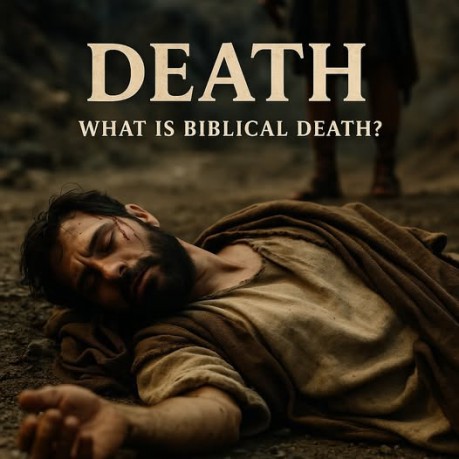
Death
- What is Biblical Death? 1
Corinthians 15:21 † In Adam, humanity
entered spiritual death, separation from God. Romans 5:12 and
Ephesians 2:1-5 describe this condition plainly, we were dead in
trespasses, yet God makes us alive together with Christ. Adam and the day of death Genesis 2:7 Genesis 2:15-17 † Adam and Eve
became living beings by God's breath, yet on the day they sinned
they died spiritually. Their eyes were opened, they hid from God's
presence, and they were expelled from the garden, all marks of
spiritual separation though their bodies continued for centuries. How do we become alive? John 11:25-26 † Jesus defines
real life in Himself. The believer who dies physically still lives,
and the one who lives and believes in Him will never die
spiritually. Victory over death 1 Corinthians 15:54-57 † Death's sting is
sin, and sin's power was the Law. In Christ's finished work, the Law
that condemned was brought to its appointed end for righteousness to
everyone who believes, Romans 10:4, and the old covenant was
becoming obsolete and ready to vanish away, Hebrews 8:13. What happens to believers when
we die? 2 Corinthians 5:8 Philippians 1:23 † Scripture anchors
our hope in immediate presence with Christ at death. There's no
delay in some shadow-land for the believer. Union with Christ's death and
life Romans 6:3-4 † Baptism isn't
just a symbol of washing but a sign of participation in Christ's
death. We're united with Him in what He accomplished, sharing in the
death that ended the old covenant order and brought a new
creation. Galatians 2:20 † Paul speaks of a
present reality. Our identity is no longer found in the old man but
in Christ living through us. The believer's daily life is the
outworking of Christ's own life, not a self-improvement project. Romans 6:5-8 † Union with Christ
means the death of the old man and freedom from sin's mastery. This
isn't a promise postponed to some future age but a present
liberation. Romans 7:4 † Through Christ's
body we died to the covenant of the Law. Our belonging has
changed—we're now joined to the risen Lord. Fruitfulness is the
result of this new union, not the cause of it. Galatians 3:27 † To be clothed
with Christ is to share His righteousness and His identity. It's the
fulfillment of the promise of a new covenant people where there is
neither Jew nor Greek, but all are one in Him. Colossians 2:12-13 † Paul ties
forgiveness, resurrection life, and baptism into one event. Through
faith we share His death and resurrection and are already made
alive. So, do we still need a future
resurrection to gain life? † We affirm what
the apostles taught. Christ was raised, 1 Corinthians 15:12-19, and
in Him the promised resurrection and judgment arrived on schedule
for that generation, Matthew 16:27-28, Matthew 24:34. How this applies to us today † Assurance, You
don't live under the threat of spiritual death. Your life is hidden
with Christ in God, Colossians 3:3. Historical Witnesses † Josephus (AD
37–100) records that many Jews of his day believed the righteous
would immediately enter a blessed state while the wicked suffered
apart from God (Antiquities 18.1.3). † This is the fulfilled
perspective we proclaim at Fulfilled Prophecies † Source Index
By Dan Maines
For since by a man came death, by a man also
came the resurrection of the dead.
†
Spiritual death is separation, not the end of existence. Isaiah 59:2
shows that iniquity separates from God, explaining why Adam could
live physically while being spiritually dead.
†
The gospel addresses this death at its root, restoring fellowship
with God now, not merely at some distant time.
Then the Lord God
formed man of dust from the ground, and breathed into his nostrils
the breath of life, and man became a living being.
From any tree of
the garden you may eat freely, but from the tree of the knowledge of
good and evil you shall not eat, for in the day that you eat from it
you will surely die.
†
This explains why Scripture can speak of people as physically alive
yet spiritually dead, and why salvation is described as being made
alive with Christ.
I am the
resurrection and the life; he who believes in Me will live even if
he dies, and everyone who lives and believes in Me will never die.
Do you believe this?
† John 5:24 confirms the same
promise, the one who hears and believes has eternal life, has passed
out of death into life. This is a present possession for the
believer.
But when
this perishable puts on the imperishable, and this mortal puts on
immortality, then will come about the saying that is written, Death
is swallowed up in victory.
Where, O death, is your victory?
Where, O death, is your sting?
The sting of death is sin, and
the power of sin is the Law, but thanks be to God, who gives us the
victory through our Lord Jesus Christ.
†
From the fulfilled perspective, the resurrection was a real,
covenantal, once-for-all transition that vindicated Christ and His
people. The dead were raised as promised, 1 Corinthians 15, 1
Thessalonians 4:16-17, and Death and Hades were judged, Revelation
20:13-14.
† Before this victory, saints who
died were described as in Sheol or Hades, Luke 16:22, Psalm 16:10 as
cited in Acts 2:27. Christ opened the way to the Father's presence,
Luke 23:43, Hebrews 9:24-28.
† Paradise is
now with God, and believers don't return to Hades. At physical death
we're with the Lord.
We are of good
courage, and prefer rather to be absent from the body and to be at
home with the Lord.
Having the
desire to depart and be with Christ, for that is very much better.
†
Where there is no death's dominion, there's no need to await another
resurrection to receive life. We already possess eternal life in
Christ, John 17:3.
Or do you not know
that all of us who have been baptized into Christ Jesus have been
baptized into His death? Therefore we have been buried with Him
through baptism into death, so that, just as Christ was raised from
the dead through the glory of the Father, so we too may walk in
newness of life.
† To be buried with Him is to have
our old self counted as finished. This is covenantal language,
describing our shift from the realm of sin and law to the realm of
grace.
I have been
crucified with Christ, and it's no longer I who live, but Christ
lives in me, and the life which I now live in the flesh I live by
faith in the Son of God, who loved me and gave Himself up for me.
For if we have
become united with Him in the likeness of His death, certainly we
shall also be in the likeness of His resurrection, knowing this,
that our old self was crucified with Him, in order that our body of
sin might be done away with, so that we would no longer be slaves to
sin, for the one who has died is freed from sin. Now if we have died
with Christ, we believe that we shall also live with Him.
† The likeness of His
resurrection is the new life of the Spirit now, not merely a bodily
event later.
Therefore, my brothers
and sisters, you also were put to death in regard to the Law through
the body of Christ, so that you might belong to another, to Him who
was raised from the dead, in order that we might bear fruit for God.
For all of you who
were baptized into Christ have clothed yourselves with Christ.
Having been
buried with Him in baptism, in which you were also raised with Him
through faith in the working of God, who raised Him from the dead.
And when you were dead in your wrongdoings and the uncircumcision of
your flesh, He made you alive together with Him, having forgiven us
all our wrongdoings.
† This is the heart of fulfilled
life: no waiting for another age, we're forgiven and alive with
Christ now.
†
We have eternal life now, John 3:36, John 5:24. We can't ever die
spiritually, John 11:26. Therefore, we don't await life, we live
from it. At death, we go immediately to be with Christ, 2
Corinthians 5:8, Philippians 1:23.
† As
believers, we've put on immortality in Christ. Physical death is the
shedding of the mortal body, not a loss of life. We continue in
God's presence.
†
Freedom, The Law's condemning power is gone in Christ, so guilt and
fear don't rule you, Romans 8:1-2.
†
Presence, You already share resurrection life. Prayer, worship, and
mission flow from union with the risen Lord.
†
Hope, When a believer dies, it's departure to be with Christ. We
grieve with hope, 1 Thessalonians 4:13-14.
† Philo
of Alexandria (c. 20 BC–AD 50) wrote of the soul's immortality and
of the righteous entering the presence of God beyond the body (On
the Creation 135–139).
† Clement of Rome
(c. AD 96) spoke of those who have finished their course and entered
into the place promised them by the Lord (1 Clement 5).
†
Ignatius of Antioch (c. AD 110) affirmed that when he died he'll be
with Christ, not waiting in a distant future age (Letter to the
Romans 5–7).
† Polycarp (c. AD 155)
encouraged believers that those who die are with the Lord awaiting
the final appearing already vindicated (Martyrdom of Polycarp 14).
†
Genesis 2:7, 15-17; Isaiah 59:2; John 5:24; 11:25-26; 17:3; Romans
5:12; 6:3-8; 7:4; 8:1-2; 10:4; Galatians 2:20; 3:27; Ephesians
2:1-6; Colossians 2:12-13; 3:1-3; 1 Corinthians 15:12-19, 21, 54-57;
1 Thessalonians 4:13-17; 2 Corinthians 5:6-8; Philippians 1:21-23;
Hebrews 8:13; 9:24-28; Luke 16:19-31; 23:43; Matthew 16:27-28;
24:34; Revelation 20:13-14
Links