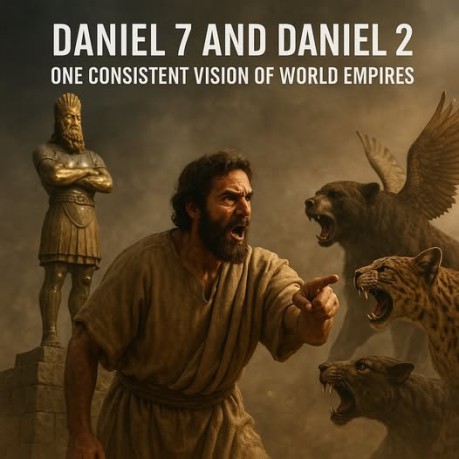
Daniel 7 and Daniel 2 – One Consistent Vision of World
Empires Daniel's
prophecy shows a single, unified picture of the kingdoms that
ruled God's covenant people from Babylon to the arrival of
Christ's everlasting kingdom. Some teachers claim the beasts of
Daniel 7 cannot represent the same empires as the metals in Daniel
2. They point to Daniel 8:20-21, where the ram is identified as
Medo-Persia and the goat as Greece, and argue these true beastly
symbols mean the bear and the leopard of chapter 7 must be
something else. Scripture shows otherwise. Daniel 2 – The Four
Metals Daniel 7 – The Four
Beasts Why Daniel 8 Doesn't Break
the Pattern Historical Fulfillment One Continuous Prophecy How This Applies Today Historical Writers † This is the fulfilled perspective we proclaim at
Fulfilled Prophecies † Daniel 2 – The Four
Metals Daniel 7 – The Four
Beasts Daniel 8 – Identification
of Medo-Persia and Greece Historical Fulfillment
Timeline Unification and Fulfillment
in Christ Medo-Persia as one kingdom Early Christian and Jewish
testimony How This Applies Today
By Dan Maines
Daniel 2:37-38 Head of gold –
Babylon
Daniel 2:39 Chest and arms of silver –
Medo-Persia
Daniel 2:39 Belly and thighs of bronze –
Greece
Daniel 2:40 Legs of iron with feet of iron and clay –
Rome
† God interprets these for us: In the
days of those kings the God of heaven will set up a kingdom which
will never be destroyed (Daniel 2:44). This points to the
first-century arrival of Christ's kingdom.
†
The four metals portray a steady decline in glory and strength,
showing the impermanence of earthly empires compared to God's
eternal rule.
† The mixed iron and clay
feet reveal a divided final empire, historically fulfilled in the
fragile alliances of Rome's provinces.
†
Early church writers such as Hippolytus affirmed this sequence,
identifying the fourth kingdom with Rome long before modern debate
arose.
† The stone cut without hands
points directly to Christ's kingdom, not a future earthly empire,
but a spiritual reign inaugurated in the first century.
Daniel later sees four beasts rise from the
sea.
Lion with eagle's wings
Bear raised up on one
side
Leopard with four wings and four heads
A dreadful
beast with iron teeth
† The angel
explains: These great beasts are four kings which will arise from
the earth (Daniel 7:17). The sequence matches the four in Daniel
2. The imagery changes from metals to animals, but the order and
meaning stay the same, world empires dominating God's people until
Messiah reigns.
† The lion's plucked wings
mirror Babylon's humbling under God, matching Nebuchadnezzar's own
fall and restoration (Daniel 4:28-37).
†
The bear lifted on one side fits the unequal partnership of the
Medes and Persians, one side stronger than the other (Daniel
8:3).
† The leopard with four heads
reflects the rapid Greek conquest and the fourfold division after
Alexander's death (Daniel 8:8, 8:22).
†
The dreadful beast with iron teeth clearly matches Rome's
unmatched power and the iron legs of Daniel 2 (Daniel 7:7,
7:23).
† Daniel 7:26-27 shows the handoff
of dominion to the saints, perfectly matching Hebrews 12:28 where
believers receive a kingdom that cannot be shaken.
Daniel 8 narrows the lens to focus on
the second and third empires only. The angel says plainly: The ram
which you saw with the two horns represents the kings of Media and
Persia. The shaggy goat represents the kingdom of Greece (Daniel
8:20-21).
† This is not a new set of
symbols replacing the earlier ones. It is a close-up of the
Medo-Persian and Greek phase, giving more detail about how Greece
would rise and splinter, fulfilled in Alexander the Great and his
four generals.
† Daniel 8 confirms, rather
than contradicts, the sequence of Daniel 2 and 7 by naming
Medo-Persia and Greece explicitly.
† The
vision highlights God's sovereignty in revealing the exact empires
centuries in advance, silencing claims of coincidence.
†
Historical records from Josephus show that Jewish leaders
recognized these prophecies as fulfilled in Alexander's day
(Antiquities 11.8.5).
† The detail of the
great horn broken and replaced by four smaller horns perfectly
fits the historical division among Alexander's generals (Daniel
8:8, 8:22).
† The four Diadochi named in
history—Cassander, Lysimachus, Seleucus, and Ptolemy—fulfill
this prophecy exactly, confirming the inspired precision of
Daniel's vision.
†
Babylon fell to the Medes and Persians (539 BC, Daniel 5:30-31).
†
Greece, led by Alexander, conquered Persia (331 BC, Daniel
8:21-22).
† Rome absorbed the Greek world
and ruled during Christ's ministry and the destruction of
Jerusalem (AD 70, Luke 21:20-24).
All four empires ruled
consecutively, just as Daniel 2 and 7 predict.
†
The accuracy of these fulfillments proves that biblical prophecy
is anchored in verifiable history.
†
Secular historians like Tacitus and Josephus confirm Rome's
dominance during the time of Christ and the fall of Jerusalem
(Tacitus Histories 5:11-13, Josephus War 6.8.5).
†
The destruction of the Temple in AD 70 stands as the decisive end
of the old covenant order (Matthew 24:1-2, Luke 21:5-6).
†
Each empire's fall demonstrates that human power is temporary, but
God's kingdom endures forever (Hebrews 12:28).
†
Luke 21:22 adds Christ's own declaration: "These are days of
vengeance, so that all things which are written will be
fulfilled," confirming that Daniel's timeline reached its
completion in that generation.
The
claim that Daniel 7's beasts are different from Daniel 2's metals
ignores the angelic explanation. Both visions outline the same
succession of kingdoms, culminating in the kingdom of God that
would never be destroyed, a kingdom inaugurated by Christ in the
first century (Luke 1:32-33, Hebrews 12:28).
†
The repetition of the same empires in multiple visions reinforces
the certainty of the message.
† Christ's
kingdom was not postponed but established, fulfilling the stone
that struck the statue and the Son of Man receiving dominion
(Daniel 2:34-35, Daniel 7:13-14).
† Early
Christian writers consistently interpreted these prophecies as
completed in their own generation (Eusebius Ecclesiastical History
3.5).
† This unified timeline leaves no
room for a future earthly empire to fit between the fourth kingdom
and Christ's reign.
† The passive
singulars describing the ram in Daniel 8:3-4 underscore that
Medo-Persia is a single united kingdom, answering objections that
try to split Media and Persia into separate prophetic empires.
†
Christ's kingdom is present now, giving believers confidence that
no political power can overthrow God's rule (Colossians 1:13).
†
We are called to live as citizens of that unshakable kingdom,
showing loyalty to Christ above all nations (Philippians 3:20).
†
The fall of every earthly empire reminds us that our security is
not in governments or economies but in God's promises (Psalm
46:1-2).
† The fulfilled prophecies
strengthen our witness, proving that God's word is true and
encouraging us to proclaim His reign with boldness (Revelation
1:5-6).
†
Josephus – The Jewish War 6.8.5, Antiquities of the Jews 11.8.5
document the fall of Jerusalem and Rome's supremacy, aligning with
Daniel's outline.
† Tacitus – Histories
5.11-13, The Annals 15.44 describe Rome's dominance, Nero's
persecution, and first-century conditions tied to the New
Testament setting.
† Eusebius –
Ecclesiastical History 3.5, 3.7 records the early church's
testimony that Christ's kingdom had begun and that Daniel's
visions were fulfilled.
† Hippolytus –
Commentary on Daniel 4.9 identifies the fourth kingdom as Rome,
reflecting the ancient Christian consensus on Daniel 2 and 7.Proof Appendix –
Every statement sourced
† Babylon as head of gold:
Daniel 2:37-38
† Second, third, fourth
kingdoms follow: Daniel 2:39-40
† Feet of
iron and clay: Daniel 2:41-43
†
Everlasting kingdom established: Daniel 2:44-45
†
Early Christian identification of the fourth kingdom as Rome:
Hippolytus, Commentary on Daniel 4.9
† Four beasts = four
kings/kingdoms: Daniel 7:3, 7:17, 7:23
†
Lion imagery with Nebuchadnezzar's humbling: Daniel 4:28-37
†
Bear lifted on one side: Daniel 8:3
†
Leopard with four heads/wings: Daniel 8:8, 8:22
†
Dreadful beast with iron teeth: Daniel 7:7, 7:23
†
Dominion to the saints: Daniel 7:26-27
† Ram =
Medo-Persia, Goat = Greece: Daniel 8:20-21
†
Great horn broken, four arise: Daniel 8:8, 8:22
†
Four Diadochi successors: Cassander, Lysimachus, Seleucus, Ptolemy
(Diodorus Siculus 18-20, Arrian Anabasis 7, Plutarch Life of
Alexander)
† Babylon falls 539 BC:
Daniel 5:30-31; Nabonidus Chronicle
†
Greece defeats Persia 331 BC: Daniel 8:21-22; Arrian Anabasis
3.15-16
† Roman domination and Jerusalem's
fall AD 70: Luke 21:20-24; Tacitus Histories 5.11-13; Josephus War
6.8.5
† Christ receives
everlasting kingdom: Daniel 7:13-14; Luke 1:32-33
†
Believers receive unshakable kingdom: Hebrews 12:28
†
All things fulfilled in first century: Luke 21:22
†
Transfer of dominion to the saints: Daniel 7:26-27; Hebrews 12:28;
Revelation 1:5-6
†
Ram identified as Media and Persia together: Daniel 8:20
†
Unified action of the ram described with singular verbs: Daniel
8:3-4
† Josephus: War 6.8.5,
Antiquities 11.8.5
† Tacitus: Histories
5.11-13, Annals 15.44
† Eusebius:
Ecclesiastical History 3.5, 3.7
†
Hippolytus: Commentary on Daniel 4.9
†
Present transfer into Christ's kingdom: Colossians 1:13
†
Heavenly citizenship now: Philippians 3:20
†
God as refuge beyond political upheavals: Psalm 46:1-2
†
Priestly standing and present kingdom service: Revelation 1:5-6
Links