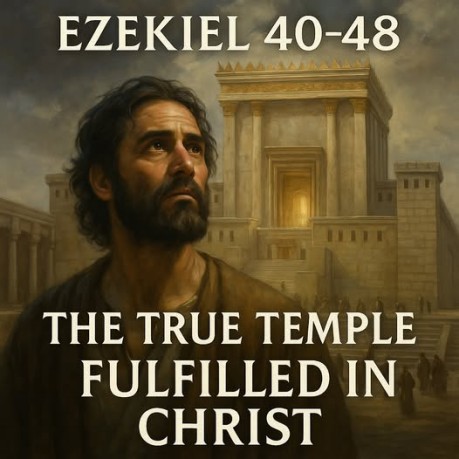
Ezekiel
40-48 and the Fulfillment in Christ Ezekiel
40:2-4 † Ezekiel's temple
vision came after the first temple had been destroyed by Babylon.
The people longed for restoration, but what God revealed was not a
blueprint for another physical temple, but a symbolic vision of His
future dwelling with His people. Ezekiel 43:4-5 † The glory that
Ezekiel saw filling the temple is fulfilled in Christ. John 1:14
says, And the Word became flesh and dwelt among us, and we saw His
glory. Ezekiel 47:1, 9 † This river of
life is not physical water, but the Spirit of God flowing from
Christ to the nations. Ezekiel 48:35 † This is the
climax of Ezekiel's vision. The city is not literal, it is the
dwelling of God with His people. How it applies to us today † This is the fulfilled
perspective we proclaim at Fulfilled Prophecies † Source Index
By Dan Maines
In the visions of God He brought me into the
land of Israel and set me on a very high mountain, and on it to the
south there was something like the structure of a city. So He
brought me there, and behold, there was a man whose appearance was
like the appearance of bronze, with a thread of flax and a measuring
rod in his hand, and he was standing in the gateway. And the man
said to me, Son of man, see with your eyes, hear with your ears, and
pay attention to all that I am going to show you, for you have been
brought here in order to show it to you. Declare to the house of
Israel everything that you see.
† The angel
with the measuring rod is the same image later used in Revelation
21, showing continuity between Ezekiel's temple and the New
Jerusalem.
† Josephus writes that the Jews
who returned from Babylon built a modest temple (Ezra 6), but it
never matched Ezekiel's vision. This shows the prophecy was pointing
to something greater.
And
the glory of the Lord came into the house by way of the gate facing
east. And the Spirit lifted me up and brought me into the inner
courtyard, and behold, the glory of the Lord filled the house.
† The old temple had lost its glory
and was destroyed. The true temple was Christ Himself, filled with
the glory of God.
† Eusebius testifies that
after Christ's coming, the church understood itself to be the new
temple of God, indwelt by His Spirit (Ecclesiastical History 2.3).
Then
he brought me back to the door of the house, and behold, water was
flowing from under the threshold of the house toward the east, for
the house faced east. And the water was flowing down from under the
right side of the house, from south of the altar. And it will come
about that every living creature which swarms in every place the
river goes, will live. And there will be very many fish, for these
waters go there and the others become fresh. So everything will live
where the river goes.
† Jesus declared this
openly in John 7:38, The one who believes in Me, as the Scripture
said, From his innermost being will flow rivers of living water.
†
Tacitus mentions that after the fall of Jerusalem, the Christian
movement spread rapidly across the empire, like living waters
reaching many nations (Histories 5.13).
The
city shall be eighteen thousand cubits round about, and the name of
the city from that day shall be, The Lord is there.
†
Revelation 21:2, 22 explains this clearly: the New Jerusalem is the
bride, the church, and there is no temple in it, for the Lord God
Almighty and the Lamb are its temple.
† This
shows the complete fulfillment: God no longer dwells in stone
buildings, but among His people forever.
†
Ezekiel's temple was never about physical architecture. It was about
God's promise to dwell with His people in a greater way.
†
That promise is fulfilled in Christ, who is the true temple, and in
His church, which is His body.
† The river
of life flows today as the Spirit works through the gospel, bringing
life to all who believe.
† We live in the
reality of the New Jerusalem, where God is with us, and His glory
fills His people.
†
Josephus – Antiquities 11.4-6
† Tacitus –
Histories 5.13
† Eusebius – Ecclesiastical
History 2.3
† Philo – The Embassy to Gaius
Links