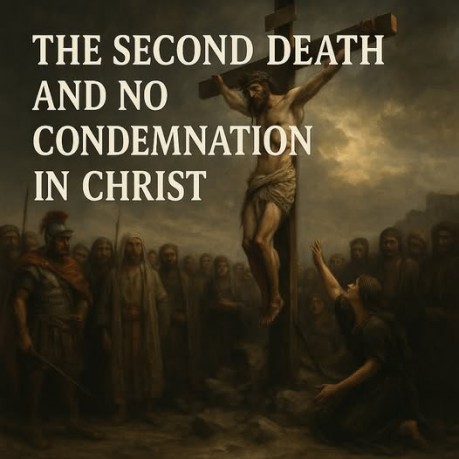
The
Second Death and No Condemnation in Christ †
The heart of Revelation's message isn't fear of future doom, it's
assurance that Christ finished the work of judgment in the first
century. The second death already fell on apostate Israel, while the
faithful were raised in covenant life and secured in the kingdom.
That is why Paul could say in Romans 8:1 that there is now no
condemnation for those in Christ Jesus. Revelation is not about our
future, but about how God ended the Old Covenant world and brought
His people into the New Covenant reality. Revelation 4:1 † Some interpret
this as moving all fulfillment into heaven, but the open door is
John's vantage point, not the location of events. Like Ezekiel 8:3
and Daniel 7:9-14, John was given a heavenly view of judgment that
had direct relevance on earth. Audience relevance is preserved by
John's repeated statements in Revelation 1:1-3 that the time was
near. John says the time was near, John is told not to seal the
book, Jesus promises repayment according to deeds within the
lifetime of some standing there, and He says all these things would
come upon that generation. These four timing anchors rule out a
distant fulfillment and fix the judgment in the first century. Relevance to the Sheep † Revelation 2:10,
3:10 show Jesus warning first-century believers to overcome because
tribulation was imminent. The seven letters prove these were living
Christians who had to endure until the end. Revelation 7:3-4 shows
the sheep sealed and protected, not already all on the other side.
Audience relevance demands the sheep were on earth when John wrote. Nineveh, Tyre, Sidon, and
Sodom as Witnesses † Matthew 10:15,
11:22-24, and 12:41 show these groups as courtroom witnesses against
Israel. It is not literal resurrection, but testimony language.
Their past responses condemned Israel's unbelief. Hebrews 11:4
confirms this same pattern: Abel still speaks, even though he is
dead. Abel didn't walk into a courtroom either, but his life
testified against unbelief. Scripture treats them as a great cloud
of witnesses and rests judgments on two or three witnesses (Hebrews
12:1, Deuteronomy 19:15), reinforcing that this is courtroom
testimony language, not a mass resurrection scene. † Jesus' point was
that Israel's guilt was greater than Nineveh's, Tyre's, or even
Sodom's. All these stood as witnesses highlighting the hardness of
Israel's heart. That is why Jesus said all these things would come
upon that generation (Matthew 23:36). † Josephus confirms
the same truth. In Wars of the Jews 5.13.6 he wrote: I suppose that
had the Romans delayed to come against these villains, the city
would either have been swallowed up by the ground opening under
them, or been overflowed by water, or else been destroyed by such
thunder as the country of Sodom perished by. In other words,
Israel's sin had become worse than Sodom's, exactly as Jesus
declared. † Tacitus also
confirms the horrors of that generation, describing Jerusalem as
overflowing with every crime (Histories 5.12). Their wickedness made
their destruction unavoidable, proving Jesus' words of judgment. The White Throne Judgment
Fulfilled † Revelation
20:11-15 is the same first-century judgment complex described in 2
Corinthians 5:10 and Matthew 16:27-28. The White Throne, the
judgment seat of Christ, and the Son of Man repaying each according
to his deeds converge in timing, audience, and function, forming one
first century judgment complex. The phrase heaven and earth fled is
covenantal, not cosmic (Isaiah 34:4, Haggai 2:6-7, Isaiah 13:10,
Jeremiah 4:23-28). The dead are covenantally dead under the Old
Covenant, judged by the books of covenant records. Revelation 22:10
contrasts Daniel 12:4, Daniel sealed his vision because fulfillment
was far, John was told not to seal his because fulfillment was near. The Second Death Defined † Revelation 20:14,
21:8 defines the second death as the lake of fire. It is covenant
exclusion, not biological death twice. Jesus described the same in
Matthew 8:12, where the sons of the kingdom were cast into outer
darkness. Daniel 12:2 confirms this covenant resurrection and
exclusion tied to the first century end. Jesus' own wording about
being cast out with weeping and gnashing of teeth, Luke 13:28,
matches Revelation's lake of fire exclusion and points to covenant
removal, not a second biological demise. Hebrews 9:27 and the Judgment † Hebrews 9:26-28
ties judgment to the once for all death of Christ at the end of the
ages. It is not a universal courtroom scene for every individual,
but covenant judgment following the death of the Old Covenant.
Hebrews 11:4-5, 12:1 ties this to witness language: the faithful
testified to covenant faithfulness, just as Nineveh testified
against Israel. The theme is consistent, covenant death, followed by
covenant judgment. The Judgment of Good and Bad
Works † 2 Corinthians
5:10, Matthew 16:27-28, and Revelation 22:12 all speak of judgment
according to deeds in that generation. It was not about eternal
destiny for all mankind, but covenant separation of sheep and goats.
Faithful overcomers inherited the New Jerusalem, unfaithful covenant
breakers perished in the second death. Paul and Peter agree with
Jesus: God will render to each according to his works and the end of
all things is at hand (Romans 2:6, 1 Peter 4:5-7), fixing the works
judgment inside the apostolic generation. † Josephus records
how the judgment fell in Jerusalem. In Wars 6.9.3 he described the
slaughter as so great that the number of those that perished
exceeded all the destructions that either men or God ever brought
upon the world. This was the recompense of that generation. Does the Second Death Mean
Literal Death Twice? † Revelation 20:14
defines it as covenant exclusion. If apocalyptic language were
literal, we would have to accept Matthew 24:29, Isaiah 34:4, Micah
1:4, and many other passages as describing physical stars falling,
heavens rolling, and mountains melting. But these were fulfilled
symbolically. The second death is the same, judgment language,
fulfilled covenantally in that generation. Romans 8:1 and No Condemnation
Today † Romans 8:1
declares no condemnation for those in Christ. John 5:24 says
believers pass from death to life without coming into judgment.
Romans 8:38-39 says nothing can separate us from the love of God.
These are covenant realities secured after AD 70, not vague promises
for the distant future. The Book of Life as Present
Reality † Philippians 4:3
speaks of living believers as already written in the book of life.
Revelation 21:27 shows that only those written in it may enter the
New Jerusalem, which is the church, the bride. John 3:18 and 1 John
4:17 confirm believers have confidence in judgment, because judgment
is behind us. How It Applies Today † The White Throne
judgment has already taken place. Apostate Israel experienced the
second death, while the faithful inherited the New Jerusalem. The
Old Covenant passed away, and the New Covenant order was
established. Romans 8:1 is our present reality, no condemnation for
those in Christ Jesus. God dwells in us as His temple (1 Corinthians
3:16). The second death is past. What remains is eternal life in the
kingdom that has no end. † This is the fulfilled
perspective we proclaim at Fulfilled Prophecies † Source Index
By Dan Maines
†
Josephus, Wars of the Jews 5.12.3, 5.13.6, 6.3.4, 6.8.5, 6.9.3
†
Tacitus, Histories 5.1, 5.12
Links