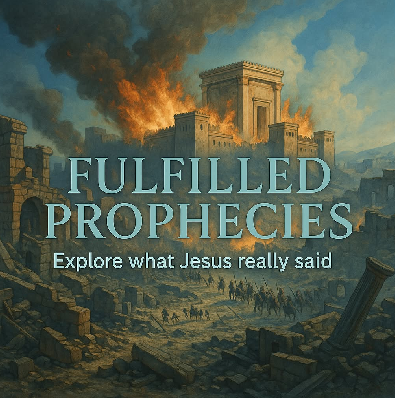
"No One Knows the Day or the Hour" - What Did Jesus
Really Mean?
Just before Jesus said "But about that day and hour no one
knows" (Matthew 24:36), He also said, "Truly I say to you,
this generation will not pass away until all these things take
place." (Matthew 24:34, NASB) Let that sink in. Jesus was not
speaking of a future generation thousands of years later. He was
talking to His disciples in the first century. The phrase "this
generation" always means the generation alive at the time Jesus
was speaking. (See Matthew 11:16; 12:38-45; 23:36; 24:34; Mark
8:38-9:1; Luke 7:31; 11:29-32; 17:25.) So what did He mean by "no one
knows the day or the hour"? Simple. He meant that while the
destruction of Jerusalem, the fall of the Temple, His Parousia
(divine presence), and the resurrection would happen within
that generation, no one knew the exact day
or hour. It would take place during a 3-1/2 year period (66-70 AD),
and they were to be watchful. Compare this with Luke 21:20-22 - "But
when you see Jerusalem surrounded by armies, then recognize that her
desolation is near. Then those who are in Judea must flee to the
mountains... because these are days of punishment, so that all
things which have been written will be fulfilled." Luke 21:32 - "Truly I say to you,
this generation will not pass away until all things take place." There it is again - this
generation. All those things - not future events thousands
of years off. The Apostle Paul confirms this
urgency: 1 Thessalonians 5:1 - "Now as to the periods and
times, brothers and sisters, you have no need of anything to be
written to you." Why? 1 Thessalonians 5:4 - "But you,
brothers and sisters, are not in darkness, so that the day would
overtake you like a thief." They were not in
darkness. Not us - them. They knew the season and the signs, just as
Jesus had taught. Jesus and John the Baptist both said the Kingdom was at
hand: Matthew 3:2 - "Repent, for
the kingdom of heaven is at hand." Matthew 4:17 - "Repent, for the kingdom of heaven is at
hand." Does "at hand" mean 2,000
years away? If you think so, you're saying God doesn't know how to
tell time. 2 Peter 3:8 is often quoted to deny
imminence - "With the Lord one day is like a thousand years,
and a thousand years like one day." But the context is scoffers
questioning Jesus' promised return in their generation. Peter warns
them not to mistake God's patience for slackness. He writes in the
60s AD of a soon-coming day - the destruction of Jerusalem was only
years away. Look at how God speaks of time elsewhere: Daniel 10:1 - "the message
was true and one of great conflict, but he understood the message
and had an understanding of the vision." Daniel 10:14 - "Now I have come to help you understand
what will happen to your people in the latter days, because the
vision pertains to the days still future." God says 600 years is "a long
time" in Daniel. He did not use phrases like "at hand"
or "soon" there. But in the New Testament, He does.
That's a big difference. When God told Israel that judgment was
at hand in Ezekiel 7, He meant it. It happened quickly. So when
Jesus and His apostles said "soon," "quickly,"
or "at hand" - they meant it. Not thousands of years
later. The futurist view ignores the
immediate time statements Jesus gave. When He said "this
generation," He meant the generation standing in front of Him.
When He said "some standing here will not taste death until
they see the Son of Man coming in His kingdom" (Matthew 16:28),
He wasn't talking about people 2,000 years in the future. God can tell time. Man just doesn't
like what He actually said.
By Dan Maines
Links