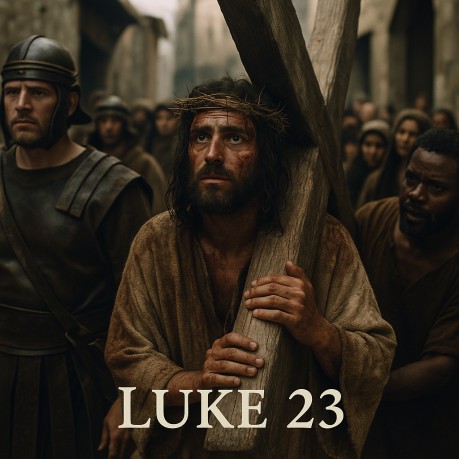
Luke 23 Luke 23:1-12 Now when Pilate heard this, he asked whether the man was a
Galilean. And when he learned that He belonged to Herod's
jurisdiction, he sent Him to Herod, who was also in Jerusalem at that
time. Now Herod was overjoyed when he saw Jesus; for he had wanted to
see Him for a long time, because he had been hearing about Him and
was hoping to see some sign performed by Him. And he questioned Him
at some length; but He offered him no answer at all. Now the chief
priests and the scribes stood there, vehemently charging Him. And
Herod, together with his soldiers, treated Him with contempt and
mocked Him, dressing Him in a brightly shining robe, and then sent
Him back to Pilate. And so Herod and Pilate became friends with one
another that very day; for previously, they had been enemies toward
each other. † Pilate and Herod found no guilt in Christ,
yet mocked Him. Luke 23:13-25 Now he was obligated to release to them at the feast one prisoner.
But they cried out all together, saying, "Away with this man,
and release to us Barabbas!" (He was one who had been thrown
into prison for a revolt that took place in the city, and for
murder.) But Pilate, wanting to release Jesus, addressed them again,
but they kept on crying out, saying, "Crucify, crucify Him!"
And he said to them a third time, "Why, what has this man done
wrong? I have found in His case no grounds for a sentence of death;
therefore I will punish Him and release Him." But they were
insistent, with loud voices, demanding that He be crucified. And
their voices began to prevail. And so Pilate decided to have their
demand carried out. And he released the man for whom they were
asking, who had been thrown into prison for a revolt and murder; but
he handed Jesus over to their demand. † Barabbas, guilty of revolt and murder, was
freed while the innocent Christ was condemned. Luke 23:26-43 Two others, who were criminals, were also being led away to be put
to death with Him. And when they came to the place called The Skull,
there they crucified Him and the criminals, one on the right and the
other on the left. But Jesus was saying, "Father, forgive them;
for they do not know what they are doing." And they cast lots,
dividing His garments among themselves. And the people stood by,
watching. And even the rulers were sneering at Him, saying, "He
saved others; let Him save Himself if this is the Christ of God, His
Chosen One." The soldiers also ridiculed Him, coming up to Him,
offering Him sour wine, and saying, "If You are the King of the
Jews, save Yourself!" Now there was also an inscription above
Him: "THIS IS THE KING OF THE JEWS." Now one of the criminals who were hanging there was hurling abuse
at Him, saying, "Are You not the Christ? Save Yourself and us!"
But the other responded, and rebuking him, said, "Do you not
even fear God, since you are under the same sentence of condemnation?
And we indeed are suffering justly, for we are receiving what we
deserve for our crimes; but this man has done nothing wrong."
And he was saying, "Jesus, remember me when You come into Your
kingdom!" And He said to him, "Truly I say to you, today
you will be with Me in Paradise." † Christ forgave even His executioners. Luke 23:44-49 † Darkness and the torn veil signified the end
of the old covenant order. Luke 23:50-56 † Joseph of Arimathea courageously cared for
Jesus' body. How it applies to us today: † This is the fulfilled perspective we proclaim at
Fulfilled Prophecies † Source Index
By Dan Maines
Then the entire assembly of
them set out and brought Him before Pilate. And they began to bring
charges against Him, saying, "We found this man misleading our
nation and forbidding us to pay taxes to Caesar, and saying that He
Himself is Christ, a King." Now Pilate asked Him, saying, "So
You are the King of the Jews?" And He answered him and said, "It
is as you say." But Pilate said to the chief priests and the
crowds, "I find no grounds for charges in the case of this man."
But they kept on insisting, saying, "He is stirring up the
people, teaching all over Judea, starting from Galilee as far as this
place!"
† The leaders' accusations
revealed their hatred, not truth.
† Christ's
silence fulfilled Isaiah 53:7.
Now Pilate summoned to himself
the chief priests, the rulers, and the people, and he said to them,
"You brought this man to me on the ground that He is misleading
the people; and behold, after examining Him before you, I have found
no basis at all in the case of this man for the charges which you are
bringing against Him. No, nor has Herod; for he sent Him back to us;
and behold, nothing deserving death has been done by Him. Therefore I
will punish Him and release Him."
†
The crowd chose violence over the Prince of Peace.
†
Pilate's weakness revealed compromise with injustice.
And when they led Him away,
they seized a man, Simon of Cyrene, as he was coming in from the
country, and placed on him the cross to carry behind Jesus. Now
following Him was a large crowd of the people, and women who were
mourning and grieving for Him. But Jesus turned to them and said,
"Daughters of Jerusalem, stop weeping for Me, but weep for
yourselves and for your children. For behold, days are coming when
they will say, ‘Blessed are those who cannot bear children, and the
wombs that have not given birth, and the breasts that have not
nursed.' Then they will begin to say to the mountains, ‘Fall on
us,' and to the hills, ‘Cover us.' For if they do these things when
the tree is green, what will happen when it is dry?"
†
The thief's faith secured his place in Paradise.
†
Jerusalem's women were warned of the city's coming judgment.
It was now about the sixth
hour, and darkness fell over the entire land until the ninth hour,
because the sun stopped shining; and the veil of the temple was torn
in two. And Jesus, crying out with a loud voice, said, "Father,
into Your hands I entrust My spirit." And having said this, He
died. Now when the centurion saw what had happened, he began praising
God, saying, "This man was in fact innocent!" And all the
crowds who came together for this spectacle, after watching what had
happened, began to return home, beating their chests. And all His
acquaintances, and the women who accompanied Him from Galilee, were
standing at a distance, watching these things.
† Christ's death
brought access to God through His sacrifice.
†
Even a Roman centurion declared His innocence.
And a man named Joseph, who
was a member of the Council, a good and righteous man (he had not
consented to their plan and action), a man from Arimathea, a city of
the Jews, who was waiting for the kingdom of God—this man went to
Pilate and asked for the body of Jesus. And he took it down and
wrapped it in a linen cloth, and laid Him in a tomb cut into the
rock, where no one had ever lain. It was a preparation day, and a
Sabbath was about to begin. Now the women who had come with Him from
Galilee followed, and they saw the tomb and how His body was laid.
And then they returned and prepared spices and perfumes. And on the
Sabbath they rested according to the commandment.
† The women faithfully prepared
to honor Him, even in grief.
† His burial
confirmed His real death, preparing for resurrection.
†
Luke 23 reveals the injustice, suffering, and sacrifice of Christ.
The fulfilled perspective reminds us that His death ended the old
covenant, bringing forgiveness and access to God. For us today, this
chapter calls us to live in gratitude for His sacrifice, embrace His
forgiveness, and proclaim His reign.
† Josephus,
Wars 6.5.3
† Philo, On the Embassy to Gaius
302
† Tacitus, Annals 15.44
†
Irenaeus, Against Heresies 4.33.15
Links