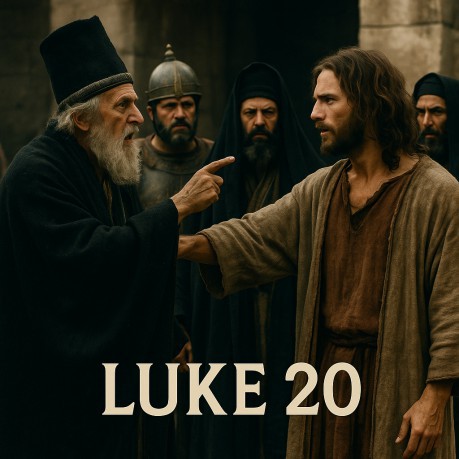
Luke 20 Luke 20:1-8 † The leaders' refusal to answer exposed their
hypocrisy. Luke 20:9-18 When they heard this, they said, "May it never happen!"
But Jesus looked at them and said, "Then what is this statement
that has been written: ‘A stone which the builders rejected, this
has become the chief cornerstone'? Everyone who falls on that stone
will be broken to pieces; but on whomever it falls, it will crush
him." † The vineyard represented Israel, the tenants
its leaders, and the son Christ. Luke 20:19-26 † Their trap failed because His wisdom was
greater than theirs. Luke 20:27-40 Jesus said to them, "The sons of this age marry and the women
are given in marriage, but those who are considered worthy to attain
to that age and the resurrection from the dead, neither marry nor are
given in marriage; for they cannot even die anymore, because they are
like angels, and are sons of God, being sons of the resurrection. But
that the dead are raised, even Moses showed in the passage about the
burning bush, where he calls the Lord the God of Abraham, the God of
Isaac, and the God of Jacob. Now He is not the God of the dead, but
of the living; for all are alive to Him." Some of the scribes
answered and said, "Teacher, You have spoken well." For
they did not have the courage to question Him any longer about
anything. † The Sadducees denied resurrection, but Christ
proved it from the Law. Luke 20:41-47 And while all the people were listening, He said to the disciples,
"Beware of the scribes, who like to walk around in long robes,
and love personal greetings in the marketplaces, and chief seats in
the synagogues, and places of honor at banquets, who devour widows'
houses, and for appearance's sake offer long prayers. These will
receive all the more condemnation." † Christ revealed His identity as greater than
David, the true Lord. How it applies to us today: † This is the fulfilled perspective we proclaim at
Fulfilled Prophecies † Source Index
By Dan Maines
On one of the days while He was
teaching the people in the temple and preaching the gospel, the chief
priests and the scribes with the elders confronted Him, and they said
to Him, "Tell us by what authority You are doing these things,
or who is the one who gave You this authority?" But He responded
and said to them, "I will also ask you a question, and you tell
Me: was the baptism of John from heaven, or from men?" They
discussed it among themselves, saying, "If we say, ‘From
heaven,' He will say, ‘Why did you not believe him?' But if we say,
‘From men,' all the people will stone us to death, since they are
convinced that John was a prophet." So they answered that they
did not know where it came from. And Jesus said to them, "Neither
am I telling you by what authority I do these things."
† Christ's authority came directly
from the Father.
† They feared men rather
than God, showing their corruption.
Now He began to tell the people
this parable: "A man planted a vineyard and leased it to
vine-growers, and went on a journey for a long time. At the harvest
time he sent a slave to the vine-growers, so that they would give him
his share of the produce of the vineyard; but the vine-growers beat
him and sent him away empty-handed. And he proceeded to send another
slave; but they beat him also and treated him shamefully, and sent
him away empty-handed. And he proceeded to send a third; but this one
too they wounded and threw out. Now the owner of the vineyard said,
‘What am I to do? I will send my beloved son; they will probably
respect him.' But when the vine-growers saw him, they discussed with
one another, saying, ‘This is the heir; let's kill him, so that the
inheritance will be ours.' And so they threw him out of the vineyard
and killed him. What, then, will the owner of the vineyard do to
them? He will come and put these vine-growers to death, and will give
the vineyard to others."
† Their
rejection and murder of the Son brought covenant judgment.
†
The rejected stone became the cornerstone of the new covenant.
The scribes and the chief
priests tried to lay hands on Him that very hour, and yet they feared
the people; for they understood that He spoke this parable against
them. And so they watched Him closely, and sent spies who pretended
to be righteous, in order that they might catch Him in some
statement, so that they could hand Him over to the jurisdiction and
authority of the governor. And the spies questioned Him, saying,
"Teacher, we know that You speak and teach correctly, and You
are not partial to anyone, but You teach the way of God on the basis
of truth. Is it permissible for us to pay taxes to Caesar, or not?"
But He saw through their trickery and said to them, "Show Me a
denarius. Whose image and inscription does it have?" They said,
"Caesar's." And He said to them, "Then pay to Caesar
the things that are Caesar's, and to God the things that are God's."
And they were unable to catch Him in a statement in the presence of
the people; and, astonished at His answer, they became silent.
† His answer revealed
submission to earthly rule but ultimate loyalty to God.
†
The image of Caesar contrasted with the image of God in man.
Now some of the Sadducees (who
say that there is no resurrection) came to Him, and they questioned
Him, saying, "Teacher, Moses wrote for us, that if a man's
brother dies, leaving a wife, and he is childless, that his brother
is to marry the wife and raise up children for his brother. So then,
there were seven brothers; and the first took a wife, and died
childless, and the second, and the third married her; and in the same
way, all seven died, leaving no children. Finally the woman also
died. Therefore, in the resurrection, which one's wife does the woman
be? For all seven married her."
† Resurrection life
was beyond earthly marriage.
† God is the God
of the living, not the dead.
But He said to them, "How
is it that they say the Christ is David's son? For David himself says
in the book of Psalms, ‘The Lord said to my Lord, “Sit at My
right hand, until I put Your enemies as a footstool for Your feet.”'
Therefore David calls Him ‘Lord,' and so how is He his son?"
† The scribes' pride
and exploitation exposed their corruption.
†
Their condemnation was certain, fulfilled in AD 70.
†
Luke 20 reveals Christ's authority, wisdom, and identity as
cornerstone and Lord. The fulfilled perspective reminds us that His
words judged Israel's leaders and vindicated His kingdom. For us
today, this chapter calls us to submit to His authority, honor God
above all, and beware of religious pride.
† Josephus,
Wars 4.3.10
† Philo, On Dreams 2.189
†
Tacitus, Histories 5.13
† Irenaeus, Against
Heresies 4.12.3
Links