Luke 18 Luke 18:1-8 † The parable of the persistent widow
emphasized perseverance in prayer. Luke 18:9-14 † True righteousness came from humility, not
self-righteousness. Luke 18:15-17 † The kingdom required childlike humility and
dependence. Luke 18:18-30 And Jesus looked at him and said, "How hard it is for those
who are wealthy to enter the kingdom of God! For it is easier for a
camel to go through the eye of a needle, than for a rich person to
enter the kingdom of God!" They who heard Him said, "And so
who can be saved?" But He said, "The things that are
impossible with people are possible with God." Peter said,
"Behold, we have left our own homes and followed You." And
He said to them, "Truly I say to you, there is no one who has
left house, or wife, or brothers, or parents, or children, for the
sake of the kingdom of God, who will not receive many times as much
at this time, and in the age to come, eternal life." † Wealth often hindered faith and devotion. Luke 18:31-34 † Jesus predicted His suffering, death, and
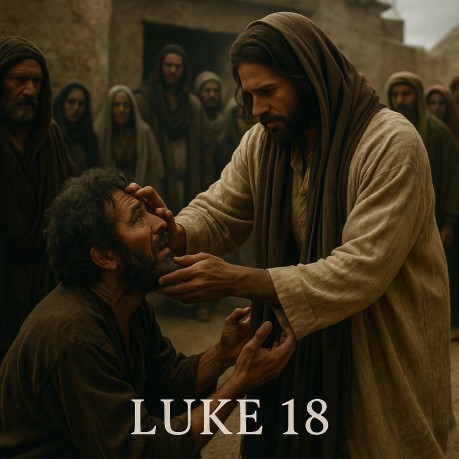
resurrection. Luke 18:35-43 † The blind man's persistent faith was rewarded
with healing. How it applies to us today: † This is the fulfilled perspective we proclaim at
Fulfilled Prophecies † Source Index
By Dan Maines
Now He was telling them a
parable to show that at all times they ought to pray and not become
discouraged, saying, "In a certain city there was a judge who
did not fear God and did not respect any person. Now there was a
widow in that city, and she kept coming to him, saying, ‘Give me
justice against my opponent.' For a while he was unwilling; but later
he said to himself, ‘Even though I do not fear God nor respect any
person, yet because this widow is bothering me, I will give her
justice, otherwise by continually coming she will wear me out.'"
And the Lord said, "Listen to what the unrighteous judge said;
now, will God not bring about justice for His elect who cry out to
Him day and night, and will He delay long for them? I tell you that
He will bring about justice for them quickly. However, when the Son
of Man comes, will He find faith on the earth?"
† Unlike
the unjust judge, God answers His people with justice.
†
This pointed to God avenging His elect in AD 70.
Now He also told this parable
to some people who trusted in themselves that they were righteous,
and viewed others with contempt: "Two men went up into the
temple to pray, one a Pharisee and the other a tax collector. The
Pharisee stood and began praying in this way to himself: ‘God, I
thank You that I am not like other people: swindlers, crooked,
adulterers, or even like this tax collector. I fast twice a week; I
pay tithes of all that I get.' But the tax collector, standing some
distance away, was even unwilling to raise his eyes toward heaven,
but was beating his chest, saying, ‘God, be merciful to me, the
sinner!' I tell you, this man went to his house justified rather than
the other one; for everyone who exalts himself will be humbled, but
the one who humbles himself will be exalted."
† God justified the
repentant, not the proud.
† This exposed the
Pharisees' hypocrisy and blindness.
Now they were bringing even
their babies to Him so that He would touch them, but when the
disciples saw it, they began rebuking them. But Jesus called for the
little ones, saying, "Allow the children to come to Me, and do
not forbid them, for the kingdom of God belongs to such as these.
Truly I say to you, whoever does not receive the kingdom of God like
a child will not enter it at all."
† Children were examples of the
faith God desired.
† Pride blocked entrance
to His reign.
A ruler questioned Him,
saying, "Good Teacher, what shall I do to inherit eternal life?"
But Jesus said to him, "Why do you call Me good? No one is good
except God alone. You know the commandments: ‘Do not commit
adultery, do not murder, do not steal, do not give false testimony,
honor your father and mother.'" And he said, "All these
things I have kept since my youth." Now when Jesus heard this,
He said to him, "One thing you still lack; sell all that you
possess and distribute it to the poor, and you will have treasure in
heaven; and come, follow Me." But when he had heard these
things, he became very sad, for he was extremely wealthy.
†
Eternal reward was greater than earthly riches.
†
God's power made salvation possible even for the rich.
Now He took the twelve aside
and said to them, "Behold, we are going up to Jerusalem, and all
the things that have been written through the prophets about the Son
of Man will be accomplished. For He will be handed over to the
Gentiles, and will be mocked, mistreated, and spit upon, and after
they have flogged Him, they will kill Him; and on the third day He
will rise." But the disciples understood none of these things,
and the meaning of this statement was hidden from them, and they did
not comprehend the things that were said.
† Fulfillment of prophecy was
certain.
† The disciples still lacked
understanding.
Now as Jesus was approaching
Jericho, a man who was blind was sitting by the road, begging. But
when he heard a crowd going by, he began inquiring what this was.
They told him that Jesus of Nazareth was passing by. And he called
out, saying, "Jesus, Son of David, have mercy on me!" Those
who led the way were sternly telling him to be quiet; but he kept
crying out all the more, "Son of David, have mercy on me!"
And Jesus stopped and commanded that he be brought to Him; and when
he came near, He asked him, "What do you want Me to do for you?"
And he said, "Lord, I want to regain my sight!" And Jesus
said to him, "Regain your sight; your faith has made you well."
And immediately he regained his sight and began following Him,
glorifying God; and when all the people saw it, they gave praise to
God.
† Calling Jesus "Son of
David" confessed His messiahship.
†
Healing opened eyes physically and spiritually, glorifying God.
†
Luke 18 highlights prayer, humility, faith, and sacrifice. The
fulfilled perspective reminds us that God vindicated His elect in AD
70 and exalted the humble. For us today, this chapter calls us to
persevere in prayer, live humbly, trust fully, and treasure eternal
life above earthly gain.
† Josephus,
Wars 6.5.3
† Philo, On the Special Laws
2.163
† Tacitus, Annals 15.44
†
Irenaeus, Against Heresies 4.7.2
Links