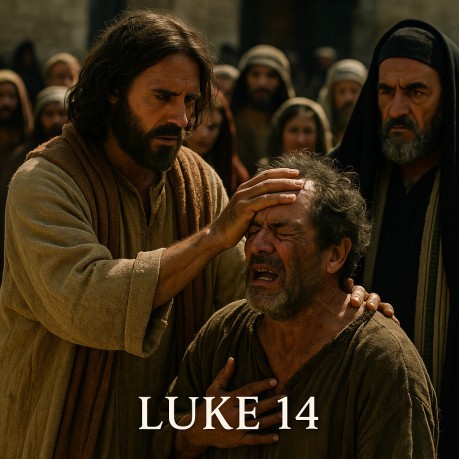
Luke 14 Luke 14:1-6 † Jesus exposed the Pharisees' hypocrisy by
showing mercy outweighed ritual. Luke 14:7-14 Now He also went on to say to the one who had invited Him,
"Whenever you give a luncheon or a dinner, do not invite your
friends, your brothers, your relatives, nor wealthy neighbors,
otherwise they might also invite you in return, and that will be your
repayment. But whenever you give a banquet, invite people who are
poor, who have disabilities, who are limping, and people who are
blind; and you will be blessed, since they do not have the means to
repay you; for you will be repaid at the resurrection of the
righteous." † True greatness came through humility, not
seeking honor. Luke 14:15-24 † The banquet symbolized the kingdom invitation
first to Israel, then to the nations. Luke 14:25-35 "Therefore, salt is good; but if even salt has become
tasteless, with what will it be seasoned? It is useless either for
the soil or the manure pile, so it is thrown out. The one who has
ears to hear, let him hear." † Discipleship demanded supreme loyalty to
Christ, above all earthly ties. How it applies to us today: † This is the fulfilled perspective we proclaim at
Fulfilled Prophecies † Source Index
By Dan Maines
It happened that when He went
into the house of one of the leaders of the Pharisees on the Sabbath
to eat bread, they were watching Him closely. And there in front of
Him was a man suffering from edema. And Jesus responded and said to
the lawyers and Pharisees, "Is it lawful to heal on the Sabbath,
or not?" But they kept silent. And He took hold of him and
healed him, and sent him away. And He said to them, "Which one
of you, if he has a son or an ox fall into a well, will not
immediately pull him out on a Sabbath day?" And they could offer
no reply to this.
† The
Sabbath was fulfilled in Christ as the true rest.
†
Silence of the leaders revealed their hardness of heart.
Now He began telling a parable
to the invited guests when He noticed how they had been picking out
the places of honor at the table, saying to them, "Whenever you
are invited by someone to a wedding feast, do not take the place of
honor, for someone more distinguished than you may have been invited
by him, and the one who invited you both will come and say to you,
‘Give your place to this person,' and then in disgrace you will
proceed to occupy the last place. But whenever you are invited, go
and recline at the last place, so that when the one who has invited
you comes, he may say to you, ‘Friend, move up higher'; then you
will have honor in the sight of all who are dining at the table with
you. For everyone who exalts himself will be humbled, and the one who
humbles himself will be exalted."
† Kingdom hospitality reached
the poor and outcast.
† Repayment came from
God, not man.
When one of those who were
reclining at the table with Him heard this, he said to Him, "Blessed
is everyone who will eat bread in the kingdom of God!" But He
said to him, "A man was giving a big dinner, and he invited
many; and at the time of the dinner he sent his slave to say to those
who had been invited, ‘Come, because everything is ready now.' And
yet they all alike began to make excuses. The first one said to him,
‘I purchased a field, and I need to go out and look at it; please
consider me excused.' And another one said, ‘I purchased five yoke
of oxen, and I am going to try them out; please consider me excused.'
And another one said, ‘I took a woman as my wife, and for that
reason I cannot come.' And the slave came back and reported this to
his master. Then the head of the household became angry and said to
his slave, ‘Go out at once into the streets and lanes of the city,
and bring in here the poor, and those with disabilities, and those
who are blind, and those who are limping.' And later the slave said,
‘Master, what you commanded has been done, and still there is
room.' And the master said to the slave, ‘Go out into the roads and
along the hedges, and press upon them to come in, so that my house
will be filled. For I tell you, none of those men who were invited
shall taste my dinner.'"
†
Excuses revealed misplaced priorities.
† The
outcasts entering revealed God's mercy to the Gentiles.
Now large crowds were going
along with Him; and He turned and said to them, "If anyone comes
to Me and does not hate his own father, mother, wife, children,
brothers, and sisters, yes, and even his own life, he cannot be My
disciple. Whoever does not carry his own cross and come after Me
cannot be My disciple. For which one of you, when he wants to build a
tower, does not first sit down and calculate the cost, to see if he
has enough to complete it? Otherwise, when he has laid a foundation
and is not able to finish, all who are watching it will begin to
ridicule him, saying, ‘This person began to build and was not able
to finish.' Or what king, when he sets out to meet another king in
battle, will not first sit down and consider whether he is strong
enough with ten thousand men to face the one coming against him with
twenty thousand? Otherwise, while the other is still far away, he
sends a delegation and requests terms of peace. So then, none of you
can be My disciple who does not give up all his own possessions.
† Bearing the
cross pointed to the cost of following Him before AD 70's
tribulation.
† Salt symbolized the preserving
influence of true disciples, but corruption led to rejection.
†
Luke 14 reveals humility, mercy, invitation, and the cost of
discipleship. The fulfilled perspective shows these warnings were
urgent for that generation, and fulfilled in Jerusalem's fall. For us
today, this chapter calls us to humble service, radical devotion, and
faithful perseverance in the kingdom.
† Josephus,
Wars 6.2.4
† Philo, On the Virtues 102
†
Tacitus, Histories 5.13
† Irenaeus, Against
Heresies 4.9.2
Links