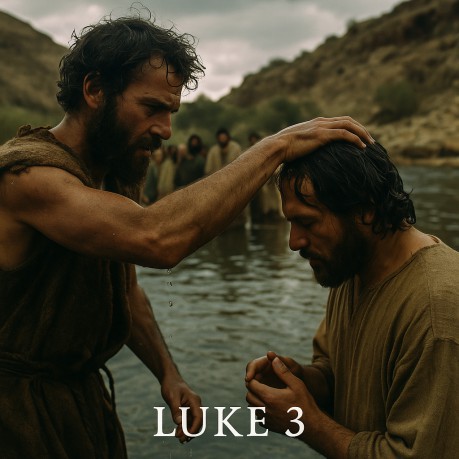
Luke 3 Luke 3:1-6 † Luke rooted John's ministry in history,
naming Roman and Jewish rulers. Luke 3:7-14 And the crowds were questioning him, saying, "Then what are
we to do?" And he would answer and say to them, "The one
who has two tunics is to share with the one who has none, and the one
who has food is to do likewise." Now even tax collectors came to
be baptized, and they said to him, "Teacher, what are we to do?"
And he said to them, "Collect no more than what you have been
ordered to." And soldiers also were questioning him, saying,
"What are we to do, we as well?" And he said to them, "Do
not extort money from anyone, nor harass anyone, and be content with
your wages." † John's rebuke warned that heritage could not
save without repentance. Luke 3:15-20 † John declared the superiority of Christ's
baptism with the Spirit and fire. Luke 3:21-22 † Jesus' baptism inaugurated His public
ministry. Luke 3:23-38 † Luke traced Jesus' lineage back to Adam,
showing Him as Savior for all humanity. How it applies to us today: † This is the fulfilled perspective we proclaim at
Fulfilled Prophecies † Source Index
By Dan Maines
Now in the fifteenth year of the
reign of Tiberius Caesar, when Pontius Pilate was governor of Judea,
and Herod was tetrarch of Galilee, and his brother Philip was
tetrarch of the region of Ituraea and Trachonitis, and Lysanias was
tetrarch of Abilene, in the high priesthood of Annas and Caiaphas,
the word of God came to John, the son of Zechariah, in the
wilderness. And he came into all the region around the Jordan,
preaching a baptism of repentance for the forgiveness of sins; as it
is written in the book of the words of Isaiah the prophet: "The
voice of one calling out in the wilderness, ‘Prepare the way of the
Lord, Make His paths straight! Every ravine will be filled, And every
mountain and hill will be lowered; The crooked will become straight,
And the rough roads smooth; And all flesh will see the salvation of
God!'"
† John
fulfilled Isaiah 40:3-5, preparing the way for the Messiah.
†
His message pointed to covenant renewal and coming judgment.
So he was saying to the crowds
who were going out to be baptized by him, "You offspring of
vipers, who warned you to flee from the wrath to come? Therefore
produce fruits that are consistent with repentance, and do not start
saying to yourselves, ‘We have Abraham as our father,' for I say to
you that from these stones God is able to raise up children for
Abraham. But indeed the axe is already being laid at the root of the
trees; so every tree that does not produce good fruit is being cut
down and thrown into the fire."
† The "wrath to
come" pointed to the destruction of Jerusalem in AD 70.
†
True repentance bore fruit in justice, mercy, and integrity.
Now while the people were in a
state of expectation and all were thinking carefully in their hearts
about John, whether he himself perhaps was the Christ, John responded
to them all, saying, "As for me, I baptize you with water; but
He is coming who is mightier than I, and I am not fit to untie the
straps of His sandals; He will baptize you with the Holy Spirit and
fire. His winnowing fork is in His hand to thoroughly clear His
threshing floor, and to gather the wheat into His barn; but He will
burn up the chaff with unquenchable fire." So with many other
exhortations he preached the gospel to the people. But when Herod the
tetrarch was reprimanded by him regarding Herodias, his brother's
wife, and regarding all the evil things which Herod had done, Herod
also added this to them all: he also locked John up in prison.
† Fire
symbolized both purification and judgment, fulfilled in AD 70.
†
John's boldness cost him his freedom, showing the cost of truth.
Now it came about, when all the
people were baptized, that Jesus also was baptized, and while He was
praying, heaven was opened, and the Holy Spirit descended upon Him in
bodily form like a dove, and a voice came from heaven: "You are
My beloved Son, in You I am well pleased."
† The Spirit's descent marked Him
as the Anointed One.
† The Father's voice
confirmed His Sonship and mission.
When He began His ministry,
Jesus Himself was about thirty years old, being as was commonly held,
the son of Joseph, the son of Eli, the son of Matthat, the son of
Levi… (genealogy continues) …the son of Enosh, the son of Seth,
the son of Adam, the son of God.
†
Unlike Matthew's genealogy focused on Israel, Luke emphasized
universality.
† Jesus is both Son of David
and Son of God, fulfilling both covenant and creation.
†
Luke 3 shows preparation for Christ's ministry, the call to
repentance, and the baptism of the Spirit. The fulfilled perspective
reminds us that judgment fell on Israel in AD 70, but Christ
established His everlasting kingdom. For us today, this chapter calls
us to bear fruit of repentance, follow the true King, and rejoice in
the Spirit's work in our lives.
† Josephus,
Antiquities 18.5.2
† Philo, On the Special
Laws 2.167
† Tacitus, Annals 15.44
†
Irenaeus, Against Heresies 3.9.3
Links