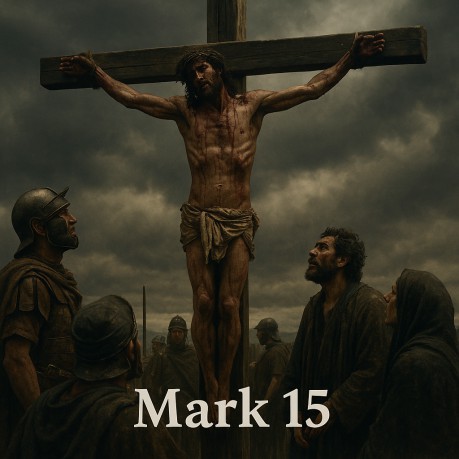
Mark 15 Mark 15:1-5 † Jesus' silence fulfilled Isaiah 53:7, the
Lamb before His shearers. Mark 15:6-15 † Barabbas, a murderer, was released while the
innocent Son of God was condemned. Mark 15:16-20 † The soldiers mocked His kingship, not knowing
they were declaring truth. Mark 15:21-32 † Simon carried the cross, showing the burden
of discipleship. Mark 15:33-41 † Darkness signified divine judgment and cosmic
upheaval. Mark 15:42-47 † Joseph of Arimathea courageously identified
with Jesus in His death. How it applies to us today: † This is the fulfilled perspective we proclaim at
Fulfilled Prophecies † Source Index
By Dan Maines
Early in the morning, the chief
priests with the elders, scribes, and the entire Council immediately
held a consultation; and they bound Jesus and led Him away, and
turned Him over to Pilate. And Pilate questioned Him, "Are You
the King of the Jews?" And He answered him, "It is as you
say." And the chief priests started accusing Him of many things.
But Pilate questioned Him again, saying, "Do You offer nothing
in answer? See how many charges they are bringing against You!"
But Jesus said nothing further in response, so Pilate was amazed.
† Pilate recognized
the accusations were false, yet remained amazed at Jesus' calmness.
†
The true King of the Jews stood condemned by His own people.
Now at the Passover Feast he
used to release for them any one prisoner whom they requested. And
the one named Barabbas had been imprisoned with the rebels who had
committed murder in the revolt. And the crowd went up and began
asking Pilate to do as he had been accustomed to do for them. Pilate
answered them, saying, "Do you want me to release for you the
King of the Jews?" For he was aware that the chief priests had
handed Him over because of envy. But the chief priests stirred up the
crowd to ask him to release Barabbas for them instead. And responding
again, Pilate said to them, "Then what shall I do with Him whom
you call the King of the Jews?" They shouted back, "Crucify
Him!" But Pilate said to them, "Why, what evil has He
done?" But they shouted all the more, "Crucify Him!"
And wishing to satisfy the crowd, Pilate released Barabbas for them,
and after having Jesus flogged, he handed Him over to be crucified.
† The
crowd chose rebellion over righteousness, echoing Israel's rejection
of God.
† Pilate's cowardice showed fear of
man over justice.
Now the soldiers took Him away
into the palace (that is, the Praetorium), and they called together
the whole Roman cohort. And they dressed Him in purple, and after
twisting together a crown of thorns, they put it on Him; and they
began saluting Him: "Hail, King of the Jews!" And they
repeatedly beat His head with a reed and spit on Him, and kneeling,
they bowed down before Him. And after they had mocked Him, they took
the purple cloak off Him and put His own garments on Him. And they
led Him out to crucify Him.
† The crown of
thorns symbolized the curse He bore for humanity.
†
Mockery and abuse fulfilled prophecy (Isaiah 50:6).
And they compelled a
passer-by, Simon of Cyrene (the father of Alexander and Rufus), as he
was coming in from the country, to carry His cross. Then they brought
Him to the place Golgotha, which is translated, Place of a Skull.
They tried to give Him wine mixed with myrrh; but He did not take it.
And they crucified Him, and divided up His garments among themselves,
casting lots for them to decide what each man would take. Now it was
the third hour when they crucified Him. The inscription of the charge
against Him read: "The King of the Jews." And they
crucified two rebels with Him, one on His right and one on His left.
Those passing by were hurling abuse at Him, shaking their heads, and
saying, "Ha! You who are going to destroy the temple and rebuild
it in three days, save Yourself by coming down from the cross!"
In the same way the chief priests also, along with the scribes, were
ridiculing Him among themselves and saying, "He saved others; He
cannot save Himself! Let this Christ, the King of Israel, come down
now from the cross, so that we may see and believe!" Those who
were crucified with Him were also insulting Him.
† The dividing of garments
fulfilled Psalm 22:18.
† The mockers
unwittingly testified that He was indeed the Christ.
When the sixth hour came,
darkness fell over the whole land until the ninth hour. At the ninth
hour Jesus cried out with a loud voice, "Eloi, Eloi, lama
sabachthani?" which is translated, "My God, My God, why
have You forsaken Me?" And some of the bystanders, when they
heard Him, began saying, "Look! He is calling for Elijah!"
And someone ran and filled a sponge with sour wine, put it on a reed,
and gave Him a drink, saying, "Let us see if Elijah comes to
take Him down." But Jesus let out a loud cry, and died. And the
veil of the temple was torn in two from top to bottom. When the
centurion, who was standing right in front of Him, saw that He died
in this way, he said, "Truly this man was the Son of God!"
Now there were also some women watching from a distance, among whom
were Mary Magdalene, Mary the mother of James the Less and Joses, and
Salome. When He was in Galilee, they used to follow Him and serve
Him; and there were many other women who came up with Him to
Jerusalem.
† Jesus' cry echoed Psalm 22,
expressing both agony and trust.
† The
tearing of the temple veil showed the end of the Old Covenant and
access to God through Christ.
When evening had already come,
since it was the preparation day, that is, the day before the
Sabbath, Joseph of Arimathea came, a prominent member of the Council,
who was himself also waiting for the kingdom of God; and he gathered
up courage and went in before Pilate, and asked for the body of
Jesus. Now Pilate was surprised that He was already dead; and he
summoned the centurion, and questioned him as to whether He was
already dead. And after learning this from the centurion, he granted
the body to Joseph. And Joseph bought a linen cloth, took Him down,
and wrapped Him in the linen cloth, and laid Him in a tomb which had
been cut out in the rock; and he rolled a stone against the entrance
of the tomb. Mary Magdalene and Mary the mother of Joses were
watching to see where He was laid.
† Jesus' burial
fulfilled Isaiah 53:9, "with a rich man in His death."
†
The women's witness prepared for the testimony of His resurrection.
†
Mark 15 reveals Christ's rejection, crucifixion, and burial. The
fulfilled perspective shows that His death ended the Old Covenant,
tore the veil, and opened the way to God. For us today, the cross
calls us to trust in His finished work, embrace His kingdom, and live
as witnesses of the Lamb who was slain and now reigns.
† Josephus,
Wars 6.5.4
† Tacitus, Annals 15.44
†
Philo, On the Embassy to Gaius 301
†
Irenaeus, Against Heresies 3.18.3
Links