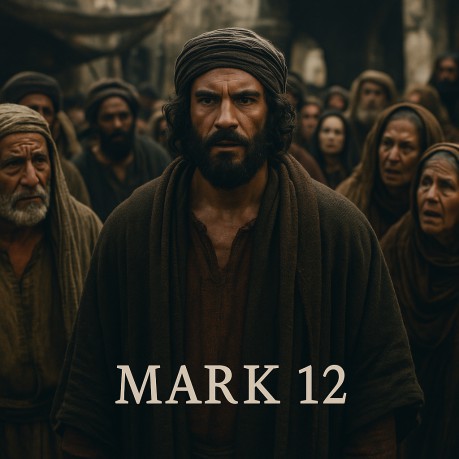
Mark 12 Mark 12:1-12 † The vineyard symbolized Israel, and the
wicked tenants represented its leaders. Mark 12:13-17 † The coin bore Caesar's image, but people bear
God's image. Mark 12:18-27 † The Sadducees denied resurrection, but Jesus
proved it from the Torah itself. Mark 12:28-34 † Love for God and neighbor summed up the
entire law. Mark 12:35-37 † Jesus showed that Messiah was more than
David's son — He was David's Lord. Mark 12:38-40 † Religious pride masked corruption and
injustice. Mark 12:41-44 † The widow's offering revealed true devotion —
sacrificial giving from the heart. How it applies to us today: † This is the fulfilled perspective we proclaim at
Fulfilled Prophecies † Source Index
By Dan Maines
And He began to speak to them
in parables: "A man planted a vineyard, and put a fence around
it, and dug a vat under the wine press, and built a tower, and leased
it to vine-growers, and went on a journey. At the harvest time he
sent a slave to the vine-growers, so that he might receive some of
the fruit of the vineyard from the vine-growers. They took him, and
beat him and sent him away empty-handed. And again he sent them
another slave, and they wounded him in the head, and treated him
shamefully. And he sent another one, and that one they killed; and so
with many others, beating some and killing others. He had one more
person to send, a beloved son; he sent him to them last of all,
saying, ‘They will respect my son.' But those vine-growers said to
one another, ‘This is the heir; come, let's kill him, and the
inheritance will be ours!' And they took him and killed him, and
threw him out of the vineyard. What will the owner of the vineyard
do? He will come and put the vine-growers to death, and give the
vineyard to others. Have you not even read this Scripture: ‘A stone
which the builders rejected, This has become the chief cornerstone;
This came about from the Lord, And it is marvelous in our eyes'?"
And they were seeking to arrest Him, and yet they feared the crowd;
for they understood that He told the parable against them. And so
they left Him and went away.
† The
prophets were the beaten and killed servants, and Christ the Son was
rejected and slain.
† The vineyard was taken
from them and given to others — the kingdom transferred to the
church.
Then they sent some of the
Pharisees and Herodians to Him in order to trap Him in a statement.
They came and said to Him, "Teacher, we know that You are
truthful and defer to no one; for You are not partial to anyone, but
You teach the way of God in truth. Is it permissible to pay a
poll-tax to Caesar, or not? Are we to pay, or not pay?" But He,
knowing their hypocrisy, said to them, "Why are you testing Me?
Bring Me a denarius to look at." They brought one. And He said
to them, "Whose image and inscription is this?" They said
to Him, "Caesar's." And Jesus said to them, "Pay to
Caesar the things that are Caesar's, and to God the things that are
God's." And they were utterly amazed at Him.
† Jesus revealed that obedience
to earthly authority does not cancel devotion to God.
†
His answer silenced their attempt to trap Him.
Some Sadducees (who say that
there is no resurrection) came to Jesus, and began questioning Him,
saying, "Teacher, Moses wrote for us that if a man's brother
dies and leaves behind a wife, and does not leave a child, his
brother is to take the wife and raise up descendants for his brother.
There were seven brothers; and the first took a wife, and died
leaving no descendants. The second one married her, and died leaving
behind no descendants; and the third likewise; and so the seven left
no descendants. Last of all the woman also died. In the resurrection,
which one's wife will she be? For each of the seven had her as his
wife." Jesus said to them, "Is this not the reason you are
mistaken, that you do not understand the Scriptures nor the power of
God? For when they rise from the dead, they neither marry nor are
given in marriage, but are like angels in heaven. But regarding the
fact that the dead rise again, have you not read in the book of
Moses, in the passage about the burning bush, how God spoke to him,
saying: ‘I am the God of Abraham, the God of Isaac, and the God of
Jacob'? He is not the God of the dead, but of the living; you are
greatly mistaken."
† God's
covenant promises made the patriarchs living, not dead.
†
Resurrection was not about earthly marriage but life in God's
presence.
One of the scribes came and
heard them arguing, and recognizing that He had answered them well,
asked Him, "What commandment is the foremost of all?" Jesus
answered, "The foremost is: ‘Hear, Israel! The Lord is our
God, the Lord is one; and you shall love the Lord your God with all
your heart, and with all your soul, and with all your mind, and with
all your strength.' The second is this: ‘You shall love your
neighbor as yourself.' There is no other commandment greater than
these." The scribe said to Him, "Well said, Teacher; You
have truly stated that He is One, and there is no other besides Him;
and to love Him with all the heart, with all the understanding, and
with all the strength, and to love one's neighbor as oneself, is much
more than all the burnt offerings and sacrifices." When Jesus
saw that he had answered intelligently, He said to him, "You are
not far from the kingdom of God." And after that, no one dared
to ask Him any more questions.
† The scribe recognized truth
beyond ritual, but he was still short of the kingdom.
†
The New Covenant would fulfill what the law pointed toward.
And Jesus responded and
continued teaching in the temple area: "How is it that the
scribes say that the Christ is the son of David? David himself said
in the Holy Spirit, ‘The Lord said to my Lord, "Sit at My
right hand, Until I put Your enemies under Your feet."' David
himself calls Him ‘Lord'; so in what sense is He his son?" And
the large crowd enjoyed listening to Him.
† Psalm
110 revealed His exalted kingship and divine authority.
†
The crowd delighted in His wisdom, though leaders resisted Him.
And in His teaching He was
saying: "Beware of the scribes who like to walk around in long
robes, and like personal greetings in the marketplaces, and seats of
honor in the synagogues, and places of honor at banquets; who devour
widows' houses, and for appearance's sake offer long prayers; these
will receive all the more condemnation."
† Pretentious piety was condemned
rather than honored.
† Judgment was certain
for those who abused their position.
And Jesus sat down opposite
the treasury, and began watching how the people were putting money
into the treasury; and many rich people were putting in large
amounts. And a poor widow came and put in two lepta, which amount to
a quadrans. Calling His disciples to Him, He said to them, "Truly
I say to you, this poor widow put in more than all the contributors
to the treasury; for they all contributed out of their surplus, but
she, out of her poverty, put in all she owned, all she had to live
on."
† God
measures gifts not by amount but by cost and sincerity.
†
Her act contrasted with the greedy leaders, exemplifying true
covenant faith.
†
Mark 12 shows Christ as the rejected Son, the cornerstone, the wise
Teacher, and the Lord above David. The fulfilled perspective reveals
that His judgment on Israel's leaders was fulfilled in AD 70, and His
kingdom rests on love, truth, and devotion. For us today, we are
called to bear fruit, love God and neighbor, give sacrificially, and
follow Christ as our true King.
† Josephus,
Wars 6.2.4
† Philo, On the Special Laws
2.63
† Tacitus, Histories 5.13
†
Irenaeus, Against Heresies 4.36.2
Links