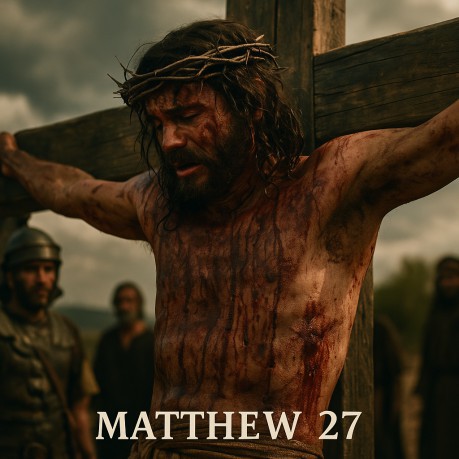
Matthew 27 Matthew 27:1-2 † Israel's leaders conspired with Rome to
condemn Jesus, proving their covenantal apostasy. Matthew 27:3-10 † Judas' remorse led to despair, not
repentance. His betrayal fulfilled prophecy. Matthew 27:11-26 Now at the Passover Feast the governor was accustomed to release
for the people any one prisoner whom they wanted. And at that time
they were holding a notorious prisoner called Barabbas. So when the
people gathered together, Pilate said to them, "Whom do you want
me to release for you: Barabbas, or Jesus who is called Christ?"
For he knew that it was because of envy that they had handed Him
over. And while he was sitting on the judgment seat, his wife sent
him a message, saying, "See that you have nothing to do with
that righteous Man; for last night I suffered greatly in a dream
because of Him." But the chief priests and the elders persuaded
the crowds to ask for Barabbas, and to put Jesus to death. And the
governor said to them, "Which of the two do you want me to
release for you?" And they said, "Barabbas." Pilate
said to them, "Then what shall I do with Jesus who is called
Christ?" They all said, "Crucify Him!" But he said,
"Why, what evil has He done?" Yet they kept shouting all
the more, saying, "Crucify Him!" Now when Pilate saw that
he was accomplishing nothing, but rather that a riot was starting, he
took water and washed his hands in front of the crowd, saying, "I
am innocent of this Man's blood; you yourselves shall see." And
all the people replied, "His blood shall be on us and on our
children!" Then he released Barabbas for them; but after having
Jesus flogged, he handed Him over to be crucified. † Pilate, though unjust, recognized Jesus'
innocence, while Israel cried for His blood. Matthew 27:27-44 And as they were coming out, they found a man of Cyrene named
Simon, whom they compelled to carry His cross. And when they came to
a place called Golgotha, which means Place of a Skull, they gave Him
wine mixed with bile to drink; and after tasting it, He was unwilling
to drink it. And when they had crucified Him, they divided His
garments among themselves by casting lots. And sitting down, they
began to keep watch over Him there. And above His head they put the
charge against Him which read, "This is Jesus the King of the
Jews." At that time two rebels were being crucified with Him,
one on the right and one on the left. And those passing by were
speaking abusively to Him, shaking their heads, and saying, "You
who are going to destroy the temple and rebuild it in three days,
save Yourself! If You are the Son of God, come down from the cross."
In the same way the chief priests also, along with the scribes and
elders, were mocking Him, and saying, "He saved others; He
cannot save Himself! He is the King of Israel; let Him now come down
from the cross, and we will believe in Him. He has trusted in God;
let God rescue Him now, if He takes pleasure in Him; for He said, 'I
am the Son of God.'" And the rebels who had been crucified with
Him were also insulting Him in the same way. † The mockery of the soldiers and leaders
revealed their blindness. Matthew 27:45-54 And behold, the veil of the temple was torn in two from top to
bottom; and the earth shook and the rocks were split. Also the tombs
were opened, and many bodies of the saints who had fallen asleep were
raised; and coming out of the tombs after His resurrection, they
entered the holy city and appeared to many. Now as for the centurion
and those who were with him keeping guard over Jesus, when they saw
the earthquake and the other things that were happening, they became
extremely frightened and said, "Truly this was the Son of God!" † Darkness, earthquake, and the torn veil
marked covenantal transition — the Old Covenant ended, the New
Covenant began. Matthew 27:55-66 † Faithful women bore witness to His death and
burial, while leaders tried in vain to stop His resurrection. How it applies to us today: † This is the fulfilled perspective we proclaim at
Fulfilled Prophecies † Source Index
By Dan Maines
Now when morning came, all
the chief priests and the elders of the people conferred together
against Jesus to put Him to death; and they bound Him and led Him
away, and handed Him over to Pilate the governor.
†
The true King of Israel was delivered into Gentile hands, fulfilling
prophecy (Psalm 2).
† Josephus records the
corruption of the priesthood and its alliances with Rome (Wars
4.3.7).
Then when Judas, who had
betrayed Him, saw that He had been condemned, he felt remorse and
returned the thirty pieces of silver to the chief priests and elders,
saying, "I have sinned by betraying innocent blood." But
they said, "What is that to us? You shall bear that yourself!"
And he threw the pieces of silver into the temple sanctuary and left;
and he went away and hanged himself. And the chief priests took the
pieces of silver and said, "It is not lawful to put them into
the temple treasury, since it is the price of blood." And they
conferred together and with the money bought the Potter's Field as a
burial place for strangers. For this reason that field has been
called the Field of Blood to this day. Then that which was spoken
through Jeremiah the prophet was fulfilled: "And they took the
thirty pieces of silver, the price of the One whose price had been
set by the sons of Israel; and they gave them for the Potter's Field,
just as the Lord directed me."
†
The priests, scrupulous about the treasury, were blind to their
greater sin of condemning the innocent.
†
Scripture was fulfilled in their actions, proving God's sovereign
plan.
Now Jesus stood before the
governor, and the governor questioned Him, saying, "So You are
the King of the Jews?" And Jesus said to him, "It is as you
say." And while He was being accused by the chief priests and
elders, He did not offer any answer. Then Pilate said to Him, "Do
You not hear how many things they are testifying against You?"
And still He did not answer him in regard to even a single charge, so
the governor was greatly amazed.
†
Their self-condemnation — "His blood be on us and our
children" — was fulfilled in the judgment of AD 70.
†
Barabbas, a murderer, was freed, while the innocent Christ was
condemned, picturing substitution and covenant reversal.
Then the soldiers of the
governor took Jesus into the Praetorium and gathered the whole Roman
cohort to Him. And they stripped Him and put a red cloak on Him. And
after twisting together a crown of thorns, they put it on His head,
and put a reed in His right hand; and they knelt before Him and
mocked Him, saying, "Hail, King of the Jews!" And they spit
on Him, and took the reed and beat Him on the head. And after they
had mocked Him, they took the cloak off Him and put His own garments
back on Him, and led Him away to crucify Him.
† Scripture was
fulfilled as they cast lots for His clothing (Psalm 22:18).
†
The King was enthroned on a cross, His suffering the path to glory.
Now from the sixth hour
darkness fell upon all the land until the ninth hour. And about the
ninth hour Jesus cried out with a loud voice, saying, "Eli, Eli,
Lama Sabachthani?" that is, "My God, My God, why have You
forsaken Me?" And some of those who were standing there, when
they heard it, said, "This man is calling for Elijah." And
immediately one of them ran, and took a sponge, filled it with sour
wine, and put it on a reed, and gave Him a drink. But the rest of
them said, "Let us see if Elijah comes to save Him." And
Jesus cried out again with a loud voice, and gave up His spirit.
† The centurion confessed
Jesus as the Son of God, a Gentile recognizing what Israel denied.
†
The resurrection of saints showed Christ's victory over death.
And many women were there
watching from a distance, who had followed Jesus from Galilee while
caring for Him. Among them were Mary Magdalene, Mary the mother of
James and Joseph, and the mother of the sons of Zebedee. Now when it
was evening, a rich man from Arimathea came, named Joseph, who
himself had also become a disciple of Jesus. This man went to Pilate
and asked for the body of Jesus. Then Pilate ordered it to be given
to him. And Joseph took the body and wrapped it in a clean linen
cloth, and laid it in his own new tomb, which he had cut out in the
rock; and he rolled a large stone against the entrance of the tomb
and went away. And Mary Magdalene was there, and the other Mary,
sitting opposite the tomb. Now on the next day, which is the day
after the preparation, the chief priests and the Pharisees gathered
together with Pilate, and they said, "Sir, we remember that when
He was still alive that deceiver said, 'After three days I am
rising.' Therefore, give orders for the tomb to be made secure until
the third day, otherwise His disciples may come and steal Him, and
say to the people, 'He has risen from the dead,' and the last
deception will be worse than the first." Pilate said to them,
"You have a guard; go, make it as secure as you know how."
And they went and made the tomb secure with the guard, sealing the
stone.
†
Joseph of Arimathea fulfilled prophecy by laying Him in a rich man's
tomb (Isaiah 53:9).
† The sealed tomb only
magnified the certainty of His coming resurrection.
†
Matthew 27 shows the Lamb slain, rejected by His people yet enthroned
as King through the cross. The fulfilled perspective teaches us that
Israel's leaders brought judgment on themselves, but Christ's death
inaugurated the New Covenant. Today we live in the power of the
cross, forgiven by His blood, freed from the Old Covenant, and secure
in the kingdom that cannot be shaken.
† Josephus,
Wars 4.3.7; 6.9.3
† Tacitus, Annals 15.44
†
Justin Martyr, Dialogue with Trypho 97
†
Irenaeus, Against Heresies 4.10.1
Links