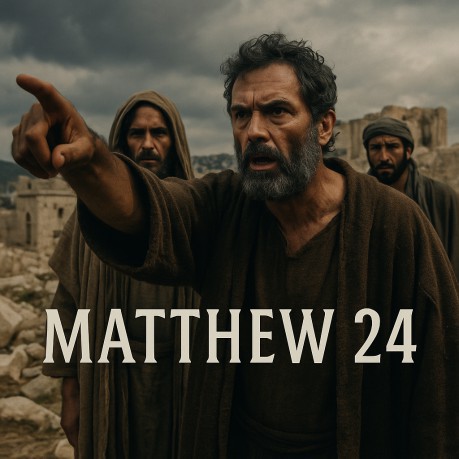
Matthew 24 Matthew 24:1-2 † The disciples admired the glory of Herod's
temple, but Jesus prophesied its destruction. Matthew 24:3 † The disciples connected the temple's fall
with Christ's coming and the end of the age. Matthew 24:4-14 † False messiahs, wars, famines, and
earthquakes were signs that preceded the destruction of Jerusalem.
Josephus and Tacitus confirm these events in the years leading to AD
70. Matthew 24:15-22 † The abomination of desolation referred to the
Roman armies and their profanation of the temple. Matthew 24:23-28 † False deliverers abounded in the days before
Jerusalem's fall. Matthew 24:29-31 † Cosmic language was covenantal, describing
the fall of nations and rulers (Isaiah 13, Ezekiel 32). Matthew 24:32-35 † Jesus confirmed the timing: all these things
would happen within that generation. Matthew 24:36-44 † The day and hour of the siege could not be
predicted precisely, but the signs revealed its nearness. Matthew 24:45-51 † The faithful servant symbolized disciples who
remained vigilant. How it applies to us today: † This is the fulfilled perspective we proclaim at
Fulfilled Prophecies † Source Index
By Dan Maines
Jesus left the temple area
and was going on His way when His disciples came up to point out the
temple buildings to Him. And He responded and said to them, "Do
you not see all these things? Truly I say to you, not one stone here
will be left upon another, which will not be torn down."
†
This was fulfilled in AD 70 when Rome leveled the temple, leaving not
one stone on another.
† Josephus described
the destruction in detail (Wars 6.4.5), confirming Jesus' prophecy.
And as He was sitting on the
Mount of Olives, the disciples came to Him privately, saying, "Tell
us, when will these things happen, and what will be the sign of Your
coming, and of the end of the age?"
†
The age in question was the Old Covenant age, not the world itself.
†
This set the stage for the Olivet Discourse, fulfilled within that
generation.
And Jesus answered and said
to them, "See to it that no one misleads you. For many will come
in My name, saying, 'I am the Christ,' and they will mislead many
people. And you will be hearing of wars and rumors of wars. See that
you are not alarmed, for those things must take place, but that is
not yet the end. For nation will rise against nation, and kingdom
against kingdom, and there will be famines and earthquakes in various
places. But all these things are merely the beginning of birth pains.
Then they will hand you over to tribulation, and kill you, and you
will be hated by all nations because of My name. And at that time
many will fall away, and they will betray one another and hate one
another. And many false prophets will rise up and mislead many
people. And because lawlessness is increased, most people's love will
become cold. But the one who endures to the end is the one who will
be saved. This gospel of the kingdom shall be preached in the whole
world as a testimony to all the nations, and then the end will come."
† Persecution of believers, betrayal, and
apostasy marked the last days of that generation.
†
The gospel was preached throughout the known world (Colossians 1:23),
fulfilling Jesus' word before the end of the Old Covenant age.
"Therefore, when you
see the abomination of desolation which was spoken of through Daniel
the prophet, standing in the holy place (let the reader understand),
then those who are in Judea must flee to the mountains. Whoever is on
the housetop must not go down to get things out of his house. And
whoever is in the field must not turn back to get his cloak. But woe
to those women who are pregnant, and to those who are nursing babies
in those days! Moreover, pray that when you flee, it will not be in
the winter, or on a Sabbath. For then there will be a great
tribulation, such as has not occurred since the beginning of the
world until now, nor ever will again. And if those days had not been
cut short, no life would have been saved; but for the sake of the
elect those days will be cut short."
†
Jesus warned His disciples to flee Jerusalem, which they did,
according to Eusebius, escaping to Pella before the final siege.
†
Josephus described the horrors of the siege as the greatest
tribulation Israel ever faced (Wars 6.9.3).
"Then if anyone says
to you, 'Behold, here is the Christ,' or 'He is over here,' do not
believe him. For false christs and false prophets will arise and will
provide great signs and wonders, so as to mislead, if possible, even
the elect. Behold, I have told you in advance. So if they say to you,
'Behold, He is in the wilderness,' do not go out; or, 'Behold, He is
in the inner rooms,' do not believe them. For just as the lightning
comes from the east and flashes as far as the west, so will the
coming of the Son of Man be. Wherever the corpse is, there the
vultures will gather."
† Jesus warned His coming
would not be hidden or local, but visible in judgment.
†
The vultures symbolized Rome's legions surrounding the corpse of
Israel.
"But immediately after
the tribulation of those days the sun will be darkened, and the moon
will not give its light, and the stars will fall from the sky, and
the powers of the heavens will be shaken. And then the sign of the
Son of Man will appear in the sky, and then all the tribes of the
earth will mourn, and they will see the Son of Man coming on the
clouds of the sky with power and great glory. And He will send forth
His angels with a great trumpet blast, and they will gather together
His elect from the four winds, from one end of the sky to the other."
†
Jesus came in judgment against Jerusalem, vindicating His reign.
†
The elect were gathered into the New Covenant community as promised.
"Now learn the parable
from the fig tree: as soon as its branch has become tender and
sprouts its leaves, you know that summer is near; so you too, when
you see all these things, recognize that He is near, right at the
door. Truly I say to you, this generation will not pass away until
all these things take place. Heaven and earth will pass away, but My
words will not pass away."
† Heaven
and earth symbolized the Old Covenant order, which would pass away.
†
His words remain certain, fulfilled in AD 70.
"But about that day
and hour no one knows, not even the angels of heaven, nor the Son,
but the Father alone. For the coming of the Son of Man will be just
like the days of Noah. For as in those days before the flood they
were eating and drinking, marrying and giving in marriage, until the
day that Noah entered the ark, and they did not understand until the
flood came and took them all away; so will the coming of the Son of
Man be. At that time there will be two men in the field; one will be
taken and one will be left. Two women will be grinding at the mill;
one will be taken and one will be left. Therefore be on the alert,
for you do not know which day your Lord is coming. But be sure of
this, that if the head of the house had known at what time of the
night the thief was coming, he would have been on the alert and would
not have allowed his house to be broken into. For this reason you
must be ready as well; for the Son of Man is coming at an hour when
you do not think He will."
†
Just as in Noah's day, judgment came suddenly on the unprepared.
†
Being "taken" referred to judgment, while the spared were
those left to enter the new kingdom order.
"Who then is the
faithful and sensible slave whom his master put in charge of his
household slaves, to give them their food at the proper time? Blessed
is that slave whom his master finds so doing when he comes. Truly I
say to you that he will put him in charge of all his possessions. But
if that evil slave says in his heart, 'My master is not coming for a
long time,' and he begins to beat his fellow slaves, and he eats and
drinks with those who are habitually drunk; then the master of that
slave will come on a day that he does not expect, and at an hour that
he does not know, and he will cut him in two, and assign him a place
with the hypocrites; in that place there will be weeping and gnashing
of teeth."
† The evil servant
symbolized corrupt leaders who believed judgment was far off.
†
Their destruction came suddenly in AD 70, just as Jesus foretold.
†
Matthew 24 is the heart of Jesus' prophecy about the destruction of
Jerusalem and the end of the Old Covenant age. The fulfilled
perspective shows us that Christ's words came true in that
generation. For us today, it means we live in the New Covenant
kingdom, secure in the promises already fulfilled. We are called to
faithfulness, knowing that God has vindicated His Son and established
His everlasting kingdom.
† Josephus,
Wars 6.4.5; 6.9.3
† Tacitus, Histories 5.13
†
Eusebius, Ecclesiastical History 3.5
†
Irenaeus, Against Heresies 5.25.4
Links