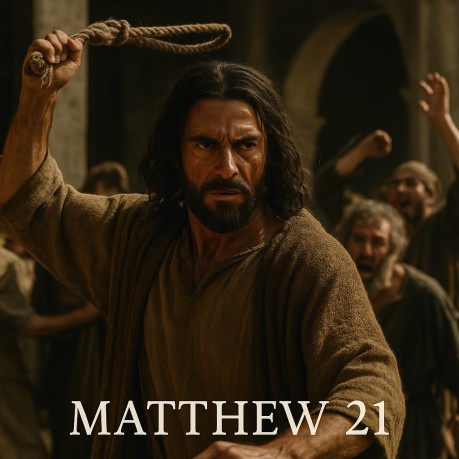
Matthew 21 Matthew 21:1-11 † Jesus entered Jerusalem as the prophesied
King, fulfilling Zechariah 9:9. Matthew 21:12-17 † Jesus cleansed the temple, exposing the
corruption of Israel's leaders. Matthew 21:18-22 † The fig tree symbolized fruitless Israel,
soon to be judged. Matthew 21:23-27 † Israel's leaders rejected both John and
Jesus, exposing their hypocrisy. Matthew 21:28-32 † The parable contrasted outward promises with
true repentance and obedience. Matthew 21:33-46 † The parable of the vineyard made Israel's
guilt undeniable. They rejected God's messengers and would kill His
Son. How it applies to us today: † This is the fulfilled perspective we proclaim at
Fulfilled Prophecies † Source Index
By Dan Maines
When they had approached
Jerusalem and had come to Bethphage, at the Mount of Olives, Jesus
then sent two disciples, saying to them, "Go into the village
opposite you, and at once you will find a donkey tied there, and a
colt with it; untie them and bring them to Me. And if anyone says
anything to you, you shall say, 'The Lord needs them,' and he will
send them on immediately." Now this took place so that what was
spoken through the prophet would be fulfilled: "Say to the
daughter of Zion, 'Behold your King is coming to you, Humble, and
mounted on a donkey, Even on a colt, the foal of a donkey.'" The
disciples went and did just as Jesus had instructed them, and brought
the donkey and the colt, and laid their cloaks on them; and He sat on
the cloaks. Most of the crowd spread their cloaks on the road, and
others were cutting branches from the trees and spreading them on the
road. Now the crowds going ahead of Him, and those who followed, were
shouting, "Hosanna to the Son of David; Blessed is the One who
comes in the name of the Lord; Hosanna in the highest!" When He
had entered Jerusalem, all the city was stirred, saying, "Who is
this?" And the crowds were saying, "This is Jesus, the
prophet from Nazareth in Galilee."
† The crowds
acclaimed Him as Son of David, though their expectations were
political.
† His humble entry foreshadowed
His judgment on the city that would reject Him.
And Jesus entered the
temple grounds and drove out all those who were buying and selling in
the temple, and He overturned the tables of the money changers and
the seats of those who were selling doves. And He said to them, "It
is written: 'My house will be called a house of prayer'; but you are
making it a den of robbers." And those who were blind and those
who limped came to Him in the temple, and He healed them. But when
the chief priests and the scribes saw the wonderful things that He
had done, and the children who were shouting in the temple, saying,
"Hosanna to the Son of David," they became indignant, and
they said to Him, "Do You hear what these children are saying?"
And Jesus said to them, "Yes; have you never read, 'From the
mouths of infants and nursing babies You have prepared praise for
Yourself'?" And He left them and went out of the city to
Bethany, and spent the night there.
† The blind
and lame received healing in the very courts polluted by greed.
†
His actions declared judgment on the temple system, which would be
destroyed in AD 70.
Now in the morning, when He
was returning to the city, He became hungry. And seeing a lone fig
tree by the road, He came to it and found nothing on it except leaves
alone; and He said to it, "No longer shall there ever be any
fruit from you." And at once the fig tree withered. Seeing this,
the disciples were amazed and asked, "How did the fig tree
wither all at once?" And Jesus answered and said to them, "Truly
I say to you, if you have faith and do not doubt, you will not only
do what was done to the fig tree, but even if you say to this
mountain, 'Be taken up and thrown into the sea,' it will happen. And
whatever you ask in prayer, believing, you will receive it all."
† Its withering pictured
the coming desolation of Jerusalem.
† The
mountain being cast into the sea symbolized the fall of the Old
Covenant order.
When He entered the temple,
the chief priests and the elders of the people came to Him while He
was teaching, and said, "By what authority are You doing these
things, and who gave You this authority?" But Jesus responded
and said to them, "I will also ask you one question, which, if
you tell Me, I will also tell you by what authority I do these
things. The baptism of John was from what source, from heaven or from
men?" And they began considering this among themselves, saying,
"If we say, 'From heaven,' He will say to us, 'Then why did you
not believe him?' But if we say, 'From men,' we fear the people; for
they all regard John as a prophet." And answering Jesus, they
said, "We do not know." He also said to them, "Neither
am I telling you by what authority I do these things."
† They
feared men more than God, proving their unfitness for leadership.
†
Their refusal to answer confirmed their hard hearts.
"But what do you
think? A man had two sons, and he came to the first and said, 'Son,
go work today in the vineyard.' But he replied, 'I do not want to.'
Yet afterward he regretted it and went. The man came to the second
and said the same thing; and he replied, 'I will, sir'; and yet he
did not go. Which of the two did the will of his father?" They
said, "The first." Jesus said to them, "Truly I say to
you that the tax collectors and prostitutes will get into the kingdom
of God before you. For John came to you in the way of righteousness
and you did not believe him; but the tax collectors and prostitutes
did believe him; and you, seeing this, did not even have second
thoughts afterward so as to believe him."
† Outcasts
like tax collectors and prostitutes entered the kingdom before
Israel's leaders.
† The fulfilled perspective
shows that faith and repentance, not status, determine entry into the
kingdom.
"Listen to another
parable. There was a landowner who planted a vineyard and put a fence
around it, and dug a wine press in it, and built a tower, and he
leased it to vine-growers and went on a journey. When the harvest
time approached, he sent his slaves to the vine-growers to receive
his fruit. And the vine-growers took his slaves and beat one, killed
another, and stoned another. Again, he sent other slaves, more than
the first; and they did the same things to them. But afterward he
sent his son to them, saying, 'They will respect my son.' But when
the vine-growers saw the son, they said among themselves, 'This is
the heir; come, let's kill him and take possession of his
inheritance!' And they took him and threw him out of the vineyard,
and killed him. Therefore, when the owner of the vineyard comes, what
will he do to those vine-growers?" They said to Him, "He
will bring those wretches to a wretched end, and lease the vineyard
to other vine-growers who will pay him the fruit in the proper
seasons." Jesus said to them, "Did you never read in the
Scriptures, 'A stone which the builders rejected, This has become the
chief cornerstone; This came about from the Lord, And it is marvelous
in our eyes'? Therefore I say to you, the kingdom of God will be
taken away from you and given to a people producing its fruit. And
the one who falls on this stone will be broken to pieces; but on
whomever it falls, it will crush him." When the chief priests
and the Pharisees heard His parables, they understood that He was
speaking about them. And although they sought to arrest Him, they
feared the crowds, since they considered Him to be a prophet.
† The kingdom was to be taken from them
and given to a people producing fruit, fulfilled in the New Covenant
community.
† The rejected stone became the
cornerstone, and judgment fell on those who opposed Him.
†
Matthew 21 reminds us that Jesus is the promised King who fulfilled
prophecy, cleansed the temple, and warned of judgment on fruitless
Israel. The fulfilled perspective shows that the kingdom was taken
from unbelieving leaders and given to a new people bearing fruit.
Today, we live in that kingdom, called to bear fruit, worship in
Spirit and truth, and recognize Christ as the cornerstone.
† Josephus,
Antiquities 20.9; Wars 5.10
† Tacitus,
Histories 5.13
† Justin Martyr, Dialogue with
Trypho 118
† Irenaeus, Against Heresies
4.36.2
Links