Matthew 19 Matthew 19:1-2 † Jesus left Galilee and moved toward Judea,
setting His path toward Jerusalem and the climax of His mission. Matthew 19:3-9 † The Pharisees tested Jesus with the divisive
question of divorce. Matthew 19:10-12 † The disciples struggled with the high calling
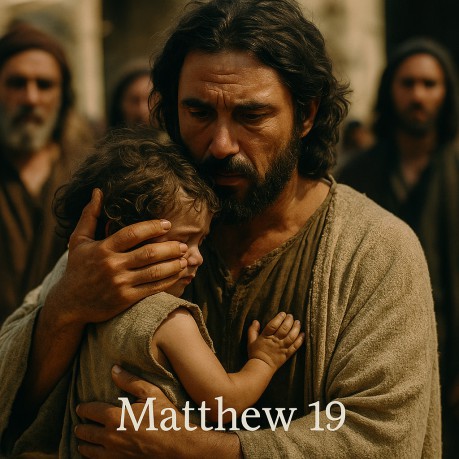
of marriage. Matthew 19:13-15 † The disciples dismissed children as
unimportant, but Jesus valued them as examples of faith. Matthew 19:16-22 † The rich young ruler sought eternal life by
works, but Jesus exposed his heart-idol of wealth. Matthew 19:23-26 † Wealth was seen as God's blessing, but Jesus
showed it could be a barrier to the kingdom. Matthew 19:27-30 † Jesus promised His apostles authority in the
coming judgment on Israel. How it applies to us today: † This is the fulfilled perspective we proclaim at
Fulfilled Prophecies † Source Index
By Dan Maines
When Jesus had finished these
words, He left Galilee and came into the region of Judea beyond the
Jordan; and large crowds followed Him, and He healed them there.
†
The healings confirmed His kingdom authority and compassion.
†
These miracles foreshadowed the spiritual healing of Israel's remnant
before judgment fell.
Some Pharisees came to Jesus,
testing Him and asking, "Is it lawful for a man to divorce his
wife for any reason at all?" And He answered and said, "Have
you not read that He who created them from the beginning made them
male and female, and said, 'For this reason a man shall leave his
father and mother and be joined to his wife, and the two shall become
one flesh'? So they are no longer two, but one flesh. Therefore, what
God has joined together, no person is to separate." They said to
Him, "Why, then, did Moses command to give her a certificate of
divorce and send her away?" He said to them, "Because of
your hardness of heart Moses permitted you to divorce your wives; but
from the beginning it has not been this way. And I say to you,
whoever divorces his wife, except for sexual immorality, and marries
another woman commits adultery."
† Jesus upheld marriage
as God's creation order, not a convenience to be discarded.
†
Hardness of heart led to brokenness under the old covenant, but
Christ restored God's original intent.
The disciples said to Him,
"If the relationship of the man with his wife is like this, it
is better not to marry." But He said to them, "Not all men
can accept this statement, but only those to whom it has been given.
For there are eunuchs who were born that way from their mother's
womb; and there are eunuchs who were made eunuchs by men; and there
are also eunuchs who made themselves eunuchs for the sake of the
kingdom of heaven. The one who is able to accept this, let him accept
it."
† Jesus acknowledged singleness
and celibacy for the kingdom as a legitimate calling.
†
In the fulfilled kingdom, devotion to Christ transcends earthly
concerns.
Then some children were
brought to Him so that He would lay His hands on them and pray; and
the disciples rebuked them. But Jesus said, "Leave the children
alone, and do not forbid them to come to Me; for the kingdom of
heaven belongs to such as these." After laying His hands on
them, He departed from there.
†
The kingdom belongs to the humble and dependent, not the proud.
†
This echoes the lesson of Matthew 18 and reinforces the fulfilled
view of kingdom life.
And someone came to Him and
said, "Teacher, what good thing shall I do so that I may obtain
eternal life?" And He said to him, "Why are you asking Me
about what is good? There is only One who is good; but if you want to
enter life, keep the commandments." He said to Him, "Which
ones?" And Jesus said, "You shall not commit murder; You
shall not commit adultery; You shall not steal; You shall not give
false testimony; Honor your father and mother; and You shall love
your neighbor as yourself." The young man said to Him, "All
these I have kept; what am I still lacking?" Jesus said to him,
"If you want to be complete, go and sell your possessions and
give to the poor, and you will have treasure in heaven; and come,
follow Me." But when the young man heard this statement, he went
away grieving; for he was one who owned much property.
†
True discipleship required surrender and following Jesus.
†
Wealth blinded many in that generation, binding them to the world
that was about to pass away.
And Jesus said to His
disciples, "Truly I say to you, it will be hard for a rich
person to enter the kingdom of heaven. And again I say to you, it is
easier for a camel to go through the eye of a needle, than for a rich
person to enter the kingdom of God." When the disciples heard
this, they were very astonished and said, "Then who can be
saved?" And looking at them, Jesus said to them, "With
people this is impossible, but with God all things are possible."
†
Salvation was not humanly possible, only God's grace could save.
†
This truth is fulfilled in the New Covenant, where God brings people
in by His power, not status.
Then Peter responded and
said to Him, "Behold, we have left everything and followed You;
what then will there be for us?" And Jesus said to them, "Truly
I say to you, that you who have followed Me, in the regeneration,
when the Son of Man will sit on His glorious throne, you also shall
sit upon twelve thrones, judging the twelve tribes of Israel. And
everyone who has left houses or brothers or sisters or father or
mother or children or farms on account of My name, will receive a
hundred times as much, and will inherit eternal life. But many who
are first will be last, and the last, first."
† Their sacrifices
would be richly rewarded in the New Covenant order.
†
The reversal of first and last highlighted the covenant shift from
unbelieving Israel to the faithful remnant.
†
Matthew 19 teaches that discipleship means surrendering all for
Christ, whether in marriage, family, or wealth. The fulfilled
perspective shows us that the judgment fell on the Old Covenant world
in AD 70, and the kingdom was established in fullness. Today we live
in that kingdom, called to humility like children, faith beyond
possessions, and full devotion to the King who reigns.
† Josephus,
Antiquities 18.5.2
† Mishnah, Gittin 9;
Ketubot 4.2
† Justin Martyr, Dialogue with
Trypho 49
† Irenaeus, Against Heresies 4.13.3
Links