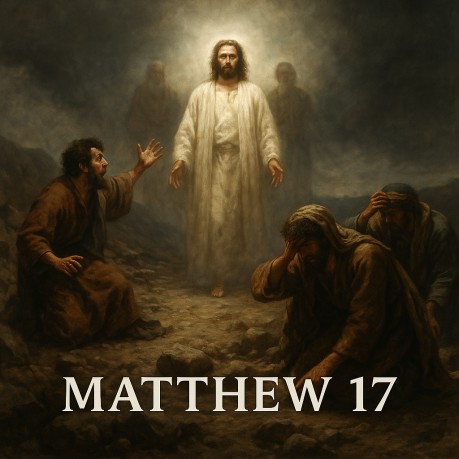
Matthew 17 Matthew 17:1-8 † The transfiguration revealed Jesus' glory as
the fulfillment of the Law and the Prophets, represented by Moses and
Elijah. Matthew 17:9-13 † Jesus explained that John the Baptist was the
Elijah who was to come. The restoration he preached was rejected,
just as the Son of Man would be rejected. Matthew 17:14-21 † The failure of the disciples revealed the
weakness of their faith. Matthew 17:22-23 † Jesus again predicted His death and
resurrection. Matthew 17:24-27 † Jesus showed that as the true Son of God, He
was not obligated to the temple tax. How it applies to us today: † This is the fulfilled perspective we proclaim at
Fulfilled Prophecies † Source Index
By Dan Maines
And six days later Jesus took
with Him Peter and James and John his brother, and led them up on a
high mountain by themselves. And He was transfigured before them, and
His face shone like the sun, and His garments became as white as
light. And behold, Moses and Elijah appeared to them, talking with
Him. Peter responded and said to Jesus, "Lord, it is good that
we are here. If You want, I will make three tabernacles here, one for
You, one for Moses, and one for Elijah." While he was still
speaking, a bright cloud overshadowed them, and behold, a voice from
the cloud said, "This is My beloved Son, with whom I am well
pleased; listen to Him!" When the disciples heard this, they
fell face down to the ground and were terrified. And Jesus came to
them and touched them and said, "Get up, and do not be afraid."
And raising their eyes, they saw no one except Jesus Himself alone.
† Peter's suggestion to build three
tabernacles showed his misunderstanding. The voice declared that only
Christ is to be heard and obeyed.
† This was
a preview of the kingdom's glory that would soon be revealed,
confirming the fulfilled perspective.
As they were coming down
from the mountain, Jesus commanded them, saying, "Tell the
vision to no one until the Son of Man has risen from the dead."
And His disciples asked Him, "Why then do the scribes say that
Elijah must come first?" And He answered and said, "Elijah
is coming and will restore all things, but I say to you that Elijah
already came, and they did not recognize him, but did to him whatever
they wanted. So also the Son of Man is going to suffer at their
hands." Then the disciples understood that He had spoken to them
about John the Baptist.
†
This confirmed prophecy was fulfilled in their generation, not
postponed.
† Josephus also records Herod's
fear of John and his execution (Antiquities 18.5.2), proving the
historical reality.
When they came to the
crowd, a man came up to Jesus, falling on his knees before Him and
saying, "Lord, have mercy on my son, because he has seizures and
suffers terribly; for he often falls into the fire and often into the
water. And I brought him to Your disciples, and they could not cure
him." And Jesus answered and said, "You unbelieving and
perverse generation, how long shall I be with you? How long shall I
put up with you? Bring him here to Me." And Jesus rebuked him,
and the demon came out of him, and the boy was healed at once. Then
the disciples came to Jesus privately and said, "Why could we
not cast it out?" And He said to them, "Because of your
meager faith, for truly I say to you, if you have faith the size of a
mustard seed, you will say to this mountain, 'Move from here to
there,' and it will move, and nothing will be impossible for you."
† Jesus rebuked the
generation for unbelief, tying their condition to the judgment soon
to fall on them.
† Faith, even small, had
power because it was anchored in God's authority.
And while they were
gathering together in Galilee, Jesus said to them, "The Son of
Man is going to be handed over to men; and they will kill Him, and He
will be raised on the third day." And they were deeply grieved.
† The disciples could not yet
understand that the kingdom would be established through His
suffering.
† Fulfillment required the cross,
not earthly triumph.
Now when they came to
Capernaum, those who collected the two drachma tax came to Peter and
said, "Does your teacher not pay the two drachma tax?" He
said, "Yes." And when he came into the house, Jesus spoke
to him first, saying, "What do you think, Simon? From whom do
the kings of the earth collect tolls or a poll-tax, from their sons
or from strangers?" When Peter said, "From strangers,"
Jesus said to him, "Then the sons are exempt. However, so that
we do not offend them, go to the sea and throw in a hook, and take
the first fish that comes up; and when you open its mouth, you will
find a stater. Take that and give it to them for you and Me."
† Yet He
paid it miraculously to avoid unnecessary offense.
†
This miracle pointed to His authority over creation and foreshadowed
the end of temple obligations in AD 70.
†
Matthew 17 reminds us that Jesus is the fulfillment of the Law and
the Prophets, the Son of God who reigns in glory. John the Baptist
fulfilled the Elijah role, showing prophecy was not postponed but
completed in their generation. The failure of the disciples calls us
to deeper trust, while the transfiguration assures us that the
kingdom is established in power. The temple tax episode reminds us
that Christ set us free from Old Covenant obligations. Today, in the
fulfilled kingdom, we live by faith in the risen Lord who has already
accomplished redemption and established His reign.
† Josephus,
Antiquities 18.5.2
† Irenaeus, Against
Heresies 3.16.2
† Justin Martyr, Dialogue
with Trypho 49
Links