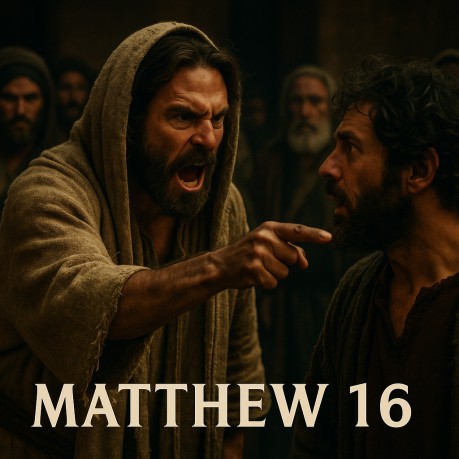
Matthew 16 Matthew 16:1-4 † The Pharisees and Sadducees, usually enemies,
united in opposition to Jesus. Their demand for a heavenly sign
revealed unbelief, not faith. Matthew 16:5-12 † The disciples misunderstood Jesus, thinking
of physical bread. He corrected them, pointing to spiritual danger. Matthew 16:13-20 † Peter's confession was the revelation that
Jesus is the Messiah, the Son of the living God. Matthew 16:21-23 † Jesus revealed plainly the necessity of His
suffering, death, and resurrection. Matthew 16:24-28 † Discipleship requires self-denial, even to
death. The cross symbolized the cost of following Him. How it applies to us today: † This is the fulfilled perspective we proclaim at
Fulfilled Prophecies † Source Index
By Dan Maines
The Pharisees and Sadducees
came up, and putting Jesus to the test, they asked Him to show them a
sign from heaven. But He replied to them, "When it is evening,
you say, 'It will be fair weather, for the sky is red.' And in the
morning, 'There will be a storm today, for the sky is red and
threatening.' You know how to discern the appearance of the sky, but
are you unable to discern the signs of the times? An evil and
adulterous generation demands a sign, and so no sign will be given to
it, except the sign of Jonah." And He left them and went away.
† Jesus rebuked
them for ignoring the "signs of the times," meaning the
prophetic indicators of the coming judgment on that generation.
†
The "sign of Jonah" pointed to His resurrection, which
would be the final proof they rejected.
And the disciples came to
the other side of the sea, but they had forgotten to bring any bread.
And Jesus said to them, "Watch out and beware of the leaven of
the Pharisees and Sadducees." They began to discuss this among
themselves, saying, "He said that because we did not bring any
bread." But Jesus, aware of this, said, "You men of little
faith, why are you discussing among yourselves the fact that you have
no bread? Do you not yet understand nor remember the five loaves of
the five thousand, and how many baskets you picked up? Or the seven
loaves of the four thousand, and how many large baskets you picked
up? How is it that you do not understand that I did not speak to you
about bread? But beware of the leaven of the Pharisees and
Sadducees." Then they understood that He did not say to beware
of the leaven of bread, but of the teaching of the Pharisees and
Sadducees.
†
The "leaven" was the corrupt teaching of Israel's leaders
that would spread destruction.
† This
corruption would culminate in Jerusalem's fall, confirming Jesus'
warning.
Now when Jesus came into
the region of Caesarea Philippi, He was asking His disciples, "Who
do people say that the Son of Man is?" And they said, "Some
say John the Baptist; and others, Elijah; and still others, Jeremiah,
or one of the prophets." He said to them, "But who do you
yourselves say that I am?" Simon Peter answered, "You are
the Christ, the Son of the living God." And Jesus said to him,
"Blessed are you, Simon son of Jonah, because flesh and blood
did not reveal this to you, but My Father who is in heaven. And I
also say to you that you are Peter, and upon this rock I will build
My church, and the gates of Hades will not overpower it. I will give
you the keys of the kingdom of heaven, and whatever you bind on earth
shall have been bound in heaven, and whatever you release on earth
shall have been released in heaven." Then He gave the disciples
strict orders that they were to tell no one that He was the Christ.
†
Jesus promised that His church, founded on this confession, would
overcome the gates of Hades.
† Authority was
given to bind and release, reflecting covenantal authority in the New
Kingdom.
From that time Jesus began
to point out to His disciples that it was necessary for Him to go to
Jerusalem and to suffer many things from the elders, chief priests,
and scribes, and to be killed, and to be raised up on the third day.
Yet Peter took Him aside and began to rebuke Him, saying, "God
forbid it, Lord! This shall never happen to You!" But He turned
and said to Peter, "Get behind Me, Satan! You are a stumbling
block to Me, for you are not setting your mind on God's purposes, but
men's."
† Peter
resisted, showing his mind was still fixed on earthly expectations.
†
Jesus rebuked Peter sharply, showing that anything opposing the cross
was satanic.
Then Jesus said to His
disciples, "If anyone wants to come after Me, he must deny
himself, take up his cross, and follow Me. For whoever wants to save
his life will lose it, but whoever loses his life for My sake will
find it. For what good will it do a person if he gains the whole
world, but forfeits his soul? Or what will a person give in exchange
for his soul? For the Son of Man is going to come in the glory of His
Father with His angels, and will then repay each person according to
his deeds. Truly I say to you, there are some of those who are
standing here who will not taste death until they see the Son of Man
coming in His kingdom."
†
Jesus promised judgment and vindication in that generation, when the
Son of Man came with His angels.
† Verse 28
confirms the fulfilled view, as some standing there witnessed His
kingdom come in power before they died.
†
Matthew 16 shows the blindness of Israel's leaders who demanded
signs, while the true "sign of Jonah" was fulfilled in
Christ's resurrection. The warning against leaven reminds us that
false teaching corrupts and leads to destruction, as it did in AD 70.
Peter's confession reminds us that the church rests on the truth of
Christ as the Son of God. His rebuke of Peter proves that God's
purposes are accomplished through the cross, not human plans. The
promise of judgment in their generation shows us that Christ
fulfilled His word, confirming that the kingdom is now established in
its fullness. Today we live in that fulfilled kingdom, called to deny
ourselves and follow the One who reigns already.
† Josephus,
Wars 4.316
† Tacitus, Histories 5.13
†
Justin Martyr, Dialogue with Trypho 121
†
Irenaeus, Against Heresies 3.20.2
Links