Matthew 14 Matthew 14:1-2 † Herod's guilty conscience made him believe
John had risen. Fear and superstition replaced truth in his mind. † Josephus records Herod's fear of John's
influence, describing how he had him killed to secure his throne
(Antiquities 18.116-119). Matthew 14:3-5 † John's boldness brought him into conflict
with power. Herodias hated him for exposing sin, but Herod feared the
people's respect for John. Matthew 14:6-12 † Herod feared men more than God. To preserve
his pride before his guests, he killed the prophet. † Josephus confirms John's execution at
Machaerus, giving historical weight to Matthew's account (Antiquities
18.119). Matthew 14:13-14 † Jesus shows divine compassion even in His
grief. He turns from sorrow to ministry, healing the multitudes. Matthew 14:15-21 † The feeding of the five thousand reveals
Jesus as the true provider, greater than Moses who gave manna. The
twelve baskets represent sufficiency for all Israel. † The Dead Sea Scrolls spoke of a coming
messianic banquet (1QSa 2.11-22). Jesus fulfills this expectation. Matthew 14:22-27 † Jesus demonstrates authority over creation
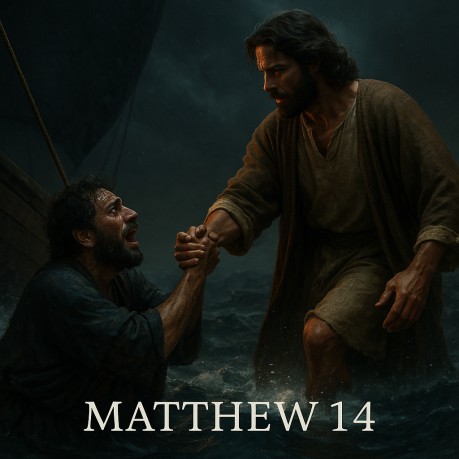
itself. The sea, a symbol of chaos, is under His feet. Matthew 14:28-33 † Peter's faltering faith reflects the weakness
of man, yet Jesus saves when we call out. The disciples worshiped Him
as the Son of God. Matthew 14:34-36 † The healing at Gennesaret shows the
overflowing power of Christ. Faith, even in touching His garment,
brought restoration. How it applies to us today: † This is the fulfilled perspective we proclaim at
Fulfilled Prophecies † Source Index
By Dan Maines
At that time Herod the
tetrarch heard the news about Jesus, and said to his servants, "This
is John the Baptist, he himself has been raised from the dead, and
that is why miraculous powers are at work in him."
For when Herod had John
arrested, he bound him and put him in prison because of Herodias, the
wife of his brother Philip. For John had been saying to him, "It
is not lawful for you to have her." Although Herod wanted to put
him to death, he feared the crowd, because they regarded John as a
prophet.
But when Herod's birthday
came, the daughter of Herodias danced before them and pleased Herod,
so much that he promised with an oath to give her whatever she asked.
Now after being prompted by her mother, she said, "Give me the
head of John the Baptist here on a platter." And although he was
grieved, the king commanded it to be given because of his oaths and
his dinner guests. He sent word and had John beheaded in the prison.
And his head was brought on a platter and given to the girl, and she
brought it to her mother. And his disciples came and took away the
body and buried it, and they went and reported to Jesus.
Now when Jesus heard about
John, He withdrew from there in a boat to a secluded place by
Himself, and when the people heard about this, they followed Him on
foot from the cities. When He came ashore, He saw a large crowd, and
felt compassion for them and healed their sick.
Now when it was evening,
the disciples came to Him and said, "This place is secluded and
the hour is already past, so send the crowds away, that they may go
into the villages and buy food for themselves." But Jesus said
to them, "They do not need to go; you give them something to
eat!" They said to Him, "We have here only five loaves and
two fish." And He said, "Bring them here to Me."
Ordering the crowds to sit down on the grass, He took the five loaves
and the two fish, and looking up toward heaven, He blessed the food,
and breaking the loaves He gave them to the disciples, and the
disciples gave them to the crowds. And they all ate and were
satisfied, and they picked up what was left over of the broken
pieces, twelve full baskets. There were about five thousand men who
ate, besides women and children.
Immediately afterward He
compelled the disciples to get into the boat and to go ahead of Him
to the other side, while He sent the crowds away. After He had sent
the crowds away, He went up on the mountain by Himself to pray, and
when it was evening, He was there alone. But the boat was already a
long distance from the land, battered by the waves, for the wind was
contrary. And in the fourth watch of the night He came to them,
walking on the sea. When the disciples saw Him walking on the sea,
they were terrified, and said, "It is a ghost!" And they
cried out in fear. But immediately Jesus spoke to them, saying, "Take
courage, it is I; do not be afraid."
Peter responded and said to
Him, "Lord, if it is You, command me to come to You on the
water." And He said, "Come!" And Peter got out of the
boat and walked on the water, and came toward Jesus. But seeing the
wind, he became frightened, and when he began to sink, he cried out,
saying, "Lord, save me!" Immediately Jesus reached out with
His hand and took hold of him, and said to him, "You of little
faith, why did you doubt?" When they got into the boat, the wind
stopped. And those who were in the boat worshiped Him, saying, "You
are truly God's Son!"
When they had crossed over,
they came to land at Gennesaret. And when the men of that place
recognized Him, they sent word into all that surrounding region and
brought to Him all who were sick, and they pleaded with Him that they
might just touch the border of His cloak, and all who touched it were
cured.
†
Matthew 14 reveals the stark contrast between the rulers of this
world and the true King. Herod lived in fear and compromise, but
Jesus reigned with compassion and power. John's death reminds us that
standing for truth often comes with a cost, yet it never goes
unnoticed by God. The feeding of the five thousand proves that Christ
supplies every need of His people, both physical and spiritual. His
walking on the sea shows His dominion over creation, and Peter's
rescue shows His mercy when our faith falters. For us today in the
fulfilled kingdom, this means we can't place our hope in corrupt
leaders or human power, but in the Son of God who reigns already. We
must live as disciples who trust Him fully, proclaim His fulfilled
promises boldly, and rest in His care even in the storms of life.
† Josephus,
Antiquities 18.116-119
† Dead Sea Scrolls,
1QSa 2.11-22
Links